The
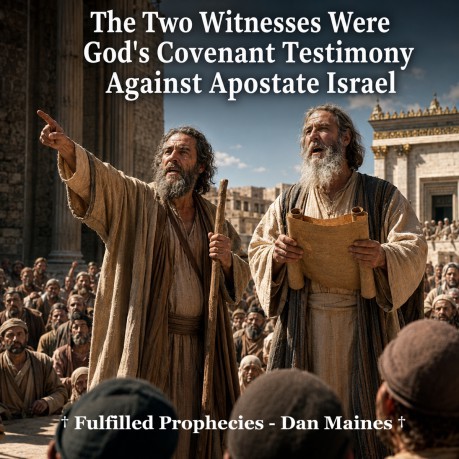
Two Witnesses Were God's Covenant Testimony Against Apostate Israel Introduction The
Two Olive Trees And Two Candlesticks The
Witnesses Speak With Moses And Elijah Imagery The
Beast Makes War Against The Witnesses The
Great City Where Their Lord Was Crucified The
Vindication Of The Witnesses Historical References How It Applies To Us
Today Q & A Appendix † This is the fulfilled
perspective we proclaim at Fulfilled Prophecies † Source Index
By Dan Maines
†
Revelation is one of the most symbolic books in Scripture. The dragon
is symbolic. The beast is symbolic. The harlot is symbolic. The seven
heads and ten horns are symbolic. The candlesticks are symbolic.
Because Revelation is filled with symbolic imagery, we should not
assume the Two Witnesses suddenly become two literal future
individuals.
†
The Two Witnesses appear during the last days of the Old Covenant age
as God's covenant testimony against apostate Israel. Their ministry,
death, and vindication fit perfectly within the first-century setting
of Revelation and the approaching judgment upon Jerusalem (Matthew
23:34-36; Luke 21:20-22).
†
Throughout Scripture, God established truth through the testimony of
two witnesses. The imagery of Revelation 11 points to God's covenant
witness being proclaimed before the fall of Jerusalem, not to two
miracle-working men appearing thousands of years later (Deuteronomy
19:15; John 8:17-18).
†
Under the Law, every matter was established by the testimony of two
witnesses (Deuteronomy 17:6; Deuteronomy 19:15).
†
Revelation presents two witnesses because God was bringing a covenant
lawsuit against apostate Israel.
†
Before judgment fell, God provided the required testimony against the
nation just as His covenant required.
Revelation
11:3-4
And I
will grant authority to my two witnesses, and they will prophesy for
1,260 days, clothed in sackcloth." These are the two olive trees
and the two lampstands that stand before the Lord of the earth.
†
The witnesses are immediately identified with symbolic imagery.
†
They are called olive trees and candlesticks, language drawn directly
from Zechariah's vision (Zechariah 4:2-14).
†
The imagery of olive trees and lampstands did not originate in
Revelation.
†
John borrowed the imagery directly from Zechariah 4 where the olive
trees symbolized God's anointed witness empowered by His Spirit.
†
This strongly supports a symbolic interpretation rather than two
future miracle workers.
†
Revelation already defines lampstands as covenant communities rather
than individual men (Revelation 1:20).
†
Since the witnesses are called lampstands, the reader is expected to
interpret them according to Revelation's own symbolism.
†
The book itself provides the key for understanding the imagery.
†
Candlesticks in Revelation represent God's covenant people who bear
His light and testimony in the world (Revelation 1:20).
†
Olive trees symbolize God's anointed source of spiritual witness and
testimony empowered by His Spirit (Zechariah 4:6; Romans 11:17-24).
†
Nothing in the passage requires us to view the witnesses as two
individual men. The language points instead to a corporate and
covenantal testimony.
†
The period of 1,260 days corresponds to the last days crisis leading
to Jerusalem's destruction and appears repeatedly throughout
Revelation's judgment context (Revelation 11:2; Revelation 12:6;
Revelation 13:5).
Revelation
11:5-6
And if
anyone wants to harm them, fire flows out of their mouth and devours
their enemies; and so if anyone wants to harm them, he must be killed
in this way. These have the power to shut up the sky, so that rain
will not fall during the days of their prophesying; and they have
power over the waters to turn them into blood, and to strike the
earth with every plague, as often as they desire.
†
The power to shut heaven reflects Elijah's ministry when rain ceased
in Israel (1 Kings 17:1; James 5:17).
†
The power to turn water into blood and strike with plagues reflects
Moses and the judgments upon Egypt (Exodus 7:17-20).
†
Revelation is presenting Moses and Elijah imagery, not necessarily
Moses and Elijah literally returned to earth.
†
Moses represented the Law and Elijah represented the Prophets.
Together they symbolize the complete covenant testimony of God
against covenant-breaking Israel (Luke 16:29-31).
†
The same Law and Prophets that testified of Christ also testified
against those who rejected Him (John 5:45-47).
Revelation
11:7
When they
have finished their testimony, the beast that comes up out of the
abyss will make war with them, and overcome them and kill them.
†
God's covenant testimony appeared defeated as Jerusalem persecuted
the prophets, Jesus, and the early church (Matthew 23:29-37).
†
The beastly power of that generation opposed the gospel witness and
sought to silence God's messengers (Acts 7:51-52).
†
The death of the witnesses symbolizes the apparent defeat of God's
testimony before divine judgment fell upon the city.
†
Yet their testimony was completed exactly as God intended before
judgment arrived (Matthew 24:14).
†
Jesus declared that all the righteous blood shed upon the earth would
come upon that generation (Matthew 23:35-36).
†
The Two Witnesses stand as the final covenant testimony against the
same generation Christ condemned.
†
Their vindication parallels the vindication of all the prophets whom
Jerusalem had rejected.
Revelation
11:8
And their
dead bodies will lie on the street of the great city which
spiritually is called Sodom and Egypt, where also their Lord was
crucified.
†
The location is clearly identified as Jerusalem because it is the
city where the Lord was crucified.
†
Jerusalem is spiritually called Sodom because of her corruption and
Egypt because of her oppression and rebellion against God (Isaiah
1:10; Ezekiel 23:1-4).
†
This verse anchors the prophecy firmly in a first-century covenant
context rather than a distant future scenario.
†
The focus of Revelation's judgment narrative continually points
toward apostate Jerusalem and her rejection of the Messiah (Matthew
23:37-38).
Revelation
11:11-12
And
after the three and a half days, the breath of life from God came
into them, and they stood on their feet; and great fear fell upon
those who were watching them. And they heard a loud voice from heaven
saying to them, "Come up here." And they went up into
heaven in the cloud, and their enemies watched them.
†
The witnesses were not ultimately defeated. God vindicated their
testimony before all who opposed it.
†
Their standing again reflects God's public vindication of His
covenant witness (Ezekiel 37:1-14).
†
Their ascension imagery echoes Christ's own vindication and
exaltation (Acts 1:9; Revelation 12:5).
†
The destruction of Jerusalem proved that God's witnesses had spoken
the truth and that the covenant lawsuit against Israel had been
upheld (Luke 21:22).
†
Josephus recorded that Jerusalem became filled with bloodshed,
famine, and devastation during the Jewish War, confirming the
severity of the judgment foretold by Christ.
†
Eusebius recorded that Christians remembered Jesus' warnings and fled
before Jerusalem's destruction.
†
Early Christian writers consistently viewed the fall of Jerusalem as
a divine judgment upon the generation that rejected Christ and
persecuted His witnesses.
†
God's truth does not fail even when it appears rejected by the world
(Isaiah 55:11).
†
The church is still called to bear faithful witness regardless of
opposition (Acts 1:8).
†
God's people can trust that He will ultimately vindicate His truth
just as He vindicated His covenant witnesses (2 Timothy 4:7-8).
†
The destruction of Jerusalem reminds us that God's warnings are real
and His promises are certain (Luke 21:33).
Q:
Who or what were the Two Witnesses, and why were there two of
them?
A: The
Two Witnesses symbolized God's covenant testimony against apostate
Israel during the last days of the Old Covenant age. They are
described as olive trees and lampstands, imagery drawn from Zechariah
4 and Revelation 1, where God's Spirit-empowered witness and covenant
people are symbolized. There were two witnesses because God's Law
required the testimony of two witnesses to establish a matter. Before
Jerusalem's judgment, God provided the covenant testimony required by
His own Law (Deuteronomy 17:6; Deuteronomy 19:15; Zechariah 4:2-14;
Revelation 1:20; Revelation 11:3-4).
Q:
Were the Two Witnesses two future men who have not yet appeared?
A:
The passage identifies them as olive trees and candlesticks, both
symbolic images (Zechariah 4:2-14).
Q:
Why do the witnesses have powers like Moses and Elijah?
A:
Their powers intentionally echo Moses and Elijah because they
symbolize God's covenant testimony through the Law and the Prophets
(Exodus 7:17-20; 1 Kings 17:1; Luke 16:29-31).
Q:
Could the Two Witnesses be Jesus Christ and Jesus ben Ananias?
A:
No. Revelation identifies the witnesses as "two olive trees and
the two candlesticks" (Revelation 11:4), which are symbolic
images rather than personal names. Jesus Christ had already died,
risen, and been exalted before Revelation was written. The witnesses
are also portrayed as a unified covenant testimony carrying Moses and
Elijah imagery, not as two specific historical individuals. While
Jesus ben Ananias may provide an interesting historical parallel
because he prophesied judgment upon Jerusalem before its fall,
Revelation does not identify either witness by name and instead
presents them symbolically. The focus is on God's covenant witness
against apostate Israel rather than on two individual men.
Q:
What city is called Sodom and Egypt?
A:
Revelation identifies it as the city where the Lord was crucified,
which is Jerusalem.
Q:
What does the resurrection and ascension of the witnesses
represent?
A:
It represents God's vindication of His covenant testimony after it
appeared defeated by those who opposed it (Revelation 11:11-12; Luke
21:22).
Q:
If the Two Witnesses are symbolic, why are they described as being
killed and resurrected?
A:
Revelation frequently uses symbolic death and resurrection imagery.
The death of the witnesses represents the apparent defeat and
rejection of God's covenant testimony, while their resurrection and
ascension represent God's vindication of that testimony. The
destruction of Jerusalem proved that the witnesses had spoken the
truth and that God's judgment had been justified (Revelation
11:11-12; Luke 21:22).
Q:
Why does Revelation call them "two" witnesses instead of
one witness?
A:
Under God's Law, a matter was established by the testimony of two
witnesses (Deuteronomy 17:6; Deuteronomy 19:15). The number two
emphasizes that God's case against apostate Israel was legally
established according to covenant requirements. Revelation presents a
covenant lawsuit in which God provides the required witness before
judgment falls upon the nation.
©
Fulfilled Prophecies - Dan Maines.
†
Revelation 11:3-4, Revelation 11:5-6, Revelation 11:7, Revelation
11:8, Revelation 11:11-12
†
Josephus, Eusebius
Links