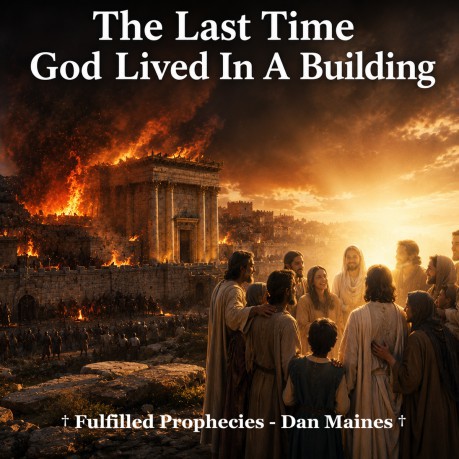
The
Last Time God Lived In A Building (Part
5 of 5) Introduction † One
of the greatest themes in Scripture is God's desire to dwell with His
people. † From
Genesis to Revelation, we see God progressively revealing where His
dwelling place would be found. † Many
still believe God primarily dwells in physical buildings made by
human hands. † Yet
the New Testament reveals a dramatic transition from physical
structures to a living spiritual temple. † The
destruction of the Jerusalem temple in AD 70 marked the last time God
would ever dwell in a covenant building made with hands. Genesis
3:8
Now they heard the sound of the Lord
God walking in the garden in the cool of the day, and the man and his
wife hid themselves from the presence of the Lord
God among the trees of the garden.
† God's
presence was with mankind from the beginning. † Eden
was not a temple made with hands. † God
dwelt directly with His creation. † Sin
brought separation and disrupted that fellowship. † The
story of Scripture is the story of restored fellowship with God. Exodus
25:8
Have them construct a sanctuary for Me, so that I may dwell among
them.
† God
instructed Israel to build a sanctuary. † The
tabernacle became the visible center of covenant worship. † God's
presence was associated with the tabernacle during Israel's
wilderness journey. † Yet
the tabernacle was never the final goal. † It
pointed forward to something greater. (Hebrews 9:8-10) 1
Kings 8:27
But will God indeed dwell on the earth? Behold, heaven and the
highest heaven cannot contain You, how much less this house which I
have built!
† Even
Solomon understood the temple could not contain God. † The
temple served a covenant purpose. † God's
presence was associated with it, but He was never limited by it. † The
temple pointed beyond itself to a greater dwelling place yet to come. John
2:19-21
Jesus answered them, "Destroy this temple, and in three days I
will raise it up." The Jews then said, "It took forty-six
years to build this temple, and yet You will raise it up in three
days?" But He was speaking about the temple of His body.
† Jesus
identified Himself as the true temple. † God's
presence was fully revealed in Christ. † The
physical temple was no longer the center of God's redemptive plan. † Christ
became the meeting place between God and man. † The
focus shifted from stone buildings to a living person. Acts
7:48
However, the Most High does not dwell in houses made by human hands;
as the prophet says:
† Stephen
directly challenged the belief that God was centered in the Jerusalem
temple. † This
statement enraged many of his hearers. † God
had never been confined to a building. † The
old covenant temple was approaching its end. † The
new covenant dwelling place was already being revealed. Ephesians
2:19-22
So then you are no longer strangers and foreigners, but you are
fellow citizens with the saints, and are of God's household, having
been built on the foundation of the apostles and prophets, Christ
Jesus Himself being the cornerstone, in whom the whole building,
being fitted together, is growing into a holy temple in the Lord, in
whom you also are being built together into a dwelling of God in the
Spirit.
† Paul
identified believers as God's holy temple. † The
church is described as God's habitation. † The
dwelling place of God is now His people. † This
temple cannot be destroyed by armies. † The
reality replaced the shadow. Revelation
21:22-23
I saw no temple in it, for the Lord God the Almighty and the Lamb are
its temple. And the city has no need of the sun or of the moon to
shine on it, for the glory of God has illuminated it, and its lamp is
the Lamb.
† The
New Jerusalem contains no physical temple. † God
and the Lamb are the temple. † The
goal of Scripture is finally reached. † God's
people dwell with Him without the need for a physical sanctuary. † The
temple story ends where it began, direct fellowship with God. Historical
References † Josephus
recorded the complete destruction of the Jerusalem temple in AD 70. † Eusebius
viewed the temple's destruction as a fulfillment of Christ's
prophecy. † Early
Christians increasingly understood themselves to be God's spiritual
temple rather than participants in the temple system. † The
destruction of the temple permanently ended the sacrificial system
established under the old covenant. How
It Applies To Us Today † God's
presence is not limited to a geographical location. † We
don't need a rebuilt temple to experience fellowship with God. † Christ
is our access to the Father. † We
are part of the dwelling place God has been building throughout
redemptive history. † The
reality of God's presence is greater than any building ever
constructed by human hands. Q&A
Appendix Q:
Does
God dwell in church buildings today? A:
No.
God dwells in His people, who together form His spiritual temple.
(Ephesians 2:19-22) Q:
Why
was the Jerusalem temple destroyed? A:
Its
covenant purpose had been fulfilled in Christ, and the old covenant
system was brought to its end. (Matthew 24:1-2) Q:
Will
God dwell in a future physical temple? A:
The
New Testament consistently points to Christ and His people as God's
dwelling place. (Acts 7:48; Ephesians 2:19-22) Q:
Why
is there no temple in New Jerusalem? A:
Because
God and the Lamb are the temple, and direct fellowship has been fully
established. (Revelation 21:22) † This
is the fulfilled perspective we proclaim at Fulfilled Prophecies † © Fulfilled
Prophecies - Dan Maines. Source
Index † Genesis
3:8; Exodus 25:8; 1 Kings 8:27; John 2:19-21; Acts 7:48; Ephesians
2:19-22; Revelation 21:22-23 † Josephus,
Wars of the Jews; Eusebius, Ecclesiastical History
By Dan Maines
Part
1 of 5
Part
2 of 5
Part
3 of 5
Part
4 of 5
Part
5 of 5
Links