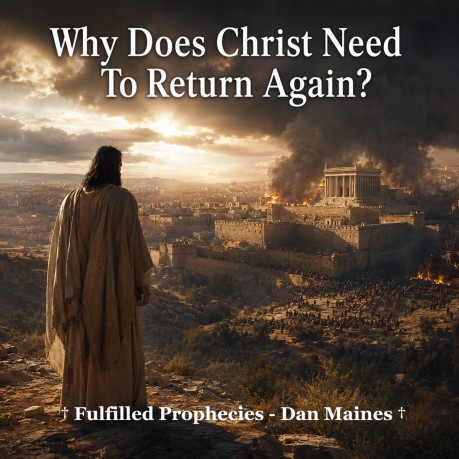
Why
Does Christ Need To Return Again? Introduction † Futurism
teaches that Christ must physically return again in our future, yet
they can never clearly explain from scripture why He needs to return
again after saying His coming would happen in that generation. † The Bible
never presents Christ's coming as an event where the world suddenly
becomes perfect and all problems disappear. His coming in judgment
was against Old Covenant Israel, exactly as the prophets described
covenant judgment throughout scripture. (Matthew 24:34; Luke
21:20-22) † Futurism
turns Christ's coming into a cosmic renovation project, yet scripture
consistently presents it as covenant judgment, kingdom fulfillment,
and the end of the Old Covenant system. † The burden
of proof is on futurists to show why Christ must return again, what
unfinished prophecy remains, and where scripture says He failed to
accomplish what He promised within the time He gave. † Christ
Himself connected His coming with judgment upon Jerusalem, the end of
the Old Covenant age, and the vindication of His saints. (Matthew
16:27-28; Matthew 24:1-34) Matthew 16:27-28 27 For
the Son of Man is going to come in the glory of His Father with His
angels, and will then repay
every person according to his deeds. 28 "Truly
I say to you, there are some of those who are standing here who will
not taste death until they see the Son of Man coming in His kingdom." Verily I say unto you, There are some
of them that stand here, who shall in no wise taste of death, till
they see the Son of man coming in his kingdom. † Jesus
directly tied His coming to the lifetime of some standing there
listening to Him. He didn't place it thousands of years later. † Futurists
constantly avoid verse 28 because it destroys the idea of a distant
future coming. † Christ said
some standing there wouldn't die before seeing His coming. Either
Jesus told the truth or futurism is correct, both cannot be true.
(Mark 9:1; Luke 9:27) † The coming
here is connected with judgment according to deeds, exactly what
happened upon apostate Israel in AD 70. (Revelation 22:10-12) Matthew 24:1-3 1 Jesus
left the temple area and was going on His way when His disciples came
up to point out the temple buildings to Him. 2 But He responded
and said to them, "Do you not see all these things? Truly I say
to you, not one stone here will be left upon another, which will not
be torn down." 3 And
as He was sitting on the Mount of Olives, the disciples came to Him
privately, saying, "Tell us, when will these things happen, and
what will be the sign of Your coming, and of the end of the age?" But he answered and said unto them, See
ye not all these things? verily I say unto you, There shall not be
left here one stone upon another, that shall not be thrown down. And as he sat on the mount of Olives,
the disciples came unto him privately, saying, Tell us, when shall
these things be? and what shall be the sign of thy coming, and of the
end of the world? † The entire
discussion was about the destruction of the temple standing before
them. † The
disciples connected Christ's coming with the end of their covenant
world, not the end of planet Earth. † The Greek
word for world here is aion, meaning age, not kosmos meaning planet.
Christ was speaking about the end of the Old Covenant age. (Hebrews
9:26) † Futurists
separate the coming from the destruction of Jerusalem even though the
disciples asked about them together. Matthew 24:34
34 Truly I say to you, this generation will not pass away until
all these things take place. † Jesus
settled the timing Himself. All these things included His coming,
judgment, tribulation, and the destruction of the temple. † Futurists
redefine generation to avoid the plain statement of Christ. † Every time
Jesus used the phrase this generation He meant the people living at
that time. (Matthew 11:16; Matthew 12:41-42; Matthew 23:36) † There is not
a single verse anywhere saying the generation would last thousands of
years. Luke 21:20-22
20 "But when you see Jerusalem surrounded by armies, then
recognize that her desolation is near. 21 Then those who are in
Judea must flee to the mountains, and those who are inside the city
must leave, and those who are in the country must not enter the city;
22 because these are days of punishment, so that all things
which have been written will be fulfilled. † Jesus said
all things written would be fulfilled in the destruction surrounding
Jerusalem. † Futurists
say prophecy is still waiting to be fulfilled, yet Jesus said all
things written would be fulfilled in those days. † Christ came
in covenant judgment exactly like Yahweh came against nations in the
Old Testament using armies and destruction. (Isaiah 19:1; Micah
1:3-4) † Coming in
judgment never required God physically appearing to every eye on
Earth. John 14:18-19
18 "I will not leave you as orphans; I am coming to you.
19 After a little while, the world no longer is going to see Me,
but you are going to see Me; because I live, you also will live. † Jesus
plainly said the world would see Him no more. † Futurists
teach the exact opposite by claiming the entire world will physically
see Him in our future. † Christ
returned to His disciples spiritually and covenantally through His
presence and kingdom. (Matthew 28:20) † If the world
sees Him no more, then futurism creates a direct contradiction with
Christ's own words. Revelation 1:1 1 The Revelation of Jesus Christ,
which God gave Him to show to His bond-servants, the things which
must soon take place; and He sent and communicated it by His angel to
His bond-servant John, † Revelation
opens with clear timing statements. † Shortly does
not mean thousands of years later. † God gave
Revelation to first century servants about events near to them, not
people living 2000 years later. (Revelation 1:3; Revelation 22:6-10) † Futurists
push nearly the entire book into the distant future even though the
book repeatedly says the time was near. Hebrews 10:37
37 For yet in a very
little while, † The writer
of Hebrews said Christ's coming would not tarry. † Futurism
turns not tarry into thousands of years of delay. † The audience
of Hebrews was expecting imminent judgment connected to the passing
of the Old Covenant system. (Hebrews 8:13) † The temple
was still standing when Hebrews was written, showing the Old Covenant
was about to vanish away. Isaiah 65:17 17 "For behold, I create new
heavens and a new earth; † Futurists
often claim the coming of Christ is about redesigning Earth into a
restored Garden of Eden, yet Isaiah was speaking covenantally about a
new people and a new covenant order. † The language
of new heavens and new earth was used throughout the prophets for
covenantal change and judgment, not the destruction of the physical
planet. (Isaiah 51:15-16) † The New
Testament identifies this New Covenant reality as already established
in Christ. (2 Corinthians 5:17) † Scripture
never says Christ would return to recreate Eden on planet Earth
physically. † If Christ's
coming was supposed to restore a physical Eden world, where does
scripture plainly say that would happen at His coming? Hebrews 12:22-28
22 But you have come to Mount Zion and to the city of the living
God, the heavenly Jerusalem, and to myriads of angels, 23 to the
general assembly and church of the firstborn who are enrolled in
heaven, and to God, the Judge of all, and to the spirits of the
righteous made perfect, 24 and to Jesus, the mediator of a new
covenant, and to the sprinkled blood, which speaks better than the
blood of Abel.
25 See to it that you do not refuse Him who is speaking. For if
those did not escape when they refused him who warned them on earth,
much less will we escape who turn away from Him who warns us from
heaven. 26 And His voice shook the earth then, but now He has
promised, saying, "Yet
once more I will shake not only the earth, but
also the heaven." 27 This expression, "Yet once
more," denotes the removing of those things which can be shaken,
as of created things, so that those things which cannot be shaken may
remain. 28 Therefore, since we receive a kingdom which cannot be
shaken, let's show gratitude, by which we may offer to God an
acceptable service with reverence and awe;
† Believers
were already receiving the unshakable kingdom in the first century. † The shaking
was the removal of the Old Covenant heaven and earth system, not the
destruction of the physical universe. † The kingdom
wasn't future to them, they were already receiving it. † Futurists
continue waiting for a physical kingdom on Earth even though
scripture says the everlasting kingdom was already being received. † The second
coming of Christ was never about what futurist pastors teach
concerning a redesigned Eden world. † Scripture
never says Christ would return to make sinners stop sinning, remove
all earthly governments, or create a politically perfect society. † Christ's
coming was about judgment, covenant fulfillment, kingdom
establishment, and the full transition into the New Covenant age. Historical References † Eusebius
recorded that the Christians fled Jerusalem before its destruction
because they believed Christ's warnings concerning the coming
judgment. † Josephus
described the destruction of Jerusalem in terrifying detail,
including famine, tribulation, and the temple's complete destruction
exactly as Jesus predicted. † Tacitus
wrote concerning the destruction and devastation of Judea under the
Roman armies. † Early
believers understood the destruction of Jerusalem as the fulfillment
of Christ's warnings concerning judgment upon that generation. How It Applies To Us
Today † We don't
live waiting for another coming of Christ because He fulfilled His
promises exactly when He said He would. † Christ
reigns now in His kingdom and His covenant has already been
established forever. (Ephesians 1:20-23) † The church
age does not end because Christ's kingdom is everlasting. (Luke
1:32-33) † Believers
today live in the fully established New Covenant kingdom with direct
access to God through Christ. † Futurism
keeps believers focused on fear and future catastrophe instead of the
finished work and present reign of Christ. † We aren't
waiting for Earth to become Eden again because the promise was never
about rebuilding the Garden physically. † Our hope is
in the everlasting kingdom and presence of Christ, not a future
political paradise on Earth. Q & A Appendix Q:
Why does futurism struggle to explain why Christ must return again? A:
Because scripture already explains the purpose of His coming as
covenant judgment, vindication of the saints, and the ending of the
Old Covenant age within that generation. Futurists rarely provide
verses explaining what unfinished purpose still requires another
return. (Matthew 24:34; Luke 21:22) Q:
Did Christ come to make the world physically perfect? A:
No. Scripture never says His coming would remove all human problems
or create a worldly utopia. His coming was judgment against apostate
Israel and the full establishment of His kingdom. (Matthew 22:7; Luke
21:20-24) Q:
Was the second coming about restoring the Garden of Eden physically? A:
No. Scripture presents Christ's coming as covenant judgment and
kingdom fulfillment, not turning planet Earth into a redesigned Eden
world. The New Covenant kingdom was already being received in the
first century. (Hebrews 12:22-28) Q:
Was Christ's coming visible to the entire world physically? A:
No. Scripture often uses coming language symbolically for divine
judgment. Jesus Himself said the world would see Him no more. (John
14:19; Isaiah 19:1) Q:
What ended in AD 70? A:
The Old Covenant age, the temple system, animal sacrifices, and Old
Covenant Jerusalem ended exactly as Jesus prophesied. (Hebrews 8:13;
Matthew 24:1-34) Q:
Is Christ reigning now? A:
Yes. Christ reigns now at the right hand of the Father and His
kingdom has no end. (Ephesians 1:20-23; Luke 1:32-33) † This is the fulfilled
perspective we proclaim at Fulfilled Prophecies † © Fulfilled Prophecies - Dan Maines. Source Index † Matthew
16:27-28; Matthew 24:1-3, 34; Luke 21:20-22; John 14:18-19;
Revelation 1:1; Hebrews 10:37; Isaiah 65:17; Hebrews 12:22-28 † Josephus,
Wars of the Jews, Book 6; Eusebius, Ecclesiastical History, Book 3;
Tacitus, Histories, Book 5
By Dan Maines
He
who is coming will come, and
will not delay.
And the former things will not be
remembered or come to mind.
Links