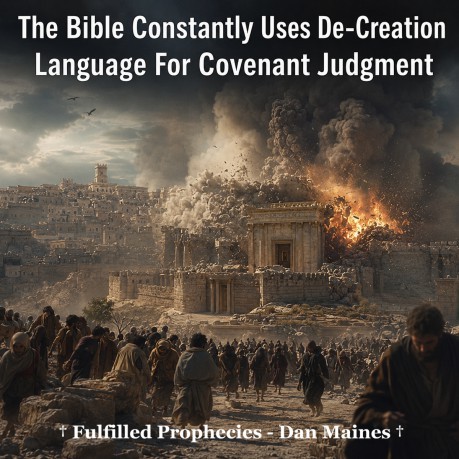
The
Bible Constantly Uses De-Creation Language For Covenant Judgment Introduction † One of the
biggest mistakes people make when reading prophetic language is
assuming every mention of the sun, moon, stars, heaven, and earth
passing away must refer to the destruction of the physical universe. † But the
Bible constantly uses de-creation language for covenant judgment. † Isaiah used
the same kind of language for Babylon, Edom, and Israel long before
Revelation was written. † The prophets
described the fall of nations and covenant systems as though creation
itself was collapsing because those kingdoms represented an entire
world order being judged by God. † The real key
is timing. † Revelation
wasn't written to people thousands of years later. It was written to
first century believers who were about to witness the end of the old
covenant age centered in Jerusalem and the temple. † Jesus
repeatedly warned that all these things would happen in their
generation, not thousands of years later. † The language
sounds cosmic because the judgment was covenantal and world changing,
but that doesn't mean the physical planet was being destroyed. † Scripture
interprets Scripture, and when we compare Revelation with the Old
Testament prophets and the book of Hebrews, the meaning becomes very
clear. Revelation 1:1 1 The Revelation of Jesus Christ,
which God gave Him to show to His bond-servants, the things which
must soon take place; and He sent and communicated it by His angel to
His bond-servant John,
† Revelation
opens by saying these things must shortly come to pass. † The word
shortly cannot honestly mean thousands of years later. † John was
writing to real churches facing real persecution in the first
century. † The
fulfilled perspective takes the timing statements seriously instead
of redefining them. † If
Revelation was mostly about events still future to us, then the
opening statement would have been meaningless to the original
audience. † God gave
this revelation to prepare believers for the coming judgment upon
Jerusalem and the old covenant order. † Jesus gave
the same timeframe in the Olivet Discourse. (Matthew 24:34) Revelation 22:10 10 And he said to me, "Do not
seal up the words of the prophecy of this book, for the time is near.
† John was
specifically told not to seal the prophecy because the time was at
hand. † Compare that
with Daniel, who was told to seal the prophecy because the
fulfillment was far off. (Daniel 12:4) † Revelation
was near in John's day. † The phrase
at hand means near, close, imminent. † This
destroys the idea that Revelation was mainly about events thousands
of years later. † The first
century church was standing on the edge of covenant judgment. † Jerusalem
was about to fall exactly as Jesus predicted. Matthew 24:34
34 Truly I say to you, this generation will not pass away until
all these things take place. † Jesus
couldn't have been clearer. † He placed
the fulfillment within the lifetime of his own generation. † The word
generation always refers to the people then living. † Futurism has
to redefine generation because Jesus' timing statements are so
direct. † Jesus was
speaking to his disciples about the coming destruction of Jerusalem
and the temple. † Every sign
in Matthew 24 led up to that covenant judgment. † The
disciples had asked when the temple would be destroyed. (Matthew
24:1-3) † Jesus
answered their question directly. † The
destruction of the temple in AD 70 marked the end of the old covenant
world. Matthew 24:29 29 "But immediately after the
tribulation of those days the
sun will be darkened, and
the moon will not give its light, and
the stars will fall
from the sky, and the powers of the heavens will be shaken.
† Jesus used
the exact same de-creation language found in Isaiah. † This was
spoken concerning the coming judgment upon Jerusalem. † Jesus
connected cosmic language directly to first century events. † The fall of
Jerusalem was the collapse of Israel's covenant world. † Christ was
ending the old covenant age exactly as he promised. Isaiah 13:9-10
9 Behold, the day of the Lord
is coming, † Isaiah used
cosmic de-creation language against Babylon. † The sun,
moon, and stars going dark did not mean the literal universe
collapsed when Babylon fell. † This was
prophetic covenant judgment language. † God often
described the fall of kingdoms as though creation itself was
unraveling. † Babylon's
world was ending. † Their
kingdom, power, and authority were being removed. † Revelation
uses the same covenant judgment language because it was describing
the fall of old covenant Jerusalem. Isaiah 34:4
4 And all the heavenly lights will wear away, † This
prophecy concerned Edom. (Isaiah 34:5) † Yet the
heavens being rolled together as a scroll did not literally happen in
the physical sky. † This proves
prophetic language must be understood covenantally and symbolically. † The Old
Testament established this language pattern long before Revelation
was written. † Revelation
did not invent de-creation language. † John was
using well established prophetic imagery that the Jews already
understood. † The
destruction of Jerusalem was the collapse of Israel's covenant world. Isaiah 51:15-16
15 For I am the Lord
your God, who stirs up the sea so that its waves roar (the Lord
of armies is His name). 16 And I have put My words in your mouth
and have covered you with the shadow of My hand, to establish the
heavens, to found the earth, and to say to Zion, 'You are My
people.'" † This is one
of the clearest covenant creation passages in the entire Bible. † God
describes establishing Zion and making covenant with Israel as
planting the heavens and laying the foundations of the earth. † This proves
heaven and earth language was often covenantal, not merely physical. † If God could
describe the establishment of covenant Israel as creating heavens and
earth, then the removal of that covenant system can also be described
as heaven and earth passing away. † Revelation
and Hebrews are following Old Testament prophetic language patterns
already established by Isaiah. Deuteronomy 32:22
22 For a fire has flared in My anger, † Moses used
de-creation judgment language against covenant Israel. † The earth
burning and the foundations of the mountains being set on fire did
not mean the literal planet was destroyed. † This was
covenant wrath language describing national judgment. † Peter used
the same kind of language in 2 Peter 3 because he was speaking about
the destruction of the old covenant order. † The Bible
consistently uses cosmic language for covenant judgment. Haggai 2:6-7
6 For this is what the Lord
of armies says: 'Once more in a little while, I am going to shake the
heavens and the earth, the sea also and the dry land. 7 I will
shake all the nations; and they will come with the wealth of all
nations, and I will fill this house with glory,' says the Lord
of armies. † Hebrews 12
directly quotes this passage. † Haggai said
the shaking would happen in a little while. † Hebrews
explains this shaking referred to the removal of the old covenant
system. † The old
covenant world was being shaken and removed so Christ's unshakable
kingdom could remain. † This
confirms that heaven and earth shaking language was covenantal. Hebrews 8:13
13 When He said, "A new covenant," He has made the
first obsolete. But whatever is becoming obsolete and growing old is
about to disappear. † The writer
of Hebrews said the old covenant was about to vanish away. † This proves
the old covenant system was still standing when Hebrews was written. † The temple
was still functioning but was near destruction. † AD 70
completed the removal of the old covenant world. † The new
covenant kingdom remained as the permanent unshakable kingdom in
Christ. Hebrews 12:26-28
26 And His voice shook the earth then, but now He has promised,
saying, "Yet once more I
will shake not only the earth, but
also the heaven." 27 This expression, "Yet once
more," denotes the removing of those things which can be shaken,
as of created things, so that those things which cannot be shaken may
remain. 28 Therefore, since we receive a kingdom which cannot be
shaken, let's show gratitude, by which we may offer to God an
acceptable service with reverence and awe; † Hebrews
directly explains what the shaking of heaven and earth meant. † The writer
says it referred to the removal of things that could be shaken. † This was the
removal of the old covenant system. † The temple,
sacrifices, priesthood, and old covenant order were about to vanish
away. (Hebrews 8:13) † The
unshakable kingdom that remained was Christ's kingdom. † This
perfectly matches Revelation 20 where heaven and earth flee away from
the presence of the One seated on the throne. † The old
covenant world was being removed so the new covenant kingdom could
fully remain. † The focus is
covenantal, not planetary destruction. Revelation 20:11 11 Then I saw a great white throne
and Him who sat upon it, from whose presence earth and heaven fled,
and no place was found for them.
† This is
covenant de-creation language. † The old
heaven and earth represented the old covenant world centered in
Jerusalem and the temple system. † The same
language was used throughout the prophets for national and covenant
judgment. † The old
covenant age could no longer stand before the presence of the risen
Christ. † The temple
system had rejected and crucified the Messiah. † Judgment
came exactly as Jesus warned. † Revelation
20 fits perfectly within the first century timeframe given throughout
the New Testament. † This wasn't
the destruction of planet earth. † It was the
final judgment and removal of the old covenant world. 2 Peter 3:10-13 10 But the day of the Lord will
come like a thief, in which the heavens will pass away with a roar
and the elements will be destroyed with intense heat, and the earth
and its works will be discovered.
11 Since all these things are to be destroyed in this way, what
sort of people ought you to be in holy conduct and godliness,
12 looking for and hastening the coming of the day of God,
because of which the heavens will be destroyed by burning, and the
elements will melt with intense heat! 13 But according to His
promise we are looking for new heavens and a new earth, in which
righteousness dwells. † Peter was
also using covenant de-creation language drawn directly from Isaiah. † The elements
here refers to the elementary principles of the old covenant system.
(Galatians 4:3; Colossians 2:20) † Peter was
warning about the coming day of the Lord against Jerusalem. † The new
heavens and new earth represented the new covenant order in Christ. † The old
covenant world was passing away. † The church
was inheriting the unshakable kingdom. † Peter said
the day was near in his own lifetime. (1 Peter 4:7) Historical References † Eusebius
wrote that the church fled Jerusalem before its destruction because
believers understood Jesus' warnings concerning the coming judgment
upon the city. † Josephus
described the destruction of Jerusalem in AD 70 in language so
horrific that it matches Jesus' prophecy concerning great
tribulation. † Clement of
Alexandria spoke of the transition from the old covenant order into
the spiritual kingdom established by Christ. † Lactantius
used prophetic judgment language regarding kingdoms collapsing under
divine judgment. † Early
Christians understood Jerusalem's destruction as a covenantal turning
point, not the end of the physical universe. How It Applies To Us
Today † We can trust
Jesus completely because everything happened exactly when he said it
would. † Christ
reigns now in his unshakable kingdom. † We aren't
waiting for another covenant age to arrive because the new covenant
kingdom is already here. † The old
covenant system has already passed away. † Believers
today live in the fulfilled kingdom of Christ. † Understanding
covenant judgment language protects us from fear based end time
systems that constantly predict the end of the physical world. † The Bible is
a message of covenant fulfillment, victory, and the completed reign
of Christ. † The
destruction of Jerusalem proved Jesus was exactly who he claimed to
be. Q & A Appendix Q:
Does Revelation 20 teach the destruction of the physical universe? A:
No. Revelation 20 uses the same covenant de-creation language found
throughout the Old Testament prophets. Isaiah used identical language
for Babylon and Edom without the literal universe ending. Revelation
20 speaks about the removal of the old covenant world centered in
Jerusalem and the temple system. (Isaiah 13:9-10; Isaiah 34:4;
Hebrews 12:26-28) Q:
Why is timing so important in understanding Revelation? A:
Because Revelation repeatedly says the events were near and would
shortly come to pass. Jesus also said all these things would happen
before that generation passed away. (Revelation 1:1; Revelation
22:10; Matthew 24:34) Q:
What is the heaven and earth that passed away? A:
It refers to the old covenant order, including the temple system,
sacrifices, and covenant structure centered in Jerusalem. Hebrews
explains that the things shaken and removed were covenantal so the
unshakable kingdom could remain. (Hebrews 12:27-28) Q:
What are the new heavens and new earth? A:
The new heavens and new earth represent the new covenant kingdom in
Christ where righteousness dwells. It's the fulfilled kingdom
believers now live in through Christ. (2 Peter 3:13; Revelation
21:1-3) Q:
If heaven and earth passed away, why are we still here physically? A:
Because the passing of heaven and earth in these prophetic passages
refers to the passing of the old covenant world, not the destruction
of the physical planet. Scripture constantly uses de-creation
language for covenant judgment. The old covenant age centered in
Jerusalem and the temple passed away in AD 70, but Christ's
unshakable kingdom remains. (Hebrews 12:26-28; Revelation 20:11) Q:
Did Jesus and the apostles expect these events in their lifetime? A:
Yes. Jesus said all these things would happen before that generation
passed away. John said the events would shortly come to pass and that
the time was at hand. Peter said the end of all things was at hand.
The New Testament consistently places these events in the first
century. (Matthew 24:34; Revelation 1:1; Revelation 22:10; 1 Peter
4:7) Q:
Why does Revelation use such dramatic cosmic language? A:
Because the destruction of Jerusalem and the temple was the end of
the old covenant world. The prophets regularly used cosmic language
when describing covenant judgment against nations and kingdoms.
Isaiah used this language for Babylon and Edom long before Revelation
was written. (Isaiah 13:9-10; Isaiah 34:4) Q:
What was actually removed in Hebrews 12? A:
Hebrews says the things that were shaken and removed were the old
covenant system and everything connected to it, including the temple,
sacrifices, and priesthood. The new covenant kingdom remained because
it cannot be shaken. (Hebrews 8:13; Hebrews 12:27-28) † This is the fulfilled
perspective we proclaim at Fulfilled Prophecies † © Fulfilled Prophecies - Dan Maines. Source Index † Revelation
1:1; Revelation 22:10; Revelation 20:11; Matthew 24:1-3, 29, 34;
Isaiah 13:9-10; Isaiah 34:4-5; Isaiah 51:15-16; Deuteronomy 32:22;
Haggai 2:6-7; Hebrews 8:13; Hebrews 12:26-28; 2 Peter 3:10-13;
Galatians 4:3; Colossians 2:20; 1 Peter 4:7 † Josephus,
Wars of the Jews, Book 6; Eusebius, Ecclesiastical History, Book 3;
Clement of Alexandria, Stromata; Lactantius, Divine Institutes
By Dan Maines
Cruel, with fury and burning anger,
To make the
land a desolation;
And He will exterminate its sinners from
it.
10 For the stars of heaven and their
constellations
Will not flash their light;
The sun will be
dark when it rises
And the moon will not shed its light.
And the sky
will be rolled up like a scroll;
All its lights will also wither
away
As a leaf withers from the vine,
Or as one withers
from the fig tree.
And it burns to the
lowest part of Sheol,
And devours the earth with its yield,
And
sets on fire the foundations of the mountains.
Links