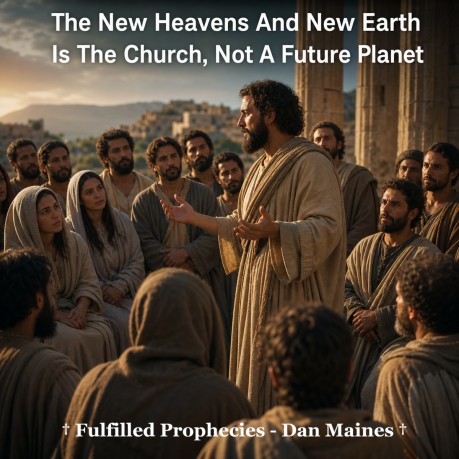
The
New Heavens And New Earth Is The Church, Not A Future Planet Introduction † Most people
read "new heavens and a new earth" and immediately think of
a future physical universe, but the Bible itself explains what this
means if we let Scripture interpret Scripture (2 Corinthians 5:16-17) † The
prophets, the apostles, and Revelation all point to the same reality,
this is about a people being transformed, not a planet being replaced
(Ephesians 2:14-16) † The wow
moment comes when we see that the "place" is actually the
people of God, the Bride, the Church (Revelation 21:2, 9-10) Isaiah 65:17-20 † This "new
heavens and new earth" clearly includes death, the child shall
die, so this cannot be a perfect eternal state with no death (Isaiah
65:20) † Sin is still
present, the sinner being accursed, which proves this is not
describing a sinless future world but a covenantal transformation
(Isaiah 65:20) † God
identifies this new creation as Jerusalem and her people, not a
planet, this is about a people being made new (Isaiah 65:18) † Childbirth
and lifespan are still functioning in this "new heavens and new
earth," proving this is describing covenant life among people,
not a perfected eternal state (Isaiah 65:20, 23) Isaiah
66:22-23 † This new
creation is tied to worship patterns like new moons and sabbaths,
showing continuity with covenantal life, not a brand new physical
cosmos (Isaiah 66:23) † The focus is
on God's people remaining before Him, again pointing to identity and
covenant, not geography (Isaiah 66:22) † The language
is clearly symbolic and covenantal, describing access to God rather
than a recreated planet (Hebrews 12:22-24) 2
Corinthians 5:17 † Paul defines
new creation as something happening in Christ, not something
happening to the planet (2 Corinthians 5:17) † The old
things passing away matches the passing of the old covenant world,
not the destruction of the physical earth (Hebrews 8:13) † This is
present reality, not future expectation, believers are already part
of the new creation (Colossians 1:13)
Ephesians 2:14-16 † The "new
man" is the new creation, Jew and Gentile united in one body,
this is the new heavens and new earth in action (Ephesians 2:15) † The old
covenant divisions are removed, showing that the "old world"
that passed away was covenantal, not physical (Galatians 3:28) † This is
about a people being created in Christ, not a universe being
recreated (2 Corinthians 5:17) Galatians
4:26 † Paul
identifies the Jerusalem above as our mother, meaning it's the source
of the people of God, not a physical location (Galatians 4:26) † This matches
Revelation where the New Jerusalem is the Bride, again showing it's a
people † This proves
our identity is tied to this Jerusalem now, not a future destination Hebrews
12:22-23 † This
explicitly says we have come, not will come, to the heavenly
Jerusalem, proving it's a present reality (Hebrews 12:22-23) † The heavenly
Jerusalem is identified as the church of the firstborn, clearly
showing it's a people, not a future city (Hebrews 12:23) † This
connects directly to Revelation 21, confirming the New Jerusalem is
the people of God Revelation
21:1-2 † John
connects the new heavens and new earth directly to the New Jerusalem,
showing they are the same reality (Revelation 21:2) † The New
Jerusalem is described as a bride, not a location, this is a people,
not a place (Revelation 21:2) † The passing
away of the first heaven and earth matches the passing of the old
covenant system (Hebrews 12:26-28) Revelation
21:9-10 And he carried me away in the Spirit to
a great and high mountain, and showed me the holy city, Jerusalem,
coming down out of heaven from God,
† The angel
explicitly says the Bride is what he will show, then shows the city,
proving the city and the Bride are the same (Revelation 21:9-10) † This is the
wow moment, the "place" is actually the people of God
(Ephesians 5:25-27) † The New
Jerusalem is the Church, the redeemed people in covenant with Christ
(Hebrews 12:22-23) † The Bible
never describes believers going to live inside the Bride, because the
Bride is the believers themselves (Revelation 21:9-10) Historical References † Irenaeus
spoke of the Church as the dwelling place of God, identifying the
people as the true habitation of God (Against Heresies, Book 5) † Augustine
described the City of God as the community of believers, not a
physical city descending in the future (City of God, Book 20) † Eusebius
connected the fall of Jerusalem with the transition into the new
covenant reality, emphasizing the people of God as the focus
(Ecclesiastical History, Book 3) How It Applies To Us
Today † We are not
waiting for a new world, we are living in the new creation right now
in Christ (2 Corinthians 5:17) † Our identity
is not tied to a future place, it's tied to being the people of God,
the Bride of Christ (Revelation 21:2) † This changes
everything, we stop looking outward for fulfillment and recognize
what God has already accomplished in His people (Colossians 2:10) Q & A Appendix Q
If the new heavens and new earth is the Church, why does it sound
physical in Isaiah and Revelation? Q
Are we in the New Jerusalem right now? Q
Does this mean the earth will never be destroyed? Q
If the New Jerusalem is the Bride, who lives in it? Q
Why does Revelation describe streets, gates, and walls if it's
people? Q
What passed away when the first heaven and earth passed away? Q
Why do people still expect a future physical new earth? Q
How do we know this was fulfilled in their generation? Q
Does this mean there is no future hope? Q
Why is it so hard for futurists to believe we're in the New
Jerusalem? Q
If this is true, what should we be focused on? † This is the fulfilled
perspective we proclaim at Fulfilled Prophecies † Source Index † Isaiah
65:17-20, Isaiah 66:22-23, 2 Corinthians 5:17, Ephesians 2:14-16,
Galatians 4:26, Hebrews 12:22-23, Revelation 21:1-2, 9-10, Matthew
24:34-35, Colossians 1:13, Hebrews 8:13, Galatians 3:28 † Irenaeus,
Against Heresies Book 5; Augustine, City of God Book 20; Eusebius,
Ecclesiastical History Book 3
By Dan Maines
For,
behold, I create new heavens and a new earth; and the former things
shall not be remembered, nor come into mind. But be ye glad and
rejoice for ever in that which I create; for, behold, I create
Jerusalem a rejoicing, and her people a joy. And I will rejoice in
Jerusalem, and joy in my people; and there shall be heard in her no
more the voice of weeping and the voice of crying. There shall be no
more thence an infant of days, nor an old man that hath not filled
his days; for the child shall die a hundred years old, and the sinner
being a hundred years old shall be accursed.
"For
just as the new heavens and the new earth,
Which I make, will
endure before Me," declares the Lord,
"So
will your descendants and your name endure.
And it shall be from
new moon to new moon
And from Sabbath to Sabbath,
All
mankind will come to bow down before Me," says the Lord.
Therefore
if anyone is in Christ, this person is a new creation; the old things
passed away; behold, new things have come.
For
He Himself is our peace, who made both groups into one and broke down
the barrier of the dividing wall, by abolishing in His flesh the
hostility, which is the Law composed of commandments expressed in
ordinances, so that in Himself He might make the two one new person,
in this way establishing peace; and that He might reconcile them both
in one body to God through the cross, by it having put to death the
hostility.
But the
Jerusalem above is free; she is our mother.
But
you have come to Mount Zion and to the city of the living God, the
heavenly Jerusalem, and to myriads of angels, to the general assembly
and church of the firstborn who are enrolled in heaven, and to God,
the Judge of all, and to the spirits of the righteous made perfect,
Then I
saw a new heaven and a new earth; for the first heaven and the first
earth passed away, and there is no longer any sea. And I saw the holy
city, new Jerusalem, coming down out of heaven from God, prepared as
a bride adorned for her husband.
Then
one of the seven angels who had the seven bowls, full of the seven
last plagues, came and spoke with me, saying, "Come here, I will
show you the bride, the wife of the Lamb."
A
Because prophetic language uses physical imagery to describe
spiritual realities, Isaiah shows death and sin still present which
proves it's not a perfect physical world, and Revelation interprets
it for us by calling the city the Bride (Isaiah 65:20; Revelation
21:9-10)
A
Yes, Hebrews says we have come to Mount Zion and the heavenly
Jerusalem, this is present reality, not future (Hebrews 12:22-23)
A
The Bible shows the passing of heaven and earth as covenantal
language tied to Israel's world, not the physical planet (Matthew
24:34-35)
A
No one lives in the Bride, because the Bride is the people of God
themselves, Revelation shows the city and the Bride are the same, not
separate (Revelation 21:9-10)
A
Those are symbolic descriptions showing beauty, security, and
perfection, just like the Church is described as a body, a temple,
and a building, all different pictures of the same people (Ephesians
2:20-22; 1 Corinthians 3:16)
A
The old covenant world, the temple system, the law, and the
separation it created, not the physical planet (Hebrews 8:13; Hebrews
9:10)
A
Because they read prophetic language literally instead of letting
Scripture interpret Scripture, and they ignore that the New Testament
says new creation is already here in Christ (2 Corinthians 5:17)
A
Jesus said all these things would happen in that generation,
including the passing of heaven and earth, tying it directly to the
first century (Matthew 24:34-35)
A
No, our hope is already fulfilled in Christ, we are in the kingdom,
in the New Jerusalem, and in the new creation now (Colossians 1:13)
A
Because they're looking for something physical and visible instead of
understanding the spiritual reality, the kingdom of God does not come
with observation, it is within and among His people (Luke 17:20-21)
A
Living as the new creation we already are, walking in unity,
holiness, and identity as the Bride of Christ instead of waiting for
something God already accomplished (Ephesians 4:1-3; Colossians
3:1-3)
©
Fulfilled Prophecies - Dan Maines.
Links