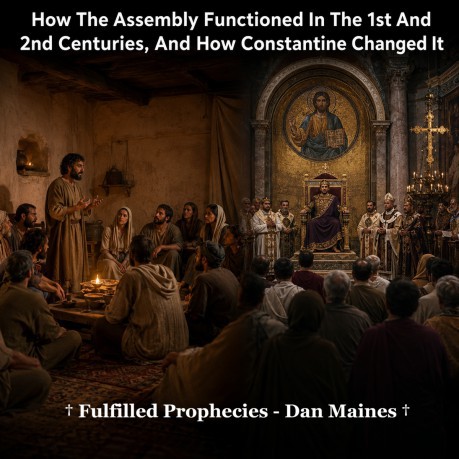
How
The Assembly Functioned In The 1st And 2nd Centuries, And How
Constantine Changed It Introduction † Many people
today picture the modern church system as if it came directly from
Christ and the apostles. But when we go back to the New Testament and
the writings of the early believers, we find something very
different. The early assemblies were simple, house-based gatherings
centered on fellowship, teaching, prayer, and mutual edification.
There were no church buildings, no elevated priesthood class, no
state-controlled religion, and no massive institutional system. † The first
century assemblies functioned as living bodies of believers gathered
together in homes. Christ alone was their head. Leadership existed,
but it was servant leadership, not a ruling hierarchy. Over time,
especially after Constantine in the 4th century, many things changed.
Christianity became institutionalized, political, and heavily
influenced by Roman structure and power. † Understanding
this history helps us separate what came from Christ and the apostles
from what later developed through Roman influence. It also helps
explain why so much of modern church tradition looks nothing like the
assemblies described in scripture. (Matthew 20:25-28; Colossians
1:18) Acts 2:46-47
Day by day continuing with one mind in the temple, and breaking bread
from house to house, they were taking their meals together with
gladness and sincerity of heart, praising God and having favor with
all the people. And the Lord was adding to their number day by day
those who were being saved.
† The
believers gathered from house to house. The assembly was centered in
homes, not dedicated church buildings. (Romans 16:5) † Their
gatherings focused on fellowship, meals, prayer, teaching, and
encouragement. The assembly functioned like a family, not a religious
corporation. (Acts 20:7) † The New
Testament never describes Christians constructing special church
sanctuaries during the apostolic age. The people themselves were the
temple of God. (1 Corinthians 3:16) Romans 16:3-5
Greet Prisca and Aquila, my fellow workers in Christ Jesus, who
risked their own necks for my life, to whom not only do I give
thanks, but also all the churches of the Gentiles; also greet the
church that is in their house. Greet Epaenetus, my beloved, who is
the first convert to Christ from Asia.
† Entire
assemblies met inside ordinary homes. This pattern appears repeatedly
throughout the New Testament. (Colossians 4:15) † The word
church referred to the gathered people, not a building. The Greek
word ekklesia simply means assembly or called-out gathering. (Acts
19:32, 39) † The early
assemblies were deeply relational. Believers knew one another
personally and shared life together daily. (Hebrews 10:24-25) 1 Corinthians 14:26
What is the outcome then, brothers and sisters? When you assemble,
each one has a psalm, has a teaching, has a revelation, has a tongue,
has an interpretation. All things are to be done for edification.
† The
gatherings were participatory. Multiple believers contributed to the
assembly instead of one man performing an entire service from a
platform. (Ephesians 4:11-16) † The goal was
mutual edification, not religious performance. Every believer was
viewed as part of the functioning body of Christ. (Romans 12:4-6) † Leadership
existed, but the gatherings were not built around celebrity
personalities or institutional authority structures. Christ remained
the center. (Matthew 23:8-10) 1 Peter 2:5
you also, as living stones, are being built up as a spiritual house
for a holy priesthood, to offer spiritual sacrifices that are
acceptable to God through Jesus Christ.
† Every
believer was part of the spiritual priesthood. The New Testament does
not establish a separate priestly class over the assembly.
(Revelation 1:6) † Under the
Old Covenant, temple priests stood between God and the people. Under
Christ, believers had direct access to the Father. (Hebrews 10:19-22) † Constantine's
later church system gradually restored distinctions resembling the
old priesthood structure, elevating bishops and clergy into positions
of religious power. (Matthew 23:11-12) Matthew 23:8-10
But as for you, do not be called Rabbi; for only One is your Teacher,
and you are all brothers and sisters. And do not call anyone on earth
your father; for only One is your Father, He who is in heaven. And do
not be called leaders; for only One is your Leader, that is, Christ.
† Jesus
directly warned against religious titles and elevated religious
classes. † The early
assemblies viewed believers as brethren under one head, Christ.
(Colossians 1:18) † The later
Roman church system created hierarchical titles and offices
completely foreign to the apostolic assemblies. (Matthew 20:25-28) † Bishops
eventually became political authorities connected to imperial power
after Constantine. Matthew 20:25-28
But Jesus called them to Himself and said, "You know that the
rulers of the Gentiles domineer over them, and those in high position
exercise authority over them. It is not this way among you, but
whoever wants to become prominent among you shall be your servant,
and whoever desires to be first among you shall be your slave; just
as the Son of Man did not come to be served, but to serve, and to
give His life as a ransom for many."
† Christ
condemned worldly religious hierarchy and authoritarian leadership
patterns. (Luke 22:25-26) † The
apostolic assemblies emphasized servant leadership instead of
institutional control. Elders shepherded the flock rather than ruling
as political officials. (1 Peter 5:1-3) † After
Constantine, church leadership increasingly mirrored Roman
governmental structure, with bishops gaining political influence,
wealth, and state authority. 1 Corinthians 9:14
So also the Lord directed those who proclaim the gospel to get their
living from the gospel.
† Support
existed for ministers, but the early assemblies did not operate like
later institutional salary systems and church corporations. † Ministry was
centered on service, sacrifice, and teaching rather than religious
career advancement. (2 Corinthians 11:7-9) † Many early
believers worked ordinary occupations while serving the assemblies.
Paul himself worked as a tentmaker. (Acts 18:3) † Constantine's
state-supported church transformed leadership into positions of
wealth, prestige, and political influence. John 18:36
Jesus answered, "My kingdom is not of this world. If My kingdom
were of this world, My servants would be fighting so that I would not
be handed over to the Jews; but as it is, My kingdom is not of this
realm."
† The early
assemblies operated independently from state control. Christianity
was often persecuted because believers would not submit Christ's
kingdom to Caesar. (Acts 5:29) † Constantine
changed this relationship dramatically by joining Christianity with
imperial power in the 4th century. † Once
Christianity became state-supported, the simple assembly structure
began transforming into an institutional religious system connected
to political authority. Acts 7:48
However, the Most High does not dwell in houses made by human hands;
as the prophet says:
† Stephen
directly rejected the idea that God was confined to physical
religious structures. † The New
Covenant shifted God's dwelling place from physical temples to His
people. (1 Corinthians 3:16) † After
Constantine, massive church buildings again became treated as sacred
religious spaces much like Old Covenant temples. † The focus
gradually shifted from the spiritual body of believers to
institutional buildings and ceremonial systems. 2 Corinthians 6:16 Or what
agreement does the temple of God have with idols? For we are the
temple of the living God; just as God said, "I will
dwell among them and
walk among them; † The New
Testament consistently taught that believers themselves were God's
dwelling place. (Ephesians 2:19-22) † Massive
cathedral systems and elaborate religious buildings developed
centuries later under Roman influence. † The focus
shifted from the gathered body of believers to sacred buildings,
religious offices, ceremonies, and institutional power structures. 1 Corinthians 1:12-13
Now I mean this, that each one of you is saying, "I am with
Paul," or "I am with Apollos," or "I am with
Cephas," or "I am with Christ." Has Christ been
divided? Paul was not crucified for you, was he? Or were you baptized
in the name of Paul?
† The
apostolic assemblies were never intended to fragment into competing
denominations and institutional systems. † The body of
Christ was centered on unity in Him, not organizational identity.
(Ephesians 4:4-6) † Many later
divisions grew out of institutional power struggles that developed
after the apostolic period. † The Roman
church structure eventually centralized authority in ways never seen
in the New Testament assemblies. Historical References † Ignatius of
Antioch, early 2nd century, described believers gathering together
regularly in local assemblies centered on fellowship, unity, and
Christ. † Justin
Martyr, around AD 150, described Christians gathering simply for
scripture reading, prayer, exhortation, and communal meals. † Tertullian
wrote that believers met as a spiritual society devoted to prayer,
encouragement, and caring for one another. † Eusebius
recorded that Constantine financed church buildings, elevated bishops
politically, and merged imperial authority with organized
Christianity. † Edward
Gibbon, in The Decline and Fall of the Roman Empire, described how
Christianity transitioned from a persecuted movement into an imperial
religious institution after Constantine. † The Council
of Nicaea in AD 325 was called and overseen by Constantine himself,
showing how deeply imperial authority had become intertwined with
Christianity. † Constantine
financed church buildings, elevated bishops socially and politically,
and gave Christianity legal and financial privileges throughout the
empire. † Lactantius
wrote about the severe persecutions before Constantine and the
dramatic political shift that followed when Christianity became state
protected. How It Applies To Us
Today † Many
believers assume church traditions automatically came from Christ,
but history shows many practices developed long after the apostles. † We should
examine everything by scripture instead of tradition alone. (Acts
17:11) † The true
assembly is still the people of God gathered in Christ, not a
building or institution. (1 Corinthians 12:27) † Fellowship,
encouragement, prayer, teaching, and mutual edification remain
central to the body of Christ today. (Hebrews 10:24-25) † Christ
warned against religious systems built on status, power, and outward
appearance. (Matthew 23:5-12) † The
fulfilled perspective reminds us that Christ already established His
kingdom and His spiritual temple. Believers are the dwelling place of
God now. (Ephesians 2:19-22) Q & A Appendix Q:
Did the apostles build church buildings? A:
No. The New Testament consistently shows believers gathering in homes
and public areas, not constructing church sanctuaries. (Romans 16:5;
Colossians 4:15) Q:
What did the word church originally mean? A:
The Greek word ekklesia means assembly or gathering. It referred to
the people, not a building. (Acts 19:32, 39) Q:
Did the early church have priests like the Old Covenant system? A:
No. All believers were viewed as part of the royal priesthood under
Christ. (1 Peter 2:5-9) Q:
What changed under Constantine? A:
Constantine ended persecution against Christians, but he also helped
institutionalize Christianity and merge it with imperial Roman power,
changing the simplicity of the early assemblies. Q:
Did the apostles establish a clergy system like we see today? A:
No. The New Testament presents leaders as servants and shepherds
among the brethren, not as a separate ruling priesthood class.
(Matthew 23:8-12; 1 Peter 5:1-3) Q:
Were church buildings part of the apostolic assembly system? A:
No. Believers primarily gathered in homes. The idea of specially
designated sacred church buildings developed later. (Romans 16:5;
Acts 7:48) Q:
Did Constantine improve Christianity? A:
Constantine ended persecution against Christians, but he also helped
institutionalize Christianity and merge it with imperial Roman power,
changing the simplicity of the early assemblies. Q:
Did Constantine change times and laws, perhaps even the Sabbath? A:
Constantine issued the first civil Sunday law in AD 321, declaring
Sunday a day of rest across the Roman Empire. This was not a command
given by Christ or the apostles. The New Testament never commands
Christians to keep Sunday as a replacement Sabbath law. (Colossians
2:16-17; Romans 14:5-6) A:
The apostles taught that believers were not under the Old Covenant
Sabbath system. Christ fulfilled the law, and believers were not to
be judged regarding sabbath days. (Galatians 4:9-11; Colossians
2:16-17) A:
Constantine helped institutional Christianity adopt practices
enforced through imperial law, blending Roman government authority
with church tradition. Q:
Was Constantine a good person? A:
Constantine ended much of the violent persecution against Christians
and legalized Christianity throughout the empire. In that sense, many
believers viewed his actions positively. A:
However, Constantine was also a Roman emperor deeply involved in
politics, warfare, and imperial control. He oversaw church councils,
elevated bishops into political power, and helped transform
Christianity into a state-supported institution. A:
History records that Constantine ordered executions, including
members of his own family, and retained many elements of Roman
imperial religion and symbolism throughout his reign. A:
The issue is not whether Constantine did some beneficial things
politically, but whether the changes that followed moved the assembly
away from the simple New Testament pattern established by Christ and
the apostles. Many historians agree that they did. † This is the fulfilled
perspective we proclaim at Fulfilled Prophecies † © Fulfilled Prophecies - Dan Maines. Source Index † Acts
2:46-47; Acts 5:29; Acts 7:48; Acts 17:11; Acts 18:3; Acts 19:32, 39;
Romans 12:4-6; Romans 16:3-5; 1 Corinthians 1:12-13; 1 Corinthians
3:16; 1 Corinthians 12:27; 1 Corinthians 14:26; 2 Corinthians 6:16; 2
Corinthians 11:7-9; Ephesians 2:19-22; Ephesians 4:4-6; Ephesians
4:11-16; Colossians 1:18; Colossians 4:15; Hebrews 10:19-25; 1 Peter
2:5-9; 1 Peter 5:1-3; Matthew 20:25-28; Matthew 23:5-12; John 18:36;
Luke 22:25-26; Revelation 1:6 † Ignatius of
Antioch, Letter to the Ephesians; Justin Martyr, First Apology,
Chapters 65-67; Tertullian, Apology, Chapter 39; Eusebius, Life of
Constantine; Lactantius, On The Deaths Of The Persecutors; Council of
Nicaea, AD 325; Edward Gibbon, The Decline and Fall of the Roman
Empire
By Dan Maines
And
I will be their God, and
they shall be My people.
Links