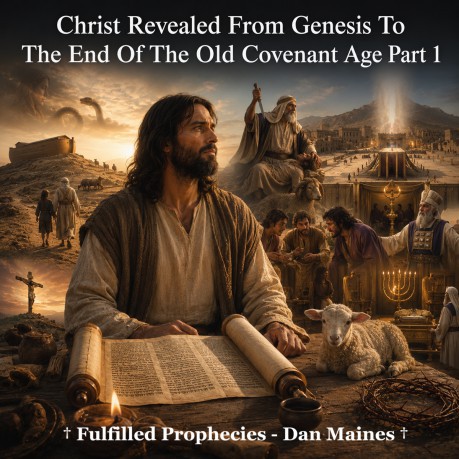
Christ
Revealed From Genesis To The End Of The Old Covenant Age Part 1 Introduction Genesis
And The Promise Of Christ Genesis
6:13 Abraham
And The Promised Seed Isaac
Carrying The Wood Joseph
As A Type Of Christ Cain
And Abel, Two Covenant Lines The
Passover And Exodus Moses
As A Type Of Christ The
Bronze Serpent The
Tabernacle Pointed To Christ The
Feast Days Pointed To Fulfillment In Christ † This
is the fulfilled perspective we proclaim at Fulfilled Prophecies † Source
Index
By Dan Maines
Part
2 of 2
†
From
Genesis to Revelation, the Bible is one connected story pointing to
Jesus Christ, the ending of the Old Covenant age, and the revealing
of the New Covenant kingdom. The Law, the sacrifices, the feast days,
the priesthood, the temple, and even the historical events were
shadows pointing forward to Christ and the fulfillment that came in
that generation. (Luke 24:27; Colossians 2:16-17)
†
Many
people read the Old Testament as disconnected stories, but Jesus and
the apostles taught that Moses, the Prophets, and the Psalms all
testified about Him. The Old Covenant system was never the final
reality. It was temporary and was preparing Israel for the coming
Messiah and the end of their covenant age. (Luke 24:44; Hebrews
8:13)
†
The
Old Covenant system contained prophetic shadows that prepared Israel
for the coming Messiah and the establishment of the New Covenant
kingdom. (Hebrews 10:1)
Genesis
3:15
And
I will make enemies
Of you and the woman,
And of your
offspring and her Descendant;
He shall bruise you on the
head,
And you shall bruise Him on the heel."
†
This
was the first prophecy of Christ. The promised seed would defeat the
serpent through suffering. Jesus fulfilled this through His death and
resurrection. (Romans 16:20; Hebrews 2:14)
†
Even
from the beginning, God revealed that redemption would come through
one coming man, not through the Law of Moses which came much later.
(Galatians 3:16-19)
†
The
entire Bible moves forward from this promise. Every covenant, shadow,
and prophecy pointed to the coming Messiah and the removal of sin.
(John 5:39)
Then
God said to Noah, "The end of humanity has come before Me; for
the earth is filled with violence because of people; and behold, I am
about to destroy them with the earth.
†
Noah's
ark pointed forward to salvation through Christ, where believers are
brought safely through judgment. (1 Peter 3:20-21)
†
The
flood also established an early pattern of covenant judgment followed
by deliverance. (Matthew 24:37-39)
†
God
repeatedly used judgment and salvation themes throughout Scripture to
reveal His redemptive plan. (Romans 15:4)
Genesis
22:18
And
in your seed all the nations of the earth shall be blessed, because
you have obeyed My voice."
†
Paul
plainly says this seed was Christ. The promises to Abraham were
always about Jesus and the inclusion of the nations into one covenant
people. (Galatians 3:16)
†
Israel
according to the flesh was never the final goal. God was preparing a
worldwide kingdom through Christ. (Ephesians 2:11-19)
†
The
Old Covenant system separated Jew and Gentile, but Christ removed
that wall in the New Covenant age. (Ephesians 2:14-15)
Genesis
22:6
And
Abraham took the wood for the burnt offering and laid it on his son
Isaac, and he took in his hand the fire and the knife. So the two of
them walked on together.
†
Isaac
carrying the wood up the mountain pointed forward to Christ carrying
the cross to His sacrifice. (John 19:17)
†
Abraham
offering his beloved son also revealed the Father offering His only
Son for the sins of the world. (Romans 8:32)
†
The
ram provided in Isaac's place pointed to substitutionary sacrifice
fulfilled in Christ. (John 1:29)
Genesis
50:20
As
for you, you meant evil against me, but God meant it for good in
order to bring about this present result, to keep many people alive.
†
Joseph
was rejected by his brothers, suffered unjustly, and was later
exalted to save the very people who rejected him. This clearly
pointed to Jesus. (Acts 2:23-24)
†
The
stories in Genesis were not random history. God designed them as
prophetic pictures revealing Christ beforehand. (Hebrews 10:1)
†
Joseph
saving many alive points forward to Christ bringing salvation to both
Jew and Gentile through the New Covenant. (John 11:49-52)
Genesis
4:4-5
Abel,
on his part also brought an offering, from the firstborn of his flock
and from their fat portions. And the Lord
had
regard for Abel and his offering; but for Cain and his offering He
had no regard. So Cain became very angry and his face was gloomy.
†
Abel
represented faith and acceptable sacrifice, while Cain represented
flesh and rejection. (Hebrews 11:4)
†
This
pattern continued throughout Scripture between the children of
promise and the children of the flesh. (Galatians 4:22-31)
†
Israel
after the flesh eventually became like Cain by persecuting the
righteous seed. (Matthew 23:35)
Exodus
12:13
The
blood shall be a sign for you on the houses where you live; and when
I see the blood I will pass over you, and no plague will come upon
you to destroy you when I strike the land of Egypt.
†
The
Passover lamb directly pointed to Christ. His blood delivers His
people from judgment. (1 Corinthians 5:7)
†
Israel's
deliverance from Egypt was a shadow of the greater deliverance from
sin and death through Jesus. (Luke 9:31)
†
The
Old Covenant feasts were prophetic rehearsals pointing to fulfillment
in Christ and His kingdom. (Colossians 2:16-17)
Deuteronomy
18:15
"The
Lord your
God will raise up for you a prophet like me from among you, from your
countrymen; to him you shall listen.
†
Moses
was a prophetic picture of Christ. Moses brought Israel out of
Egyptian bondage, but Christ brought His people out of bondage to sin
and death. (John 8:31-36)
†
Moses
mediated the Old Covenant at Sinai, but Jesus mediated the better and
everlasting covenant. (Hebrews 8:6)
†
Israel
rejected both Moses and Christ at first, yet both were appointed by
God as deliverers. (Acts 7:35-37)
Numbers
21:8-9
Then
the Lord said
to Moses, "Make a fiery serpent, and put it on a flag pole; and
it shall come about, that everyone who is bitten, and looks at it,
will live." So Moses made a bronze serpent and put it on the
flag pole; and it came about, that if a serpent bit someone, and he
looked at the bronze serpent, he lived.
†
Jesus
directly connected this event to Himself being lifted up on the
cross. (John 3:14-15)
†
The
people were healed by looking in faith, just as salvation comes
through faith in Christ. (Ephesians 2:8-9)
†
The
judgment brought by the serpents also showed that sin brings death,
but God provided one way of deliverance. (Romans 6:23)
Hebrews
9:8-9
The
Holy Spirit is signifying this, that the way into the holy place has
not yet been disclosed while the outer tabernacle is still standing,
which is a symbol for the present time. Accordingly both gifts and
sacrifices are offered which cannot make the worshiper perfect in
conscience,
†
The
tabernacle was a giant prophetic picture revealing access to God
through Christ. (Hebrews 10:19-20)
†
The
outer court represented earthly approach, the holy place represented
priestly mediation, and the Most Holy Place represented full access
into God's presence. (Hebrews 9:1-7)
†
When
the veil tore at Christ's death, God revealed that direct access had
now been opened through Jesus. (Matthew 27:51)
Colossians
2:16-17
Therefore,
no one is to act as your judge in regard to food and drink, or in
respect to a festival or a new moon, or a Sabbath day- things which
are only a shadow of what is to come; but the substance belongs to
Christ.
†
Passover
pointed to Christ's sacrifice as the Lamb of God. (1 Corinthians
5:7)
†
Firstfruits
pointed to His resurrection from the dead. (1 Corinthians 15:20)
†
Pentecost
pointed to the outpouring of the kingdom through the Spirit. (Acts
2:1-4)
†
The
feast days were prophetic rehearsals preparing Israel for fulfillment
in Christ. (Hebrews 10:1)
©
Fulfilled Prophecies - Dan Maines.
†
Genesis
3:15; Genesis 6:13; Genesis 22:6, 18; Genesis 50:20; Genesis 4:4-5;
Exodus 12:13; Deuteronomy 18:15; Numbers 21:8-9; Hebrews 9:8-9;
Colossians 2:16-17
†
Justin
Martyr, Dialogue With Trypho; Irenaeus, Against Heresies Book 4;
Clement of Alexandria, Stromata; Epistle of Barnabas
Links