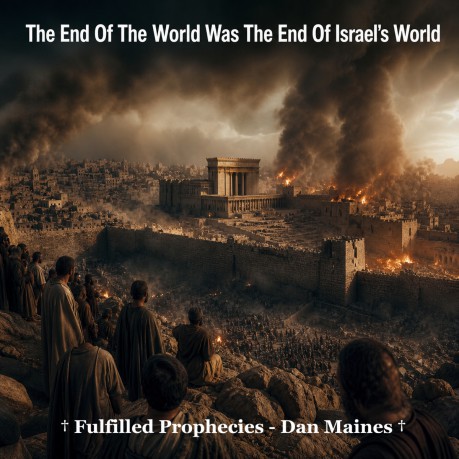
The
End Of The World Was The End Of Israel's World Introduction † Most people
hear the phrase "end of the world" and immediately think of
the destruction of the physical planet, but the Bible never defines
it that way (Matthew 24:3). † The Bible
uses covenantal language, prophetic language, and audience relevance,
and when we let Scripture define its own terms, everything becomes
clear (2 Peter 3:10). † The word
translated "world" in many passages is the Greek word aion,
which means age, not the physical earth (Matthew 24:3). † Once we
understand that, the entire conversation shifts from global
destruction to the end of a covenant age, specifically Israel's world
(Hebrews 9:26). Matthew
24:3 † The phrase
end of the world here is the Greek phrase sunteleia tou aionos, which
means completion of the age, not the destruction of the planet
(Matthew 24:3). † The
disciples were not asking about the end of planet earth, they were
asking about the end of the age they were living in, the Old Covenant
age centered around the temple (Matthew 24:3). † Jesus had
just told them the temple would be destroyed, so their question is
directly tied to that event, not some distant future global
catastrophe (Matthew 24:3). † This is
about the end of Israel's covenant world, not the end of the physical
creation (Matthew 24:3). Matthew
24:34 † This verse
defines the time frame, Jesus said everything He just described,
including the end of the age, would happen in their generation
(Matthew 24:34). † This
eliminates any future interpretation, because their generation did
not last thousands of years (Matthew 24:34). † This ties
the end of the age directly to the first century destruction of
Jerusalem (Matthew 24:34). Matthew
5:18 † Heaven and
earth here are directly connected to the Law, showing it is
covenantal language, not the physical universe (Matthew 5:18). † The Law
remained until heaven and earth passed, meaning the Old Covenant
system stayed in place until its fulfillment (Matthew 5:18). † This
perfectly aligns with the destruction of Jerusalem when that system
came to its full end (Matthew 5:18). Hebrews
9:26 † The phrase
end of the ages confirms that multiple ages were in view, and Christ
appeared at the climax of those covenant ages (Hebrews 9:26). † This shows
that the writers of the New Testament believed they were already
living in the last days of that age, not waiting thousands of years
for it (Hebrews 9:26). † The Old
Covenant system was reaching its end, and Christ's sacrifice marked
the beginning of that transition (Hebrews 9:26). † The
destruction of Jerusalem in AD 70 completed what was already in
motion (Hebrews 9:26). Hebrews
8:13 † The Old
Covenant was already in the process of disappearing in the first
century (Hebrews 8:13). † This proves
the end was not thousands of years away, it was imminent to their
audience (Hebrews 8:13). † AD 70 marks
the visible end of what was already fading (Hebrews 8:13). 2 Peter 3:10 † Many read
this and assume it's describing the literal destruction of the
planet, but this language comes directly from Old Testament prophetic
imagery (2 Peter 3:10). † The word
elements refers to the stoicheia, the basic principles or elements of
the Old Covenant system, not atoms or the periodic table (2 Peter
3:10). † The heavens
and earth language was commonly used to describe covenant systems,
governments, and nations (2 Peter 3:10). † Peter is
describing the end of the Old Covenant world in the same symbolic
language the prophets always used (2 Peter 3:10). Isaiah
34:4 † This passage
describes the judgment of Edom, yet it uses cosmic language like the
heavens dissolving and the sky rolling up (Isaiah 34:4). † No one
believes the literal stars fell when Edom was judged, because we
understand this as prophetic, covenantal language (Isaiah 34:4). † This is the
exact same type of language Peter uses, proving he is not introducing
a new idea but continuing a consistent biblical pattern (Isaiah
34:4). † When
Israel's world ended in AD 70, the language of heaven and earth
passing away was fulfilled in that covenantal sense (Isaiah 34:4). Isaiah
13:10 † This was
spoken about Babylon, yet uses the same cosmic language (Isaiah
13:10). † This proves
beyond question that prophetic language about the heavens collapsing
is symbolic of covenant judgment (Isaiah 13:10). † Peter is
using established prophetic language, not describing the end of the
physical universe (2 Peter 3:10). Historical References † Josephus,
Wars of the Jews, Book 6, Chapter 4, describes the destruction of
Jerusalem as unparalleled, marking the complete end of the Jewish
temple system. † Eusebius,
Ecclesiastical History, Book 3, Chapter 5, records that Christians
recognized the destruction of Jerusalem as a divine judgment tied to
Christ's prophecy. † Tacitus,
Histories 5.13, confirms the devastation of Jerusalem and the
collapse of the Jewish system. How It Applies To Us
Today † We are not
waiting for the world to end, we are living in the age that came
after the Old Covenant was removed (Hebrews 8:13). † The fear of
global destruction is not a biblical teaching, it comes from
misunderstanding prophetic language (2 Peter 3:10). † Christ
already brought judgment on that system and established His kingdom,
and we are living in it now (Matthew 24:34). † This changes
everything, instead of fear, we walk in confidence knowing His work
is complete (Hebrews 9:26). Q & A Appendix Q
If the world did not end physically, why does the Bible use such
extreme language? Q
What does aion really mean? Q
What are the elements in 2 Peter 3? Q
Are we living in the new heavens and new earth now? Q
Why do so many people still believe the earth will be destroyed? Q
What exactly ended in AD 70? Q
Did Jesus ever say the physical earth would be destroyed? Q
What does heaven and earth passing away really mean? Q
Why is 2 Peter 3 misunderstood? Q
What difference does this make for us today? † This is the fulfilled
perspective we proclaim at Fulfilled Prophecies † Source Index † Matthew
24:3, Matthew 24:34, Matthew 5:18, Hebrews 9:26, Hebrews 8:13, 2
Peter 3:10, Isaiah 34:4, Isaiah 13:10 † Josephus,
Wars of the Jews, Book 6, Chapter 4, Eusebius, Ecclesiastical
History, Book 3, Chapter 5, Tacitus, Histories 5.13
By Dan Maines
And as He
was sitting on the Mount of Olives, the disciples came to Him
privately, saying, "Tell us, when will these things happen, and
what will be the sign of Your coming, and of the end of the age?"
Truly I
say to you, this generation will not pass away until all these things
take place.
For truly
I say to you, until heaven and earth pass away, not the smallest
letter or stroke of a letter shall pass from the Law, until all is
accomplished!
Otherwise,
He would have needed to suffer often since the foundation of the
world; but now once at the consummation of the ages He has been
revealed to put away sin by the sacrifice of Himself.
When He
said, "A new covenant," He has made the first obsolete. But
whatever is becoming obsolete and growing old is about to disappear.
But
the day of the Lord will come like a thief, in which the heavens will
pass away with a roar and the elements will be destroyed with intense
heat, and the earth and its works will be discovered.
And all
the heavenly lights will wear away,
And the sky will be rolled
up like a scroll;
All its lights will also wither away
As a
leaf withers from the vine,
Or as one withers from the fig tree.
For the
stars of heaven and their constellations
Will not flash their
light;
The sun will be dark when it rises
And the moon will
not shed its light.
A
Because that is how prophetic judgment language has always been used.
Isaiah 34:4 and Isaiah 13:10 use the same language for nations, yet
the physical earth remained.
A
It means age, not planet. Matthew 24:3 is asking about the end of the
age, not the destruction of the earth.
A
They are the stoicheia, the elements of the Old Covenant system, not
physical matter.
A
Yes, the old covenant world has passed, and we are in the new
covenant reality established by Christ as seen within that generation
(Matthew 24:34).
A
Because they read prophetic language literally instead of comparing
it with Old Testament usage like Isaiah 13:10 and Isaiah 34:4.
A
The Old Covenant world, the temple system, the sacrificial system,
and Israel's covenant identity centered on the Law came to a complete
end (Hebrews 8:13).
A
No, He spoke about the end of the age and tied it directly to the
destruction of the temple and that generation (Matthew 24:3, 34).
A
It refers to the passing of the Old Covenant system connected to the
Law, not the physical universe (Matthew 5:18).
A
Because people ignore the Old Testament background where identical
language was used for covenant judgment, not literal cosmic
destruction (Isaiah 34:4).
A
It removes fear and confusion, and it shows that Christ's work is
complete and His kingdom is fully established now (Hebrews 9:26).
©
Fulfilled Prophecies - Dan Maines.
Links