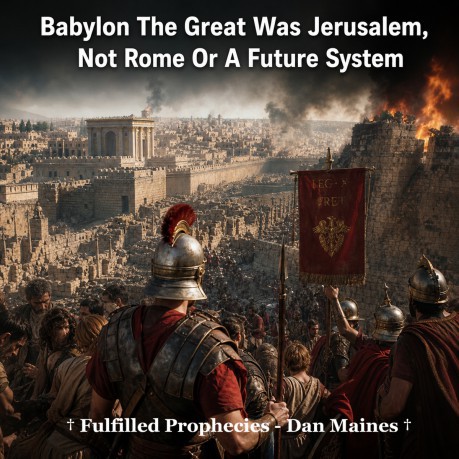
Babylon
The Great Was Jerusalem, Not Rome Or A Future System Introduction † Most people
are taught that Babylon the Great is either Rome or some future
worldwide system, but Scripture identifies her plainly, and it
doesn't leave room for speculation (Revelation 17:18). † The key is
letting the Bible define its own symbols, not importing modern ideas
into the text (1 Corinthians 2:13). † Once we
follow the internal evidence, the identity becomes undeniable,
Babylon the Great was covenant Jerusalem under judgment (Matthew
23:37-38). Revelation
11:8 † The great
city is directly identified as the place where the Lord was
crucified, that is Jerusalem, not Rome, not a future city (Luke
13:33). † The phrase
spiritually is called Sodom and Egypt shows covenant judgment
language, just like the prophets used against Israel when she became
unfaithful (Isaiah 1:10). † This
establishes that the great city in Revelation is Jerusalem, and this
same great city appears again later as Babylon (Revelation 17:18). Revelation
17:18 † This
directly identifies Babylon as the great city, the same phrase used
in Revelation 11:8, locking the identity together (Revelation 11:8). † The great
city where the Lord was crucified is Jerusalem, so the woman,
Babylon, must be Jerusalem (Luke 13:33). † This removes
Rome and any future system completely, because the Bible already
defined the city. Matthew
23:37-38 † Jesus places
the guilt of killing the prophets directly on Jerusalem, not Rome or
any future system (Luke 11:50-51). † He declares
their house desolate, which is temple judgment language, pointing to
the destruction that would come in that generation (Matthew 24:2). † This matches
the judgment language of Babylon in Revelation, a city guilty of the
blood of the prophets (Revelation 18:24).
Luke 11:49-51 † Jesus says
all the blood of the prophets would be required of that generation,
the same exact charge given to Babylon (Revelation 18:24). † This proves
Babylon cannot be Rome or future, because the judgment was tied to
that first century generation. † The guilt is
covenantal and localized to Jerusalem, exactly as Revelation
describes. Ezekiel
16:35-36 † God calls
Jerusalem a harlot, this isn't new language, it's covenant language
used throughout the Old Testament (Jeremiah 3:6). † The harlot
imagery in Revelation is directly tied back to this same covenant
unfaithfulness, not a pagan nation (Ezekiel 23:30). † Babylon the
Great being called a harlot fits Jerusalem perfectly, because she
broke covenant with God (Revelation 17:5). Ezekiel
23:37 † The charge
of blood guilt is again placed on Jerusalem, matching Revelation's
description of Babylon being drunk with the blood of the saints
(Revelation 17:6). † This shows
the harlot is not Rome, Rome was never in covenant with God, but
Jerusalem was (Amos 3:2). † Covenant
unfaithfulness is the basis for judgment, which only applies to
Israel (Hosea 1:2). Revelation
17:5 † The title
mother of harlots connects directly to Ezekiel 16 and 23, where
Jerusalem is called the source of harlotry (Ezekiel 16:44-45). † This shows
continuity, not a new entity, Revelation is using Old Testament
covenant language. † Babylon is
not a new mystery system, it is the revealed identity of apostate
Jerusalem. Revelation
18:24 † This is the
same charge Jesus gave to Jerusalem, all righteous blood coming upon
that generation (Matthew 23:35-36). † No other
city in Scripture is ever held responsible for all the blood of the
prophets except Jerusalem (Luke 13:33). † This is the
connecting point that proves Babylon the Great is Jerusalem. Historical References † Josephus,
Wars of the Jews, Book 6, Chapter 9 describes Jerusalem filled with
blood during the Roman siege, matching the judgment language of
Revelation. † Eusebius,
Ecclesiastical History, Book 3, Chapter 5 records the destruction of
Jerusalem as the fulfillment of Christ's warnings. † Tacitus,
Histories 5.13 confirms the devastation and judgment that fell upon
Jerusalem in the first century. † Clement of
Alexandria, Who is the Rich Man That Shall Be Saved, Section 42
affirms the early church understood the judgment of Jerusalem as
fulfillment of Christ's warnings. How It Applies To Us
Today † We must let
Scripture interpret Scripture and not follow traditions that ignore
clear biblical identification (2 Peter 1:20). † God's
judgment was real, historical, and fulfilled exactly as Jesus said it
would happen in that generation (Matthew 24:34). † We're not
waiting for Babylon to fall, it already fell, and we're living in the
fulfilled kingdom today (Hebrews 12:28). Q & A Appendix Q:
If Babylon was Jerusalem, why do people think it's Rome or a future
system? Q:
Was Rome guilty of killing the prophets? Q:
Does this mean Revelation is already fulfilled? Q:
Why does Revelation use the name Babylon instead of Jerusalem? Q:
If Babylon was Jerusalem, why is she called a great city ruling over
kings? Q:
Why is Babylon said to sit on many waters? Q:
How could Jerusalem be drunk with the blood of the saints? Q:
Why does Babylon fall suddenly if it is Jerusalem? Q:
What about the kings of the earth committing fornication with her? Q:
Why do people think Babylon is a future system? Q:
Was the fall of Babylon visible and historical? Q:
Does this mean we are not waiting for any future Babylon judgment? † This is the fulfilled
perspective we proclaim at Fulfilled Prophecies † Source Index † Revelation
11:8; Revelation 17:18; Matthew 23:37-38; Luke 11:49-51; Ezekiel
16:35-36; Ezekiel 23:37; Revelation 17:5; Revelation 18:24 † Josephus,
Wars of the Jews, Book 6, Chapter 9; Eusebius, Ecclesiastical
History, Book 3, Chapter 5; Tacitus, Histories 5.13; Clement of
Alexandria, Who is the Rich Man That Shall Be Saved, Section 42
By Dan Maines
And their
dead bodies will lie on the street of the great city which
spiritually is called Sodom and Egypt, where also their Lord was
crucified.
The woman
whom you saw is the great city, which reigns over the kings of the
earth.
Jerusalem,
Jerusalem, who kills the prophets and stones those who have been sent
to her! How often I wanted to gather your children together, the way
a hen gathers her chicks under her wings, and you were unwilling.
Behold, your house is being left to you desolate!
For
this reason also, the wisdom of God said, 'I will send them prophets
and apostles, and some of them they will kill, and some they will
persecute, so that the blood of all the prophets, shed since the
foundation of the world, may be charged against this generation, from
the blood of Abel to the blood of Zechariah, who was killed between
the altar and the house of God; yes, I tell you, it shall be charged
against this generation.'
Therefore,
you prostitute, hear the word of the Lord.
This is what the Lord God
says: "Because your lewdness was poured out and your nakedness
uncovered through your obscene practices with your lovers and with
all your detestable idols, and because of the blood of your sons that
you gave to idols,
For they
have committed adultery, and blood is on their hands. So they have
committed adultery with their idols, and even made their sons, whom
they bore to Me, pass through the fire to them as food.
and on her
forehead a name was written, a mystery: "BABYLON THE GREAT, THE
MOTHER OF PROSTITUTES AND OF THE ABOMINATIONS OF THE EARTH."
And in
her was found the blood of prophets and of saints, and of all who
have been slaughtered on the earth.
A:
Because they ignore Revelation 11:8 and Matthew 23:35-36, which
clearly identify the guilty city as Jerusalem.
A:
No, Jesus said that responsibility belonged to Jerusalem (Luke
13:33).
A:
Yes, the judgment on Babylon, Jerusalem, was fulfilled in AD 70 just
as Jesus said (Matthew 24:34).
A:
Because it is symbolic covenant language, just like Sodom and Egypt
in Revelation 11:8, describing Jerusalem in her judged, apostate
condition (Isaiah 1:10).
A:
Because Jerusalem held covenant authority as the center of God's
kingdom on earth, and even Rome acknowledged her religious influence,
but Revelation identifies her specifically as the same great city
where the Lord was crucified (Revelation 11:8; Revelation 17:18).
A:
Revelation explains the waters are peoples, multitudes, nations, and
tongues, showing Jerusalem's covenant reach through the diaspora Jews
scattered among the nations (Revelation 17:15; Acts 2:5-11).
A:
Jesus said Jerusalem killed the prophets and would kill His apostles,
and that all righteous blood would come upon that generation (Matthew
23:34-36; Luke 11:49-51).
A:
Because Jesus said her judgment would come quickly and within that
generation, fulfilled in the destruction of Jerusalem in AD 70
(Matthew 24:34; Luke 21:20-22).
A:
This reflects covenant unfaithfulness, just like in the prophets,
where Israel formed alliances with pagan nations instead of trusting
God (Ezekiel 16:26-29; Hosea 7:11).
A:
Because they ignore the time statements and clear identifiers, and
instead read modern ideas into the text instead of letting Scripture
interpret itself (Revelation 1:1; Revelation 22:10).
A:
Yes, it was fulfilled in the destruction of Jerusalem, recorded in
Scripture and confirmed by historians like Josephus (Luke 21:20-24).
A:
That's right, Babylon has already fallen, and we are living in the
established kingdom that cannot be shaken (Hebrews 12:28).
©
Fulfilled Prophecies - Dan Maines.
Links