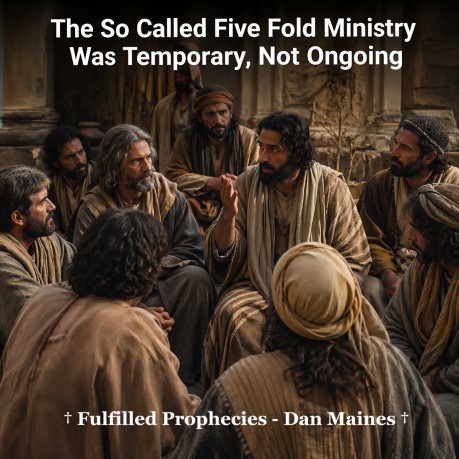
The So Called Five Fold
Ministry Was Temporary, Not Ongoing Introduction † The so called five fold ministry comes from
Ephesians 4:11, but it must be read in context and in time, not
pulled out and stretched into our day (Ephesians 4:11) † The passage itself tells you there was a
purpose and a stopping point, and that stopping point is key to
understanding it correctly (Ephesians 4:11-13) † If you ignore the timing and the purpose,
you'll end up rebuilding something that was never meant to continue
(Ephesians 4:13) Ephesians 4:11-13 11 And He gave some as apostles, some as prophets, some as
evangelists, some as pastors and teachers, 12 for the equipping of
the saints for the work of ministry, for the building up of the body
of Christ; 13 until we all attain to the unity of the faith, and of
the knowledge of the Son of God, to a mature man, to the measure of
the stature which belongs to the fullness of Christ. † The word until sets a clear time limit on
these roles, they were never meant to last forever (Ephesians
4:11-13) † These roles were given to build up the body
during a period when things were still being revealed and established
(Ephesians 4:12; 1 Corinthians 13:9) † Once the body reached maturity and fullness,
those temporary roles were no longer needed (Ephesians 4:13;
Colossians 1:25-26) † You don't continue scaffolding after the
building is finished, the structure stands complete (Ephesians 4:13;
Ephesians 2:20) Ephesians 2:20 20 having been built on the foundation of the apostles and
prophets, Christ Jesus Himself being the cornerstone, † Apostles and prophets are clearly identified
as the foundation, not the ongoing structure (Ephesians 2:20) † You don't keep laying a foundation over and
over, once it's set, the building stands on it (Ephesians 2:20; 1
Corinthians 3:10-11) † This proves those roles were never intended
to continue beyond the foundational stage (Ephesians 2:20; Hebrews
2:3-4) Acts 1:21-22 21 Therefore it is necessary that of the men who have accompanied
us all the time that the Lord Jesus went in and out among us 22
beginning with the baptism of John until the day that He was taken up
from us one of these must become a witness with us of His
resurrection. † Apostles had to be eyewitnesses of the risen
Christ, that requirement can't be met today (Acts 1:21-22) † This alone shuts the door on modern claims of
apostleship in the biblical sense (Acts 1:21-22; 1 Corinthians 9:1) † What people call apostles today doesn't match
the biblical definition at all (Acts 1:21-22; 2 Corinthians 12:12) 1 Corinthians 13:8-10 8 Love
never fails; but if there are gifts of prophecy, they will be done
away with; if there are tongues, they will cease; if there is
knowledge, it will be done away with. 9 For
we know in part and prophesy in part; 10 but
when the perfect comes, the partial will be done away with.
† Prophecies, tongues, and partial knowledge
were temporary and were going to come to an end (1 Corinthians
13:8-10) † That partial state belonged to that first
century generation while revelation was still unfolding (1
Corinthians 13:9; Ephesians 3:3-5) † Once completion came and the Old Covenant
system ended, those partial roles were done away (1 Corinthians
13:10; Hebrews 8:13) Hebrews 2:3-4 3 how will we escape if we neglect so great a salvation? After it
was at the first spoken through the Lord, it was confirmed to us by
those who heard, 4 God also testifying with them, both by signs and
wonders and by various miracles and by gifts of the Holy Spirit
according to His own will. † God was bearing witness with them, confirming
the message through signs and wonders during that time (Hebrews
2:3-4) † The miracles and gifts were tied to those who
heard Him and carried that message, not to an ongoing system (Hebrews
2:3-4; 2 Corinthians 12:12) † This again shows a time bound function
connected to the establishment of the New Covenant message (Hebrews
2:3-4; Mark 16:20) Historical References † Irenaeus noted that the apostolic authority
was tied directly to those who had seen the Lord and received the
original commission (Acts 1:21-22) † Eusebius recorded that the apostles were
unique witnesses whose role was not repeated after their generation
(Ephesians 2:20) † Clement of Alexandria spoke of the apostles
as the foundation already laid, not something ongoing (1 Corinthians
3:10-11) † After the apostolic age, leadership shifted
to elders and bishops, not new apostles, confirming the foundation
was already laid (Philippians 1:1; Titus 1:5) How It Applies To Us Today † We are not waiting for new apostles or
prophets, we stand on what was already established (Ephesians 2:20) † Our role today is to teach, shepherd, and
preach what has already been revealed, not to add to it (Jude 1:3; 2
Timothy 4:2) † The body of Christ has already reached its
intended maturity in that completed covenant transition (Ephesians
4:13; Colossians 1:27-28) † We walk in the finished work, not in an
unfinished system that still needs new revelation (Hebrews 8:13; John
19:30) † Chasing modern apostles and prophets pulls
people away from the finished work and back into something that was
already completed (Colossians 2:10; Hebrews 1:1-2) † The danger today isn't lack of revelation,
it's ignoring the complete revelation we already have (Jude 1:3; 2
Timothy 3:16-17) Q and A Appendix Q Are there apostles today in any sense? Q What about modern prophets? Q Does the church still need the five fold
ministry? Q What remains today? Q What about Ephesians 4:11 being for today? Q Does the word until mean it stopped? Q What was the goal of those roles? Q Has that maturity already happened? Q Why were prophets needed in the first
century? Q What does foundation mean in Ephesians 2:20? Q Can someone be an apostle in a different sense
today? Q What about people who claim signs and miracles
today? Q Did the early church expect new apostles after
the first century? Q What is the danger of believing in modern
apostles and prophets? Q What should believers focus on today? Q Does God still work today without apostles and
prophets? Q What replaced the role of prophets? Q Why do so many still believe in the five fold
ministry today? † This is the fulfilled perspective we proclaim at
Fulfilled Prophecies † Source Index † Ephesians 4:11-13; Ephesians 2:20; Acts
1:21-22; Hebrews 2:3-4; Colossians 1:25-28; Hebrews 8:13; Jude 1:3; 2
Timothy 4:2; 2 Timothy 3:16-17; John 19:30; Colossians 2:10; Hebrews
1:1-2; Philippians 1:1; Titus 1:5; Mark 16:20
By Dan Maines
A
No, not in the biblical sense, because apostles had to be
eyewitnesses of the risen Christ, and that requirement can't be met
today (Acts 1:21-22; 1 Corinthians 9:1)
A
Prophets were part of the partial system that was done away when
completion came, so there are no prophets today delivering new
revelation (1 Corinthians 13:8-10; Hebrews 8:13)
A No, that system was for the
building phase until maturity, once the body was established, those
roles ended (Ephesians 4:11-13)
A
Teaching, shepherding, and preaching what has already been revealed,
not adding new revelation (Jude 1:3; 2 Timothy 4:2)
A
The passage itself says until maturity, once that was reached, the
roles fulfilled their purpose and were no longer needed (Ephesians
4:11-13)
A
Yes, until sets a limit, once the goal was reached, the roles ended
because their purpose was fulfilled (Ephesians 4:11-13)
A
The goal was unity of the faith and full knowledge of the Son of God,
reaching maturity in Christ (Ephesians 4:13; Colossians 1:27-28)
A
Yes, Paul said the mystery was revealed and Christ was fully made
known in that generation (Colossians 1:25-27; Ephesians 3:3-5)
A Because revelation was still partial
and being revealed, prophets delivered that message until completion
(1 Corinthians 13:9-10; Ephesians 3:5)
A
It means a once laid base, not something ongoing, the apostles and
prophets established it, and it was never meant to be repeated
(Ephesians 2:20; 1 Corinthians 3:10-11)
A Not in the biblical sense, because the
requirement was to witness the risen Christ and be directly appointed
(Acts 1:21-22; 1 Corinthians 9:1)
A Signs confirmed the original message
delivered by those who heard Him, not an ongoing system of new
revelation (Hebrews 2:3-4; Mark 16:20)
A No, historical records
show leadership continued through elders and bishops, not new
apostles (Philippians 1:1; Titus 1:5)
A It shifts authority
away from completed revelation and opens the door to adding new
teachings (Jude 1:3; Galatians 1:8)
A
Holding to and teaching the faith that was once for all delivered,
not looking for new revelation (Jude 1:3; 2 Timothy 4:2)
A Yes, God works through His
completed word and through believers, not through new revelation
offices (2 Timothy 3:16-17; Hebrews 1:1-2)
A
Nothing replaced them, their role ended once revelation was complete,
and now we have the full revealed message (1 Corinthians 13:10; Jude
1:3)
A Because the timing element is
ignored and the passage is applied outside its first century context
(Ephesians 4:11-13; Matthew 24:34)
© Fulfilled Prophecies - Dan
Maines.
†
Irenaeus, Against Heresies; Eusebius, Ecclesiastical History; Clement
of Alexandria, Stromata
Links