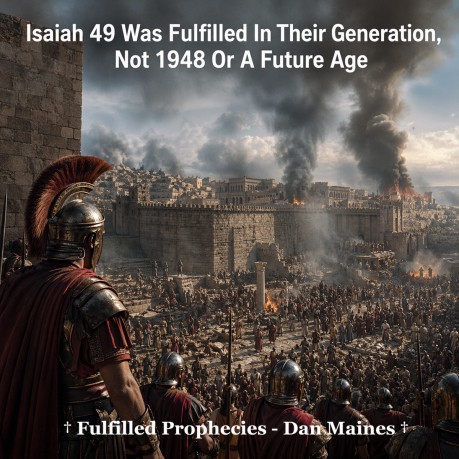
Isaiah 49 Was Fulfilled In
Their Generation, Not 1948 Or A Future Age Introduction † The claim being made today is that Isaiah 49
is still unfolding, tied to modern Israel, 1948, and ongoing wars,
but the text itself places its fulfillment in the first century
through Christ and the judgment that came upon Jerusalem (Luke 21:22,
32) † Isaiah 49 is about the Servant, Christ,
restoring Israel and bringing salvation to the nations, and that work
was completed in His ministry and in the judgment that ended the old
covenant system (Acts 13:47) † The idea that nations today must physically
bow and lick the dust misses the prophetic language used throughout
scripture, where such imagery describes covenant judgment and
submission, not literal modern geopolitics (Isaiah 2:11-17) † Scripture never points to a modern political
return to a physical land as the fulfillment, instead it points to
Christ as the fulfillment of all promises made to Israel (2
Corinthians 1:20) † The gathering of Israel is defined in the New
Testament as being gathered into Christ, not into a geographic nation
(John 11:51-52) Isaiah 49:6 † This was fulfilled in Christ bringing
salvation to the nations in the first century, not beginning in 1948
(Luke 2:30-32) † Paul directly applies this to his own
ministry to the Gentiles, showing it was already in fulfillment in
his day (Acts 13:47) † The end of the earth refers to the spread of
the gospel throughout the known world of that age, not a modern
timeline marker (Romans 10:18) † Simeon identified Jesus as the fulfillment of
this promise, showing it was already present in His first coming, not
delayed thousands of years (Luke 2:30-32) Isaiah 49:23 † This is prophetic imagery of submission, not
literal rulers crawling in the dirt in a modern nation-state (Psalm
72:9-11) † This language is used throughout the Old
Testament to describe defeated enemies being brought low under God's
judgment (Micah 7:16-17) † The fulfillment came when the old covenant
persecutors were judged and the kingdom of Christ was established,
causing the nations to submit to His authority through the gospel
(Philippians 2:10-11) † The phrase lick the dust connects back to the
curse language given to the serpent, showing humiliation and defeat,
not a literal future political submission (Genesis 3:14) Isaiah 49:25-26 † This is judgment language, the same kind used
in describing the fall of Jerusalem and the destruction of the old
covenant enemies (Luke 21:22) † Jesus said all things written would be
fulfilled in that generation, including these judgments (Luke 21:32) † The imagery matches covenant curse language
and what actually happened in the Roman siege, recorded historically
(Deuteronomy 28:53-57) † Jesus identified that generation as the one
where all covenant judgment would come to its fullness, including
what was written in the prophets (Matthew 23:36) † The destruction of Jerusalem marked the end
of the old covenant age, proving these promises and judgments were
completed in that time (Hebrews 8:13) Historical References † Josephus records the destruction of
Jerusalem, showing the complete collapse of the old covenant system
and the suffering that matched prophetic judgment language (Josephus,
Wars of the Jews, Book 5-6) † Josephus describes people driven to consume
their own flesh during the siege, directly reflecting the covenant
curse language found in the Law and the prophets (Josephus, Wars of
the Jews, Book 6) † Eusebius writes that the church understood
these events as the fulfillment of Christ's warnings and the prophets
(Eusebius, Ecclesiastical History, Book 3) † Tacitus confirms the devastation brought by
Rome, aligning with the judgment imagery of Isaiah and Jesus
(Tacitus, Histories 5.13) How It Applies To Us Today † We're not waiting for Isaiah 49 to be
fulfilled, it's already done in Christ and the judgment of that
generation (Luke 21:32) † The kingdom is not tied to a physical land or
modern nation, it's a spiritual kingdom established through Christ
(John 18:36) † The submission of the nations is through the
gospel, not through political dominance or modern warfare (Colossians
1:13) † We don't look to 1948 or modern conflicts to
validate scripture, we look to Christ's finished work and the
fulfilled promises (2 Corinthians 1:20) † If we push these prophecies into our future,
we deny that Christ finished what He was sent to accomplish in His
generation (John 19:30) † Understanding fulfillment keeps us grounded
in what Christ has already done, instead of looking for signs in
modern political events (Luke 17:20-21) Q & A Appendix Q Is Isaiah 49 about modern Israel returning to
the land? Q What does it mean that kings lick the dust? Q Didn't the nations begin a new era after AD
70? Q Is there any connection to 1948? Q Why do people connect Isaiah 49 to modern
Israel? Q Does all flesh shall know mean a future global
event? Q Is Isaiah 49 about modern Israel returning to
the land? Q What does it mean that kings lick the dust? Q Didn't the nations begin a new era after AD
70? Q Is there any connection to 1948? Q Why do people connect Isaiah 49 to modern
Israel? Q Does all flesh shall know mean a future global
event? Q If Isaiah 49 is fulfilled, why do nations still
oppose God's people today? Q Who are the oppressors in Isaiah 49? Q What does it mean that captives are set free? Q Does all flesh shall know mean every single
person on earth? Q If the promises were fulfilled, what are we
living in now? Q Did the apostles believe Isaiah 49 was
future? Q Why is modern Israel not the fulfillment? Q What is the restoration of Israel in Isaiah
49? Q Why does the prophecy use such violent
imagery? Q Does this mean there are no future prophecies
left? † This is the fulfilled perspective we proclaim at
Fulfilled Prophecies † Source Index † Isaiah 49:6, 23, 25-26; Luke 2:30-32; Acts
13:47; Romans 10:18; Psalm 72:9-11; Micah 7:16-17; Philippians
2:10-11; Luke 21:22, 32; Deuteronomy 28:53-57; Matthew 23:36; Hebrews
8:13; John 18:36; Colossians 1:13; 2 Corinthians 1:20; John 11:51-52;
John 19:30; Luke 17:20-21; Isaiah 52:10; Genesis 3:14 † Josephus, Wars of the Jews, Book 5-6;
Eusebius, Ecclesiastical History, Book 3; Tacitus, Histories 5.13
By Dan Maines
He says, "It is too small a
thing that You should be My Servant To raise up the tribes of Jacob
and to restore the protected ones of Israel; I will also make You a
light of the nations So that My salvation may reach to the end of the
earth."
"Kings will be your
guardians, And their princesses your nurses. They will bow down to
you with their faces to the ground And lick the dust from your feet;
And you will know that I am the Lord; Those who hopefully wait for Me
will not be put to shame.
Indeed, this is what the
Lord says: "Even the captives of the mighty man will be taken
away, And the prey of a tyrant will be rescued; For I will contend
with the one who contends with you, And I will save your sons. "I
will feed your oppressors with their own flesh, And they will become
drunk with their own blood as with sweet wine; And humanity will know
that I, the Lord, am your Savior And your Redeemer, the Mighty One of
Jacob."
A No, it's about Christ restoring
Israel and bringing salvation to the nations, fulfilled in the first
century (Acts 13:47)
A
It's prophetic language showing total defeat and submission, not a
literal future event (Micah 7:16-17)
A Yes, but that was the result of Christ's
completed work, not an ongoing fulfillment still waiting to happen
(Luke 21:22)
A
No, scripture never points to that event, all prophecy was fulfilled
in that generation as Jesus said (Luke 21:32)
A Because they ignore the New Testament
interpretation and replace it with modern events, but the apostles
already showed it was fulfilled in Christ and their generation (Acts
13:47)
A No, it refers to the public
manifestation of God's judgment and salvation in that time, just like
other Old Testament judgments that were seen and known among the
nations (Isaiah 52:10)
A No, it's about Christ restoring
Israel and bringing salvation to the nations, fulfilled in the first
century (Acts 13:47)
A
It's prophetic language showing total defeat and submission, not a
literal future event (Micah 7:16-17)
A Yes, but that was the result of Christ's
completed work, not an ongoing fulfillment still waiting to happen
(Luke 21:22)
A
No, scripture never points to that event, all prophecy was fulfilled
in that generation as Jesus said (Luke 21:32)
A Because they ignore the New Testament
interpretation and replace it with modern events, but the apostles
already showed it was fulfilled in Christ and their generation (Acts
13:47)
A No, it refers to the public
manifestation of God's judgment and salvation in that time, just like
other Old Testament judgments that were seen and known among the
nations (Isaiah 52:10)
A Because opposition
has always existed, but prophecy was about covenant fulfillment, not
eliminating all conflict in history (John 15:18-20)
A
They were the enemies of God's covenant people in that age,
especially those who rejected Christ and persecuted His followers
(Matthew 23:29-36)
A
It refers to deliverance from sin and the old covenant bondage
through Christ, not a political or military rescue (Luke 4:18)
A No, it means a widespread
recognition of God's judgment and salvation in that time, just like
other prophetic judgments (Isaiah 40:5)
A We are living in the
established kingdom of Christ, where all promises have been fulfilled
in Him (Colossians 1:13)
A No, they applied it directly to their
own ministry and time, showing they understood it as being fulfilled
(Acts 13:47)
A
Because the New Testament never redirects these promises to a future
nation, it consistently points to Christ and His body as the
fulfillment (Ephesians 2:14-16)
A It is the restoration of God's people
through Christ, bringing both Jew and Gentile into one body (John
11:51-52)
A Because it is covenant judgment
language, the same kind used throughout the Law and the prophets to
describe God's judgment on a rebellious people (Deuteronomy 28:53-57)
A All things written concerning that age
were fulfilled as Jesus said, leaving us living in the completed
kingdom (Luke 21:32)
© Fulfilled Prophecies - Dan
Maines.
Links