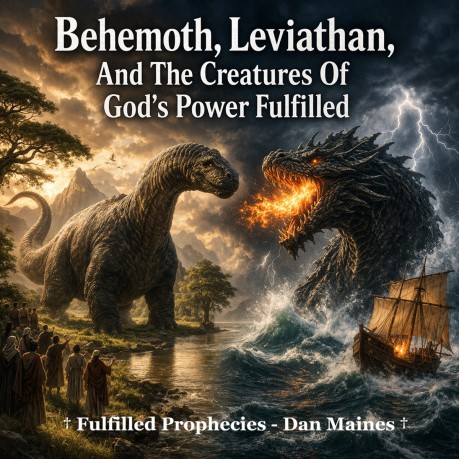
Behemoth,
Leviathan, And The Creatures Of God's Power Fulfilled Introduction † The Bible
doesn't use the word dinosaur, but it clearly describes massive,
powerful creatures that lived alongside man. Job
40:15-17 † This
creature is said to be made along with man, not millions of years
before, showing they coexisted (Job 40:15). Job
40:8-14
"Adorn yourself with pride and dignity, † God surrounds the
description of Behemoth with a challenge to Job, showing the creature
is part of His argument about power (Job 40:8-14). Job 41:1, 18-21
His sneezes flash forth light, † Leviathan is
described as untamable and beyond human control, showing God's
superiority over creation (Job 41:1). Job
41:10 † God directly
connects Leviathan to His own authority, if no man can stand before
the creature, how can anyone stand before God (Job 41:10). Psalm
74:13-14 † Leviathan is
again presented as a real creature, not just symbolism (Psalm
74:14). Psalm
104:25-26 † Leviathan is
described as part of the natural order, created by God and active in
the sea (Psalm 104:26). Psalm
148:7 Isaiah 27:1 † This shows
Leviathan continued to be known and referenced throughout scripture
(Isaiah 27:1). Genesis
1:21 † The Bible
clearly states that great sea creatures were created by God from the
beginning (Genesis 1:21). Genesis
1:24-25 † Large land
creatures were created directly by God as part of the same creation
account (Genesis 1:24-25). Psalm
91:13 † Scripture
continues to reference powerful and dangerous creatures, including
serpents, as real entities (Psalm 91:13). Historical References † Josephus
describes large, unusual creatures and confirms that ancient people
were aware of animals no longer present today. How It Applies To Us
Today † God is still
the Creator of all things, including creatures we no longer see, and
that should humble us. Q & A Appendix Q
Are dinosaurs mentioned in the Bible? Q
Did humans live with these creatures? Q
Why don't we see these creatures today? Q
Are these creatures symbolic or real? Q
Why would God create such massive and powerful creatures? Q
Are Behemoth and Leviathan just symbolic creatures? Q
Why does the Bible mention creatures we don't see today? Q
What is the main point God is making with these creatures in Job? Q
When was the word dinosaur created? † This is the fulfilled
perspective we proclaim at Fulfilled Prophecies † Source Index † Job
40:15-17; Job 40:8-14; Job 41:1, 18-21; Job 41:10; Psalm 74:13-14;
Psalm 104:25-26; Psalm 148:7; Isaiah 27:1; Genesis 1:21; Genesis
1:24-25; Psalm 91:13 † Josephus,
Antiquities of the Jews; Pliny the Elder, Natural History; Augustine
of Hippo
By Dan Maines
†
These creatures are not myths, they are presented as real creations
of God.
†
When we read these passages plainly, we see that God created
creatures far beyond what we see today, and He used them to display
His power and authority.
"Behold,
Behemoth, which I made as well as you;
He eats grass like an
ox.
Behold, his strength in his waist,
And his power in the
muscles of his belly.
He hangs his tail like a cedar;
The
tendons of his thighs are knit together.
†
The description of a tail like a cedar doesn't match any modern
animal like a hippo or elephant (Job 40:17).
†
God points to Behemoth as a real, visible example of His creative
power, not a symbol or metaphor (Job 40:15-17).
Will
you really nullify My judgment?
Will you condemn Me so that you
may be justified?
Or do you have an arm like God,
And can
you thunder with a voice like His?
And clothe yourself
with honor and majesty.
Let out your outbursts of anger,
And
look at everyone who is arrogant, and humble him.
Look at
everyone who is arrogant, and humble him,
And trample down the
wicked where they stand.
Hide them together in the
dust;
Imprison them in the hidden place.
Then I will also
confess to you,
That your own right hand can save you.
†
If Job can't even deal with what God created, he can't question the
Creator Himself (Job 40:8-14).
† This
confirms Behemoth is not symbolic, it's part of a real demonstration
of God's authority (Job 40:8-14).
"Can
you drag out Leviathan with a fishhook,
And press down his
tongue with a rope?
And his eyes are like the eye of
dawn.
From his mouth go burning torches;
Sparks of fire
leap forth.
From his nostrils smoke goes out
As from a
boiling pot and burning reeds.
His breath sets coals aglow,
And
a flame goes forth from his mouth.
†
The fire and smoke imagery goes far beyond any known animal today,
pointing to a creature no longer present (Job 41:18-21).
†
God uses Leviathan to humble Job, showing that if man can't control
this creature, he certainly can't challenge God (Job 41).
No one is
so reckless that he dares to stir him;
Who then is he who
opposes Me?
†
This reinforces that Leviathan is part of God's argument about His
unmatched power (Job 41:10).
†
The point is clear, man is not in control, God is (Job 41:10).
You
divided the sea by Your strength;
You broke the heads of the sea
monsters in the waters.
You crushed the heads of Leviathan;
You
gave him as food for the creatures of the wilderness.
†
Multiple heads are mentioned, showing the magnitude and terrifying
nature of this creature (Psalm 74:14).
†
God is shown as the one who destroys even the most powerful
creatures, proving His absolute authority (Psalm 74:13-14).
There
is the sea, great and broad,
In which are swarms without
number,
Animals both small and great.
The ships move along
there,
And Leviathan, which You have formed to have fun in it.
†
This shows these creatures were not rare myths, but part of the
created world people could observe (Psalm 104:25-26).
†
God even describes it as playing, showing His control and purpose
over even the largest creatures (Psalm 104:26).
Praise
the Lord
from the earth,
Sea monsters, and all the ocean depths;
Sea
creatures, including great monsters, are called to praise God,
showing they are part of His creation (Psalm 148:7).
†
This confirms these creatures were known and acknowledged, not
imaginary (Psalm 148:7).
†
Even the greatest creatures exist for God's glory (Psalm 148:7).
On
that day the Lord
will punish Leviathan the fleeing serpent,
With His fierce and
great and mighty sword,
Even Leviathan the twisted serpent;
And
He will kill the dragon who lives in the sea.
†
The language connects with earlier descriptions, reinforcing that
this is the same type of creature (Isaiah 27:1).
†
God alone is the one who ultimately destroys even the greatest of
creatures (Isaiah 27:1).
And God
created the great sea creatures and every living creature that moves,
with which the waters swarmed, according to their kind, and every
winged bird according to its kind; and God saw that it was good.
†
These are not later developments, they were part of the original
creation (Genesis 1:21).
†
What we call dinosaurs today would fall into these categories of land
and sea creatures created on Day 5 and Day 6 (Genesis 1:21, 24-25).
Then
God said, "Let the earth produce living creatures according to
their kind: livestock and crawling things and animals of the earth
according to their kind"; and it was so. God made the animals of
the earth according to their kind, and the livestock according to
their kind, and everything that crawls on the ground according to its
kind; and God saw that it was good.
†
This supports the existence of massive land animals like Behemoth
(Genesis 1:24-25).
†
These creatures were created in the same timeframe as man, not
separated by ages (Genesis 1:24-25).
You will
walk upon the lion and cobra,
You will trample the young lion
and the serpent.
†
This shows a consistent theme of man encountering powerful creatures
in the world God created (Psalm 91:13).
†
These references reinforce the reality of creatures beyond what we
commonly see today (Psalm 91:13).
†
Pliny the Elder wrote about massive reptiles and sea creatures in his
Natural History, showing these ideas weren't foreign to the ancient
world.
†
Augustine of Hippo acknowledged that creation included creatures no
longer seen in their time.
†
We shouldn't reinterpret scripture to fit modern assumptions, we
should let the text speak plainly.
†
These passages remind us that God's power is beyond our
understanding, and His creation is greater than what we see today.
†
Just like Job, we're called to trust God, not question Him based on
our limited view of the world.
A
The word dinosaur is not used, but large creatures like Behemoth and
Leviathan are clearly described in Job 40-41, Psalm 74:13-14, Psalm
148:7, and Genesis 1:21-25.
A
Yes, Job 40:15 says Behemoth was made along with man, showing they
coexisted.
A
Scripture doesn't give a full explanation, but it shows that God
created many kinds of creatures, some of which are no longer present,
Genesis 1:21-25.
A
The detailed descriptions and physical characteristics show they are
real creatures, not just symbols, especially in Job 40-41.
A
God created all things for His purpose and glory, Genesis 1:21,
24-25. In Job 40-41, God points to Behemoth and Leviathan to show His
power over creation and to humble man, Job 40:8-14; Job 41:10. These
creatures show that God alone has authority over all things.
A
No, they're described with detailed physical characteristics,
behavior, and strength, Job 40:15-24; Job 41:1-34. God presents them
as real examples that Job could understand and observe, not as
abstract symbols.
A
Scripture shows that God created many kinds of creatures, Genesis
1:21, 24-25. Some aren't present today, but their mention shows the
fullness of God's creation and His authority over all of it, Psalm
104:25-26.
A
God is showing that if man can't control or stand before these
creatures, then he can't question or challenge God, Job 40:8-14; Job
41:10. The focus isn't the creatures themselves, but God's unmatched
power.
A
The word dinosaur was created in 1842 by Richard Owen. The Bible was
written long before that, so it uses terms like beasts, serpents, and
sea-monsters instead of the modern word dinosaur.
©
Fulfilled Prophecies - Dan Maines.
Links