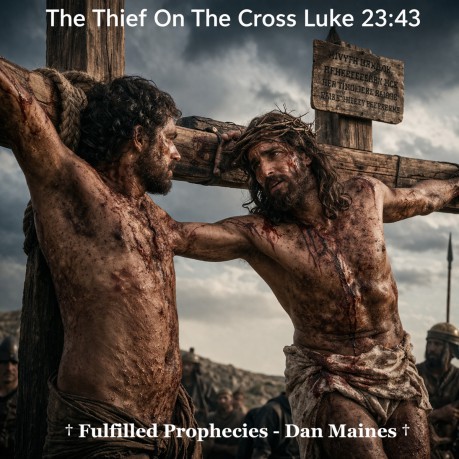
The Thief On The Cross Luke
23:43 Introduction † The words spoken by Jesus on the cross aren't
random, they're precise, and they must be understood in harmony with
all of Scripture, not isolated from it. † The question that often comes up is how Luke
23:43 fits with John 20:17 and 1 Peter 3:18-19, and whether the
punctuation needs to be changed. † The answer is simple when we let Scripture
define its own terms instead of forcing assumptions onto the text. † We're not dealing with contradictions, we're
dealing with misunderstood definitions of places and timing. Luke 23:43 † Jesus made a direct promise, and He said
today, not later, not after ascension, but that very day. † The key is understanding what He meant by
Paradise, not changing what He said. † Paradise here isn't the throne of the Father
in heaven, it's the realm of the dead where the righteous were kept. † This is the same realm described elsewhere,
not the final dwelling after all things were fulfilled. † If we keep the definition consistent, there
isn't any conflict. John 20:17 † After His resurrection, Jesus clearly states
He had not yet ascended to the Father. † That means whatever happened in Luke 23:43
wasn't the ascension. † This alone proves Paradise isn't the same as
the Father's presence in this context. † The timing is clear, death, then time in the
realm of the dead, then resurrection, then ascension. † Scripture isn't contradicting itself, it's
laying out a sequence. 1 Peter 3:18-19 † After His death, Christ went somewhere, and
that place is described as where spirits were in prison. † This aligns perfectly with the understanding
of the realm of the dead. † He wasn't inactive, He was proclaiming,
fulfilling what was written. † This shows movement after death but before
ascension. † Again, this confirms that Paradise is part of
that realm, not the final heavenly throne. Luke 16:22 † Jesus already described this realm during His
ministry. † Abraham's arms represents comfort for the
righteous dead. † This isn't heaven where the Father is, it's a
distinct place. † The thief would've gone to this same place. † That's where Jesus and the thief were
together that day. † Jesus Himself uses the language of the realm
of the dead elsewhere, confirming this wasn't a new concept but
something already understood in Israel. † This shows that when He spoke to the thief,
He was using language that already had meaning, not introducing
something new on the cross. Bringing It Together † Jesus died and entered the realm of the dead. † The thief died and entered that same realm. † They were together that very day, exactly as
Jesus said. † There is no gap in the timeline, death
happened, then both entered the same realm that very day, exactly as
stated. † The resurrection did not happen that day, and
the ascension did not happen that day, so Paradise cannot mean the
Father's throne. † Jesus had not yet ascended to the Father when
He spoke to Mary. † There isn't any need to move commas or change
the text. † If the comma needed to be moved, then the
statement would lose its immediate fulfillment, but Jesus emphasized
today, and He meant it. † The issue has never been punctuation, it's
always been definition. † When we let Scripture define Paradise,
everything lines up perfectly. Historical References † Irenaeus wrote that the Lord descended into
the regions beneath the earth, preaching His advent there, confirming
the understanding of an intermediate realm. † Tertullian taught that souls are kept in
Hades until the resurrection, distinguishing it from heaven. † Hippolytus of Rome described the righteous
being in a place of light within Hades, separated from the wicked. † These early writers weren't confused about
this, they understood the distinction clearly. How It Applies To Us Today † We don't need to alter Scripture to make it
fit our theology, we need to align our understanding with Scripture. † When something seems like a contradiction,
it's usually because definitions have been mixed. † Jesus kept His promise exactly as He said it,
that should strengthen our confidence in every word He spoke. † This also shows that God's plan was unfolding
in stages, not all at once, and each step had purpose. † We're not left guessing, Scripture gives us a
complete and consistent picture when we read it together. Q & A Appendix Q Does Luke 23:43 require changing the comma to
make sense? Q Where did Jesus go after He died? Q Was Paradise the same as heaven where the
Father is? Q Where was the thief that day? Q Did Jesus fulfill His promise to the thief
immediately? Q Why do people think Paradise means heaven? Q Does this teaching remove any tension between
these verses? † This is the fulfilled perspective we proclaim at
Fulfilled Prophecies † Source Index † Luke 23:43; John 20:17; 1 Peter 3:18-19; Luke
16:22
By Dan Maines
And He said to him, Truly I say
to you, today you will be with Me in Paradise.
Jesus said to her, Stop clinging
to Me, for I have not yet ascended to the Father; but go to My
brothers and say to them, I ascend to My Father and your Father, and
My God and your God.
For Christ also suffered for
sins once for all time, the righteous for the unrighteous, so that He
might bring you to God, having been put to death in the flesh, but
made alive in the spirit; in which He also went and made proclamation
to the spirits in prison,
Now the poor man died and was
carried away by the angels to Abraham's arms; and the rich man also
died and was buried.
A No, it does not. When Paradise is
understood as the realm of the dead, the verse stands exactly as
written and fits perfectly with John 20:17 and 1 Peter 3:18-19.
A
He went to the realm of the dead, where He made proclamation to the
spirits in prison, as shown in 1 Peter 3:18-19.
A No, Jesus said in John 20:17 that
He had not yet ascended to the Father, proving they are not the same
in this context.
A
He was with Jesus in Paradise, the place of the righteous dead, as
described in Luke 23:43 and Luke 16:22.
A Yes, He did. Jesus said today,
and both entered the same realm of the dead that very day, fulfilling
His words exactly.
A
Because terms get blended together, but Scripture separates them
clearly, Paradise is shown as the place of the righteous dead, while
the Father's presence is associated with ascension, which had not yet
happened in John 20:17.
A Yes, it removes all tension.
Once Paradise is understood correctly, Luke 23:43, John 20:17, and 1
Peter 3:18-19 all align perfectly without any need to change
punctuation.
© Fulfilled Prophecies - Dan
Maines.
† Irenaeus, Against Heresies Book 5;
Tertullian, On the Soul; Hippolytus, Against Plato
Links