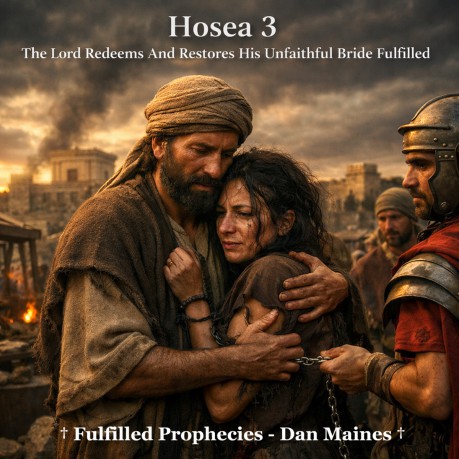
Hosea 3 The Lord Redeems And
Restores His Unfaithful Bride Fulfilled Introduction † Hosea 3 is a powerful picture of redemption,
not just judgment. God commands Hosea to love again the same
unfaithful woman, showing that His covenant love doesn't stop even
when His people are unfaithful. This chapter points directly to
Christ and the restoration of Israel in that generation. † From the fulfilled perspective, this isn't
about some distant future. It's about what God was doing leading up
to the first century and what was completed in Christ and the
destruction of Jerusalem. † Hosea becomes a living prophecy. What he does
physically, God is doing covenantally with Israel. Hosea 3:1 Then the Lord said to me, Go again, love a woman who is loved by
her husband, yet an adulteress, just as the Lord loves the sons of
Israel, though they turn to other gods and love raisin cakes. † God tells Hosea to love again, showing that
His love isn't based on Israel's faithfulness but His own covenant
promise (Deuteronomy 7:7-8). † The adulterous woman represents Israel, who
turned to idols yet was still loved by God (Jeremiah 3:1). † This is fulfilled in Christ, who came to
redeem a people who had already broken the covenant (Romans 5:8). † The mention of loving raisin cakes points to
idolatrous worship practices, showing how deeply Israel had turned
away (Isaiah 57:6). Hosea 3:2 So I purchased her for myself for fifteen shekels of silver and a
homer and a half of barley. † Hosea redeems her with a price, showing that
restoration requires payment (Leviticus 25:25). † This directly points to Christ, who purchased
His people with His own blood (1 Peter 1:18-19). † The low price reflects her degraded
condition, just as Israel had fallen spiritually before redemption. † This isn't about future redemption, it's
about what Christ accomplished in that generation. Hosea 3:3 Then I said to her, You shall stay with me for many days. You
shall not play the prostitute, nor shall you have a man, so I will
also be toward you. † This period of waiting represents Israel's
condition between covenant judgment and restoration. † It points to the time leading up to AD 70,
where Israel was restrained and under covenant transition (Luke
21:20-22). † God wasn't abandoning them, He was preparing
them for restoration through Christ. † This shows discipline, not rejection,
consistent with covenant correction (Hebrews 12:6). Hosea 3:4 For the sons of Israel will remain for many days without king or
prince, without sacrifice or memorial stone, and without ephod or
household idols. † This describes Israel's condition during the
transition period before the end of the Old Covenant system. † They would be without temple function,
sacrifices, and leadership, which was fulfilled in the events leading
to AD 70. † Jesus spoke of this desolation coming upon
that generation (Matthew 24:1-2). † The removal of sacrifice shows the end of the
Old Covenant system, not a pause waiting for a future temple. Hosea 3:5 Afterward the sons of Israel will return and seek the Lord their
God and David their king, and they will come trembling to the Lord
and to His goodness in the last days. † This return is fulfilled in Christ, the true
David (Luke 1:32-33). † The last days refer to the last days of the
Old Covenant age, not the end of the world (Hebrews 1:1-2). † Israel returning means turning to Christ, not
rebuilding a physical kingdom (Acts 2:36-38). † This was fulfilled before AD 70 when the
remnant came to Christ and entered the new covenant. Historical References † Josephus describes the collapse of Jerusalem,
the loss of temple worship, and the complete breakdown of leadership,
matching Hosea 3:4 perfectly. † Eusebius records that believers fled
Jerusalem before its destruction, showing the transition from old
covenant Israel to the new covenant people. † Tacitus confirms the devastation of the
Jewish system, showing that sacrifice and priesthood ended exactly as
Hosea said. How It Applies To Us Today † This shows us that God's love is faithful
even when people aren't, but it also shows that judgment is real and
was fulfilled. † We aren't waiting for Hosea 3 to happen, it's
already fulfilled in Christ and the end of the Old Covenant system. † We live in the restored relationship, not in
the waiting period. † Christ has already redeemed His bride, and we
stand in that completed work. † There's no future restoration of national
Israel needed, the true restoration is already complete in Christ. Q & A Appendix Q Was Hosea 3 about a future restoration of
Israel? Q Who is David their king in Hosea 3:5? Q What does the period without sacrifice mean? Q What are the last days? Q Did God abandon Israel? † This is the fulfilled perspective we proclaim at
Fulfilled Prophecies † Source Index † Hosea 3
By Dan Maines
A No, it was fulfilled in Christ and
the events leading up to AD 70. Acts 2:36-38 shows Israel returning
to God through Christ.
A
It's Christ. Luke 1:32-33 shows Jesus as the fulfillment of David's
throne.
A
It refers to the end of the temple system, fulfilled in AD 70.
Matthew 24:1-2.
A
The last days of the Old Covenant age. Hebrews 1:1-2.
A
No, He disciplined and redeemed a remnant through Christ. Romans
11:5.
© Fulfilled Prophecies - Dan
Maines.
† Josephus,
Wars of the Jews, Book 6
† Eusebius,
Ecclesiastical History, Book 3
† Tacitus,
Histories 5.13
Links