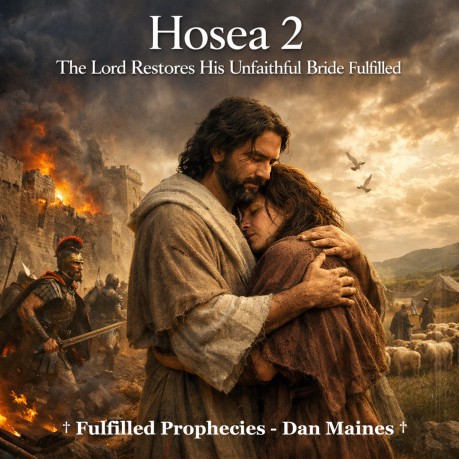
Hosea 2 The Lord Restores His
Unfaithful Bride Fulfilled Introduction † Hosea 2 shows the full picture of covenant
unfaithfulness and restoration, not just judgment, but the turning
point where God removes the old covenant relationship and establishes
a restored one. † This chapter isn't about a distant future,
it's about Israel's condition leading up to the first century and the
fulfillment of both judgment and restoration in Christ. † The language of marriage, divorce,
wilderness, and remarriage all point to covenant transition, not
individual salvation stories, but national covenant identity being
judged and renewed. Hosea 2:1-5 † This is covenant divorce language, God is
declaring that Israel is no longer His wife because of her
unfaithfulness (Jeremiah 3:8). † The stripping naked and wilderness language
points back to Egypt and exile, showing a return to covenant judgment
conditions (Ezekiel 16:37-39). † The lovers represent false gods and foreign
alliances, Israel trusted nations and idols instead of the Lord
(Isaiah 30:1-3). Hosea 2:6-13 † God removes the blessings Israel thought came
from idols, showing He was always the source (James 1:17). † The stopping of feasts and Sabbaths points
directly to the end of the old covenant system (Colossians 2:16-17). † This was fulfilled in the destruction of
Jerusalem in AD 70, where temple worship completely ceased. Hosea 2:14-17 † The wilderness here isn't punishment, it's
restoration, just like the Exodus, a new beginning (Exodus 19:4-6). † The valley of Achor, once a place of
judgment, becomes a door of hope, showing reversal and redemption
(Joshua 7:24-26). † Calling Him Ishi instead of Baali shows a new
relationship, not legal bondage, but intimate covenant union
fulfilled in Christ (Romans 7:4). Hosea 2:18-23 † This is the new covenant marriage, not a
return to Sinai, but a better covenant established in Christ (Hebrews
8:6-13). † Paul directly applies this passage to the
inclusion of the Gentiles and the new covenant people (Romans
9:25-26). † The betrothal forever shows permanence,
unlike the broken old covenant, this one cannot fail. Historical References † Josephus records the destruction of
Jerusalem, showing the complete removal of temple worship and
covenant system, Wars of the Jews Book 6. † Eusebius writes that believers fled Jerusalem
before its destruction, showing the separation of the faithful
remnant from the judged nation. † Tacitus confirms the devastation of Judea and
the collapse of its religious structure. How It Applies To Us Today † We aren't under a broken covenant system,
we're part of the fulfilled marriage, united to Christ in a permanent
relationship. † We don't look for a future restoration of
Israel's old system, that system was judged and removed exactly as
Hosea said. † We live in the reality of being His people,
those who were not a people are now His people. † Our identity isn't tied to law, temple, or
rituals, it's tied to Christ and the finished covenant. † The warning still stands, unfaithfulness
leads to judgment, but the promise stands stronger, restoration has
already been fulfilled. Q And A Appendix Q Was Hosea 2 about a future restoration of
national Israel Q What does the marriage language represent Q What does the wilderness mean Q Why were the feasts and Sabbaths removed Q Who are the people that were not a people † This is the fulfilled perspective we proclaim at
Fulfilled Prophecies † Source Index † Hosea 2
By Dan Maines
Say to your brothers, Ammi, and
to your sisters, Ruhamah.
Contend with your mother, contend, for
she is not My wife, and I am not her husband; and let her put away
her prostitution from her face and her adultery from between her
breasts,
or I will strip her naked and expose her as on the day
when she was born. I will also make her like a wilderness, make her
like desert land, and put her to death with thirst.
Also, I will
have no compassion on her children, because they are children of
prostitution.
For their mother has prostituted herself; she who
conceived them has acted shamefully. For she said, I will go after my
lovers, who give me my bread and my water, my wool and my flax, my
oil and my drink.
Therefore, behold, I will block
her way with thorns, and I will build a wall against her so that she
cannot find her paths.
She will pursue her lovers, but she will
not overtake them; and she will seek them, but will not find them.
Then she will say, I will go back to my first husband, for it was
better for me then than now.
For she does not know that it was I
who gave her the grain, the new wine, and the oil, and lavished on
her silver and gold, which they used for Baal.
Therefore, I will
take back My grain at harvest time and My new wine in its season. I
will also take away My wool and My flax given to cover her
nakedness.
And then I will uncover her lewdness in the sight of
her lovers, and no one will rescue her from My hand.
I will also
put an end to all her joy, her feasts, her new moons, her Sabbaths,
and all her festive assemblies.
I will destroy her vines and fig
trees, of which she said, These are my wages which my lovers have
given me. And I will make them a forest, and the animals of the field
will devour them.
I will punish her for the days of the Baals
when she used to offer sacrifices to them and adorn herself with her
earrings and jewelry, and follow her lovers, so that she forgot Me,
declares the Lord.
Therefore, behold, I will
allure her, bring her into the wilderness, and speak kindly to
her.
Then I will give her her vineyards from there, and the
Valley of Achor as a door of hope. And she will respond there as in
the days of her youth, as in the day when she came up from the land
of Egypt.
And it will come about on that day, declares the Lord,
that you will call Me Ishi and will no longer call Me Baali.
For
I will remove the names of the Baals from her mouth, so that they
will no longer be mentioned by their names.
On that day I will also make a
covenant for them with the animals of the field, the birds of the
sky, and the crawling things of the ground. And I will eliminate the
bow, the sword, and war from the land, and will let them lie down in
safety.
I will betroth you to Me forever; yes, I will betroth
you to Me in righteousness and in justice, in favor and in
compassion,
and I will betroth you to Me in faithfulness. Then
you will know the Lord.
And it will come about on that day that
I will respond, declares the Lord. I will respond to the heavens, and
they will respond to the earth,
and the earth will respond to
the grain, the new wine, and the oil, and they will respond to
Jezreel.
I will sow her for Myself in the land. I will also have
compassion on her who had not obtained compassion, and I will say to
those who were not My people, You are My people! And they will say,
You are my God!
A No, it was fulfilled in the
transition from the old covenant to the new covenant in Christ,
Romans 9:25-26
A
It represents covenant relationship between God and Israel, and later
fulfilled in Christ and His people, Ephesians 5:25-27
A
It represents a place of renewal and covenant transition, just like
the Exodus, not just punishment, Exodus 19:4-6
A
Because they were part of the old covenant system that was fulfilled
and ended, Colossians 2:16-17
A
They are the Gentiles brought into the covenant through Christ,
Romans 9:25-26
© Fulfilled Prophecies - Dan
Maines.
† Josephus,
Wars of the Jews Book 6; Eusebius, Ecclesiastical History; Tacitus,
Histories
Links