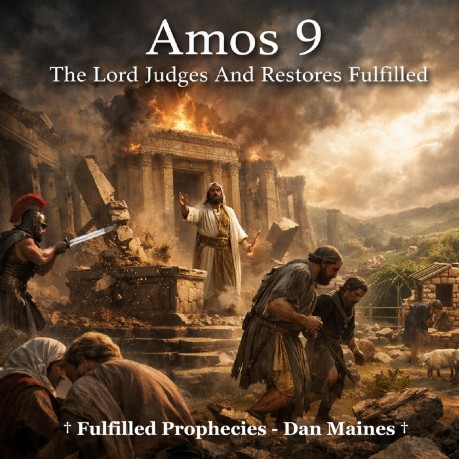
Amos 9 The Lord Judges And
Restores Fulfilled Introduction † Amos closes with both judgment and
restoration, and we have to read it through the fulfilled
perspective, not pushing it into our future. Amos 9:1 † This is God standing at the altar, meaning
judgment begins at the house of God, not the nations. (1 Peter
4:17) Amos 9:2 † This is covenant language, not literal
geography, showing there's no hiding from God's judgment. (Jeremiah
23:24) Amos 9:3 † Mount Carmel and the sea represent supposed
places of safety, but none existed. Amos 9:4 † Even captivity wouldn't spare them, judgment
followed them. Amos 9:5-6 † This is prophetic language describing
upheaval, not literal melting of the planet. Amos 9:7 † Israel is being humbled, they're no different
than other nations in terms of judgment. Amos 9:8 † The sinful kingdom is Israel under
judgment. Amos 9:9 † This is separation, not annihilation. Amos 9:10 † These are the ones who denied judgment was
coming. Amos 9:11 † This is key, and the New Testament tells us
exactly when this was fulfilled. Amos 9:12 † This is about the inclusion of the
Gentiles. Amos 9:13 † This is covenant blessing language,
describing abundance in the new covenant. Amos 9:14 † This restoration is fulfilled in the new
covenant people, not national Israel. Amos 9:15 † This is not physical land in the Middle
East. Historical References † Josephus describes the destruction of
Jerusalem as total and inescapable, matching Amos 9 language. How It Applies To Us Today † We aren't waiting for Amos 9 to be fulfilled,
it's already done in Christ. Q & A Appendix Q When was Amos 9:11 fulfilled Q Is Amos 9 about a future kingdom Q What is the tabernacle of David Q What does the destruction in Amos 9 refer to Q What land are believers planted in † This is the fulfilled perspective we proclaim at
Fulfilled Prophecies † Source Index † Amos 9 † Josephus, Wars of the Jews; Eusebius,
Ecclesiastical History; Justin Martyr, Dialogue with Trypho;
Irenaeus, Against Heresies
By Dan Maines
†
The chapter begins with unavoidable judgment on Israel, and ends with
the restoration of David's fallen booth, which the New Testament
tells us has already been fulfilled.
† This
is not about a future kingdom, it's about the end of the Old Covenant
system and the establishment of the New in Christ.
I saw the Lord standing beside the
altar, and He said, Strike the capitals so that the thresholds will
shake, And break them on the heads of them all! Then I will kill the
rest of them with the sword; They will not have a fugitive who will
flee, Or a survivor who will escape.
† The altar represents the temple
system, and this is pointing directly to its destruction in AD 70.
(Matthew 24:2)
† No escape means this
generation would face the full covenant judgment Jesus warned about.
(Luke 21:22)
Though they dig into Sheol, From
there My hand will take them; And though they ascend to heaven, From
there I will bring them down.
† Sheol and heaven here represent
extremes, meaning total exposure to judgment.
†
Jesus used the same language about the fall of Israel, showing their
fall from covenant privilege. (Matthew 11:23)
And though they hide on the summit
of Carmel, I will search them out and take them from there; And
though they conceal themselves from My sight on the bottom of the
sea, From there I will command the serpent and it will bite them.
† The
serpent imagery connects to judgment and destruction, not eternal
torment.
† This shows the completeness of the
coming covenant collapse.
And though they go into captivity
before their enemies, From there I will command the sword that it
kill them, And I will set My eyes against them for harm and not for
good.
† This was fulfilled in the
Roman siege and aftermath, where many were taken captive and killed.
(Luke 21:24)
† God setting His eyes for evil
means covenant judgment, not moral evil.
The Lord GOD of armies, The One
who touches the land so that it quakes, And all those who live in it
mourn, And all of it rises up like the Nile And subsides like the
Nile of Egypt; The One who builds His upper chambers in the heavens
And has founded His vaulted dome over the earth, He who calls for the
waters of the sea And pours them out on the face of the earth, The
LORD is His name.
†
The land refers to Israel, the covenant land, being shaken and
removed. (Hebrews 12:26-28)
† Mourning
matches what Jesus said about that generation. (Matthew 24:30)
Are you not as the sons of Ethiopia
to Me, Sons of Israel? declares the LORD. Have I not brought Israel
up from the land of Egypt, And the Philistines from Caphtor and the
Arameans from Kir?
†
Covenant privilege didn't mean immunity from covenant violation.
†
This sets the stage for the inclusion of the nations later in the
chapter.
Behold, the eyes of the Lord GOD
are on the sinful kingdom, And I will eliminate it from the face of
the earth; Nevertheless, I will not totally eliminate the house of
Jacob, declares the LORD.
† Destroyed from the earth means
the end of that covenant system.
† Yet a
remnant remains, fulfilled in the believing remnant in Christ.
(Romans 11:5)
For behold, I am commanding, And I
will shake the house of Israel among all nations As grain is shaken
in a sieve, But not a kernel will fall to the ground.
†
The faithful remnant is preserved while the unfaithful are removed.
†
Jesus speaks of this same separation. (Matthew 13:41-43)
All the sinners of My people will
die by the sword, Those who say, The disaster will not overtake or
confront us.
† This matches the first century
leaders who rejected Christ and His warnings. (Matthew 23:36)
†
Their confidence didn't stop the judgment.
On that day I will raise up the
fallen shelter of David, And wall up its gaps; I will also raise up
its ruins And rebuild it as in the days of old;
† James
quotes this in Acts 15 and says it's happening in his day. (Acts
15:16-17)
† The tabernacle of David is
restored in Christ, not in a future earthly kingdom.
So that they may possess the
remnant of Edom And all the nations who are called by My name,
declares the LORD who does this.
† Acts 15 directly applies this to
the Gentiles coming into the church.
† This
proves fulfillment in the first century, not in our future.
Behold, days are coming, declares
the LORD, When the plowman will overtake the reaper And the one who
treads grapes will overtake him who sows the seed; When the mountains
will drip sweet wine And all the hills will be dissolved.
†
It's not literal agriculture, it's spiritual abundance in Christ.
†
This matches the gospel going out rapidly and fruitfully.
I will also restore the fortunes
of My people Israel, And they will rebuild the ruined cities and live
in them; They will also plant vineyards and drink their wine, And
make gardens and eat their fruit.
† The
captivity is spiritual, and the return is in Christ. (Colossians
1:13)
† The imagery reflects covenant peace
and stability.
I will also plant them on their
land, And they will not again be uprooted from their land Which I
have given them, Says the LORD your God.
† This is the secure position in Christ
and the new covenant kingdom. (Hebrews 12:28)
†
Unlike the old covenant, this kingdom cannot be shaken or removed.
†
Eusebius records the early church understanding that the kingdom had
already been established in Christ.
† Justin
Martyr confirms the inclusion of the Gentiles as fulfillment of the
prophets.
† Irenaeus speaks of the church as
the restored people of God, not a future ethnic nation.
† The judgment
has already come, and the kingdom has already been established.
†
We live in the restored dwelling of David right now.
†
The security we have isn't tied to land, it's tied to Christ.
†
This should give us confidence, not fear of future judgment.
A
Acts 15:16-17 shows it was fulfilled in the first century as Gentiles
were brought into the church
A
Hebrews 12:28 shows the kingdom was already received and cannot be
shaken
A
It is the restored people of God in Christ, Acts 15:16
A
It refers to the destruction of Jerusalem in AD 70, Luke 21:22
A
The unshakable kingdom in Christ, Hebrews 12:28
© Fulfilled Prophecies - Dan
Maines.
Links