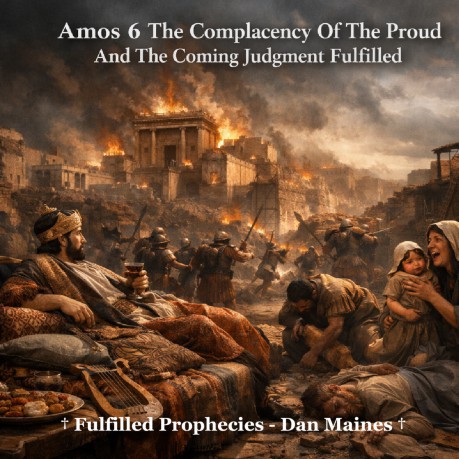
Amos 6 The Complacency Of The
Proud And The Coming Judgment Fulfilled Introduction † Amos 6 exposes the danger of false security
among God's covenant people, those who believed judgment would never
reach them. † From the fulfilled perspective, this wasn't
about some distant future, it was a warning to Israel that their
complacency would lead directly to their destruction in their own
generation. † They trusted in status, comfort, and
religious identity, but ignored righteousness, and that's exactly
what Jesus rebuked in His generation as well (Matthew 23:27-36). † This chapter shows that privilege without
obedience brings judgment, and history proves it happened just as God
said. Amos 6:1 † The warning is against those who felt safe
because of their position in Zion and Samaria, the centers of
religious and political power (Isaiah 32:9-11). † From the fulfilled perspective, this same
false confidence existed in first century Israel, they believed being
Abraham's descendants guaranteed safety (John 8:39-40). † Jesus directly confronted this mindset,
showing that lineage doesn't protect from judgment, obedience does
(Matthew 3:9-10). Amos 6:2 † God points them to other nations that had
already fallen, showing that Israel wasn't immune to the same fate. † This mirrors Jesus warning Jerusalem by
pointing to past judgments, showing history repeats when people
reject God (Luke 13:1-5). † The lesson is clear, covenant status doesn't
cancel consequences. Amos 6:3 † They pushed judgment into the future,
convincing themselves it wouldn't happen soon. † This is exactly what Peter described, people
saying things will continue as they always have (2 Peter 3:3-4). † From the fulfilled perspective, Israel in the
first century did the same, ignoring the warnings of Christ about the
coming destruction of Jerusalem. Amos 6:4 † This describes luxury and indulgence while
ignoring injustice and coming judgment. † Jesus rebuked the same spirit in the rich and
powerful leaders who lived in comfort while neglecting mercy and
justice (Luke 16:19-21). † Their lifestyle reflected spiritual
blindness, not blessing. Amos 6:5 † They imitated worship externally, but their
hearts were far from God. † This parallels Jesus statement that people
honored God with their lips but not their hearts (Matthew 15:8). † Outward religion without righteousness is
empty. Amos 6:6 † Their sin wasn't just indulgence, it was
indifference to the suffering of their own people. † This reflects the leaders in Jesus time who
burdened others but showed no compassion (Matthew 23:4). † True covenant faith always includes care for
others. Amos 6:7 † Judgment would come first to those who
thought they were safest. † Jesus said the first will be last (Matthew
19:30). † In AD 70, the leaders and elites suffered
severely in the destruction of Jerusalem, exactly fulfilling this
principle. Amos 6:8 † God rejected their pride and the very things
they trusted in. † This matches Jesus declaration that the
temple would be left desolate (Matthew 23:38). † Their confidence in physical structures
couldn't save them. Amos 6:9-10 † This describes extreme devastation and fear. † Josephus records similar scenes during the
siege of Jerusalem, where death filled the houses and silence
replaced normal life. † This is direct historical confirmation of
covenant judgment fulfilled. Amos 6:11 † Judgment would affect all levels of society,
no one would escape. † This aligns with Jesus statement that not one
stone would be left upon another (Matthew 24:2). † The destruction was total, just as
prophesied. Amos 6:12 † God uses absurd imagery to show how unnatural
their corruption was. † Justice was completely reversed,
righteousness replaced with bitterness. † Jesus condemned this same corruption in the
Pharisees (Matthew 23:23). Amos 6:13 † They trusted in their own power and
achievements. † This reflects Israel's confidence in their
status and temple system rather than in God. † Jesus warned that self-righteous confidence
leads to destruction (Luke 18:9-14). Amos 6:14 † This prophecy was fulfilled historically
through invading nations, and ultimately in the Roman destruction of
Jerusalem in AD 70. † Jesus confirmed this when He warned of armies
surrounding Jerusalem (Luke 21:20). † The judgment was not delayed, it came exactly
as spoken. Historical References † Josephus, Wars of the Jews, Book 5-6
describes the famine, death, and destruction during the siege of
Jerusalem. † Tacitus, Histories 5 records the fall of
Jerusalem and the devastation of the people. † Eusebius, Ecclesiastical History 3.5 confirms
the fulfillment of Christ's warnings about Jerusalem's destruction. How It Applies To Us Today † We can't rely on comfort, status, or
religious identity, God looks at the heart and obedience (Romans
2:28-29). † Complacency is dangerous, when people ignore
truth and live at ease, judgment always follows in some form. † True faith isn't outward appearance, it's
lived out in righteousness, mercy, and truth. † We've already entered the fulfilled kingdom,
so we live in the reality of what Christ accomplished, not waiting
for what already came. † This chapter reminds us that God keeps His
word, every warning and every promise. Q & A Appendix Q What does it mean to be at ease in Zion? Q Did this judgment happen in the future or in
their time? Q Why did God reject their worship? Q What does turning justice into gall mean? Q How do we avoid their mistake today? † This is the fulfilled perspective we proclaim at
Fulfilled Prophecies † Source Index † Amos 6
By Dan Maines
Woe to those who are at ease in
Zion,
And to those who feel secure in the mountain of
Samaria,
The distinguished men of the foremost of nations,
To
whom the house of Israel comes.
Go over to Calneh and look,
And
from there go to Hamath the great,
Then go down to Gath of the
Philistines.
Are they better than these kingdoms,
Or is
their territory greater than yours?
Do you put off the day of
disaster,
And would you bring near the seat of violence?
Those who recline on beds of
ivory
And lounge around on their couches,
And eat lambs
from the flock
And calves from the midst of the stall,
Who improvise to the sound of the
harp,
And like David have composed songs for themselves,
Who drink wine from sacrificial
bowls
While they anoint themselves with the finest of oils,
Yet
they have not grieved over the ruin of Joseph.
Therefore, they will now go into
exile at the head of the exiles,
And the lounging of the
revelers will pass away.
The Lord GOD has sworn by Himself,
the LORD God of armies has declared:
I loathe the arrogance of
Jacob,
And detest his citadels;
Therefore I will give up
the city and all it contains.
And it will be, if ten men are
left in one house, they will die.
Then one's uncle, or his
undertaker, will lift him up to bring out his bones from the house,
and he will say to the one who is in the innermost part of the house,
Is anyone else with you? And that one will say, No one. Then he will
answer, Keep quiet. For the name of the LORD is not to be mentioned.
For behold, the LORD is going to
command that the great house be smashed to pieces and the small house
to fragments.
Do horses run on rocks?
Or
does one plow them with oxen?
Yet you have turned justice into
poison,
And the fruit of righteousness into wormwood,
You who rejoice in Lodebar,
And
say, Have we not by our own strength taken Karnaim for ourselves?
For behold, I am going to raise up
a nation against you, house of Israel, declares the LORD God of
armies, and they will afflict you from the entrance of Hamath to the
brook of the Arabah.
A
It means trusting in religious position instead of obedience to God,
Amos 6:1; Matthew 3:9-10
A It happened in their time and was
fully realized in the destruction of Jerusalem, Luke 21:20-22
A
Because it was outward only and lacked righteousness, Matthew 15:8;
Amos 6:5
A
It means corrupting truth and righteousness into bitterness and
injustice, Amos 6:12; Matthew 23:23
A
By living in true obedience, humility, and faith, not trusting in
outward identity, Luke 18:9-14
© Fulfilled Prophecies - Dan
Maines.
† Josephus,
Wars of the Jews, Book 5-6
† Tacitus,
Histories 5
† Eusebius, Ecclesiastical
History 3.5
Links