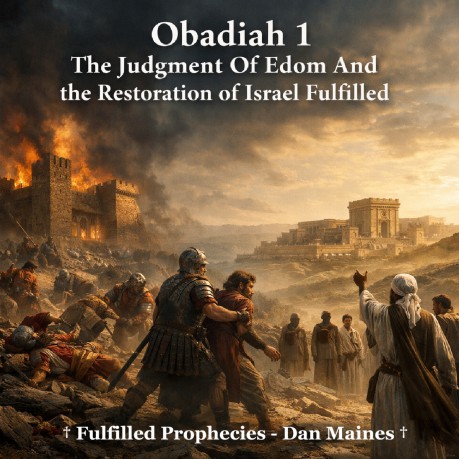
Obadiah 1 The Judgment Of
Edom And The Restoration Of Israel Fulfilled Introduction † Obadiah speaks directly against Edom, the
descendants of Esau, who stood against their brother Jacob, and
rejoiced when Jerusalem fell. Obadiah 1:1 † God Himself initiates judgment, showing this
isn't random war but divine decree against Edom's actions. (Isaiah
34:5-8) Obadiah 1:2 † Edom's pride led to humiliation, God reverses
what man exalts. (James 4:6) Obadiah 1:3-4 † Pride is the root of Edom's fall, trusting in
position and security instead of God. (Proverbs 16:18) Obadiah 1:5-6 † The destruction of Edom is total, beyond what
normal plunder would bring. Obadiah 1:7 † Edom's alliances fail, those trusted turn
against them. Obadiah 1:8-9 † Wisdom and strength fail under judgment, no
human resource can withstand God. Obadiah 1:10-11 † Edom is judged for standing against their
brother, showing covenant betrayal. Obadiah 1:12-14 † God condemns their actions in detail, showing
He sees and judges every act. Obadiah 1:15-16 † The day of the LORD is near, not distant, and
it brings reciprocal judgment. Obadiah 1:17-18 † Deliverance comes through Zion, pointing to
the remnant in Christ. (Hebrews 12:22-23) Obadiah 1:19-21 † The kingdom belongs to the LORD, this is the
ultimate fulfillment. Historical References † Josephus describes the fall of Jerusalem in
AD 70, showing complete destruction matching prophetic language. How it applies to us today † God still opposes pride, and exalts the
humble, nothing has changed in His character. Q & A Appendix Q Was Obadiah only about Edom historically Q What is the day of the LORD here Q Who is Mount Zion in fulfillment Q What does it mean the kingdom will be the
LORD'S Q Why was Edom judged so harshly † This is the fulfilled perspective we proclaim at
Fulfilled Prophecies † Source Index † Obadiah 1
By Dan Maines
† This prophecy
isn't just about ancient conflict, it's about covenant judgment
against those who opposed God's people and sided with their
destruction.
† From the fulfilled
perspective, this finds its climax in the judgment that came upon
Jerusalem in AD 70, and the complete removal of the Old Covenant
system, exposing all enemies of God.
The vision of Obadiah. This is
what the Lord GOD says concerning Edom: We have heard a report from
the LORD, and an envoy has been sent among the nations saying, Arise
and let us go against her for battle
† The nations are stirred up by God,
proving He rules over kingdoms and uses them for His purposes.
(Jeremiah 25:9)
† This reflects how Rome was
used as God's instrument in AD 70 against Jerusalem and all aligned
with her rebellion. (Luke 21:20-22)
Behold, I will make you small
among the nations; You are greatly despised
† This shows
covenant judgment always results in loss of standing and influence.
(Ezekiel 25:12-14)
† The same principle
applied to Israel when they rejected Christ, they became scattered
and brought low. (Matthew 21:43)
The arrogance of your heart
has deceived you, You who live in the clefts of the rock, In the
loftiness of your dwelling place, Who say in your heart, Who will
bring me down to earth Though you build high like the eagle, Though
you set your nest among the stars, From there I will bring you down
declares the LORD
†
No height, power, or alliance can protect from God's judgment.
(Jeremiah 49:16)
† This mirrors Jerusalem's
false security in the temple, thinking they were untouchable.
(Jeremiah 7:4)
If thieves came to you, If
robbers by night O how you will be ruined Would they not steal only
until they had enough If grape gatherers came to you, Would they not
leave some gleanings O how Esau will be ransacked, And his hidden
treasures searched out
† This shows
God's judgment is complete when it comes against covenant enemies.
(Nahum 1:9)
† Jerusalem experienced the same
complete devastation in AD 70, nothing was spared. (Matthew 24:2)
All the men allied with you will
send you forth to the border, And the men at peace with you will
deceive you and overpower you, Those who eat your bread will set an
ambush for you There is no understanding in him
† This shows worldly alliances
cannot save when God brings judgment. (Psalm 146:3)
†
Jerusalem also trusted Rome at one time, yet Rome became the
instrument of their destruction. (Luke 19:43)
Will I not on that day
declares the LORD Destroy wise men from Edom, And understanding from
the mountain of Esau Then your mighty men will be dismayed, Teman, So
that everyone may be eliminated from the mountain of Esau by
slaughter
† God
removes both intellect and power, leaving nothing to resist Him.
(Isaiah 19:3)
† This again reflects the fall
of Jerusalem, where leaders and warriors alike were powerless. (Luke
21:24)
Because of violence to your
brother Jacob, You will be covered with shame, And you will be
eliminated forever On the day that you stood aloof, On the day that
strangers carried off his wealth, And foreigners entered his gate and
cast lots for Jerusalem, You too were as one of them
† They
weren't innocent bystanders, they participated in Jerusalem's
downfall. (Psalm 137:7)
† This principle
applies to all who align themselves against God's people and
purposes.
Do not gloat over your
brother's day, The day of his misfortune And do not rejoice over the
sons of Judah In the day of their destruction Yes, do not boast In
the day of their distress Do not enter the gate of My people In the
day of their disaster Yes, you do not gloat over their catastrophe In
the day of their disaster And do not loot their wealth In the day of
their disaster Do not stand at the fork of the road To eliminate
their fugitives And do not imprison their survivors In the day of
their distress
† Rejoicing in
judgment brings judgment upon oneself. (Proverbs 24:17-18)
†
This reinforces that God holds nations accountable for how they treat
His people.
For the day of the LORD
draws near on all the nations As you have done, it will be done to
you Your dealings will return on your own head Because just as you
drank on My holy mountain, All the nations will drink continually
They will drink and swallow And become as if they had never existed
† What Edom
did returns upon them, this is divine justice. (Galatians 6:7)
†
This same day of the LORD came upon Jerusalem in that generation.
(Matthew 24:34)
But on Mount Zion there will
be those who escape, And it will be holy And the house of Jacob will
possess their possessions Then the house of Jacob will be a fire, And
the house of Joseph a flame But the house of Esau will be as stubble
And they will set them on fire and consume them, So that there will
be no survivor of the house of Esau, For the LORD has spoken
†
The enemies of God are consumed, showing finality in judgment.
†
This is fulfilled in the establishment of the New Covenant people,
the true Israel.
Then those of the Negev will
possess the mountain of Esau, And those of the Shephelah the
Philistine plain Also possess the territory of Ephraim and the
territory of Samaria, And Benjamin will possess Gilead And the exiles
of this host of the sons of Israel Who are among the Canaanites as
far as Zarephath, And the exiles of Jerusalem who are in Sepharad
Will possess the cities of the Negev The deliverers will ascend Mount
Zion To judge the mountain of Esau, And the kingdom will be the
LORD'S
† Christ establishes
this kingdom, not by land but by covenant reality. (Luke 17:20-21)
†
This is fulfilled in the reign of Christ after the Old Covenant
system passed away.
†
Eusebius records the early church understanding that these judgments
were fulfilled in their time.
† Tacitus
confirms the devastation of Judea, aligning with the day of the LORD
judgment.
†
We aren't to rejoice in judgment but understand God's justice and
mercy.
† The kingdom is already established
in Christ, we're living in the fulfilled reality, not waiting for it.
A
No, it uses Edom as an example of covenant judgment that culminates
in the broader day of the LORD Matthew 24:34
A
It is the judgment that came in that generation, culminating in AD 70
Matthew 24:34
A
It is the New Covenant people in Christ Hebrews 12:22-23
A It means Christ reigns now, His
kingdom is already established Luke 17:20-21
A
Because of pride and violence against their brother, showing covenant
betrayal Psalm 137:7
© Fulfilled Prophecies - Dan
Maines.
† Josephus,
Wars of the Jews
† Eusebius, Ecclesiastical
History
† Tacitus, Histories
Links