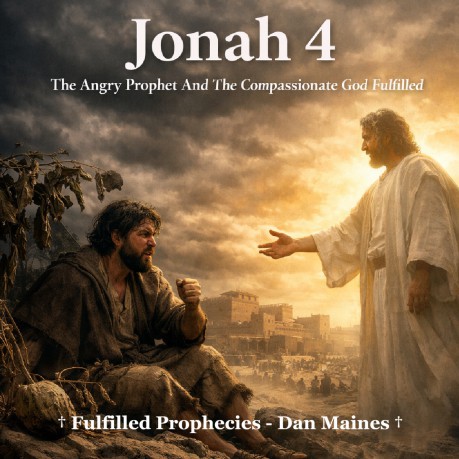
Jonah 4 The Angry Prophet And
The Compassionate God Fulfilled Introduction † Jonah 4 brings us face to face with the heart
of man and the heart of God. Jonah 4:1 But it greatly displeased Jonah, and he became angry. † Jonah wasn't upset about failure, he was
upset about success, because Nineveh repented (Jonah 3:10). Jonah 4:2 Then he prayed to the LORD and said, Please LORD, was this not
what I said when I was still in my own country? Therefore in
anticipation of this I fled to Tarshish, since I knew that You are a
gracious and compassionate God, slow to anger and abundant in mercy,
and One who relents of disaster. † Jonah admits he knew exactly who God is,
gracious, merciful, and patient (Exodus 34:6-7). Jonah 4:3 Therefore now, LORD, please take my life from me, for death is
better to me than life. † Jonah would rather die than see his enemies
receive mercy, that's how deep his anger runs. Jonah 4:4 But the LORD said, Do you have a good reason to be angry? † God confronts Jonah with a simple question,
exposing his heart. Jonah 4:5 Then Jonah left the city and sat down east of it. There he made a
shelter for himself and sat under it in the shade until he could see
what would happen in the city. † Jonah still hoped Nineveh would be destroyed,
showing he hadn't accepted God's decision. Jonah 4:6 So the LORD God appointed a plant, and it grew up over Jonah to be
a shade over his head, to relieve him of his discomfort. And Jonah
was extremely happy about the plant. † God shows kindness even to Jonah, despite his
wrong attitude. Jonah 4:7 But God appointed a worm when dawn came the next day, and it
attacked the plant and it withered. † God removes the comfort to teach Jonah a
lesson. Jonah 4:8 When the sun came up God appointed a scorching east wind, and the
sun beat down on Jonah's head so that he became faint, and he begged
with all his soul to die, saying, Death is better to me than life. † Jonah's emotions are tied to circumstances,
not truth. Jonah 4:9 Then God said to Jonah, Do you have a good reason to be angry
about the plant? And he said, I have good reason to be angry, even to
the point of death. † Jonah doubles down, justifying his anger. Jonah 4:10 Then the LORD said, You had compassion on the plant for which you
did not work and which you did not cause to grow, which came up
overnight and perished overnight. † God contrasts Jonah's concern for a plant
with his lack of concern for people. Jonah 4:11 Should I not also have compassion on Nineveh, the great city in
which there are more than 120,000 persons who do not know the
difference between their right and left hand, as well as many
animals? † God reveals His heart, compassion for people
who lack understanding. Historical References † Josephus records how Israel often resisted
foreign nations and saw themselves as exclusive recipients of God's
favor. How It Applies To Us Today † We must examine our own hearts, do we rejoice
when others receive mercy, or do we resist it. Q & A Appendix Q: Why was Jonah so angry? Q: What does this reveal about Jonah's heart? Q: How does this connect to Israel in the first
century? Q: What lesson does the plant teach? Q: What is the main message of Jonah 4? † This is the fulfilled perspective we proclaim at
Fulfilled Prophecies † Source Index † Jonah 4 † Josephus, Antiquities of the Jews † Justin Martyr, Dialogue with Trypho † Irenaeus, Against Heresies
By Dan Maines
† Jonah is angry
because God showed mercy, and this exposes how limited human
compassion can be.
† This chapter reveals
that God's purpose was never limited to Israel, it always included
the nations.
†
This exposes that Jonah cared more about judgment than mercy, which
is the opposite of God's character (Exodus 34:6).
†
From the fulfilled perspective, this shows the same issue Israel had
in the first century, they rejected Gentile inclusion (Romans
10:19-21).
†
His problem wasn't ignorance, it was resistance to God's mercy toward
others.
† This mirrors the first century Jews
who knew the scriptures but resisted their fulfillment in Christ
extending to the nations (Acts 13:45-46).
†
This reveals how pride and nationalism can distort a person's view of
God.
† In the fulfilled perspective, this
reflects Israel's rejection of the gospel when it went to the
Gentiles (Acts 22:21-22).
† This question forces
Jonah, and us, to examine whether our anger aligns with God's
righteousness.
† God does the same in the New
Testament, confronting hardened hearts (Matthew 20:15).
†
He positions himself to watch judgment, not restoration.
†
This reflects the mindset of those in Israel who expected wrath on
the nations instead of inclusion (Luke 4:28-29).
† Jonah rejoices over
personal comfort, but not over the salvation of a city.
†
This exposes misplaced priorities, valuing personal ease over God's
redemptive work (Philippians 2:21).
† The same God who gives can take
away, to reveal deeper truth (Job 1:21).
†
This is about correction, not punishment, God is shaping Jonah's
understanding.
† When comfort is gone, his anger
returns.
† This reveals how unstable we are
when we aren't aligned with God's will (James 1:8).
†
This shows how stubborn the human heart can be when confronted.
†
This same stubbornness is seen in Israel rejecting Christ even after
clear evidence (John 5:40).
† Jonah
valued something temporary more than human lives.
†
This exposes the blindness of selfishness and narrow thinking.
† This proves God's
concern has always extended beyond Israel.
†
From the fulfilled perspective, this points directly to the inclusion
of the nations in Christ (Ephesians 2:11-13).
† Justin Martyr wrote that God's mercy
extended to all nations through Christ, fulfilling what was hinted at
in the prophets.
† Irenaeus affirmed that
God's plan always included bringing the nations into covenant, not
just Israel.
†
God's character hasn't changed, He's still gracious, merciful, and
patient.
† We're called to reflect His heart,
not Jonah's.
† The fulfilled reality is that
the nations are already included, and we shouldn't act like
gatekeepers of grace.
† If we get angry at
God's mercy, we're revealing that we don't fully understand it
ourselves.
A:
Because God showed mercy to Nineveh, and Jonah didn't want his
enemies spared (Jonah 4:1-2).
A:
He valued judgment over mercy and struggled with God's compassion
(Jonah 4:2-3).
A: Israel resisted Gentile inclusion
just like Jonah resisted Nineveh's repentance (Romans 10:19-21).
A:
Jonah cared more about temporary comfort than human lives, exposing
misplaced priorities (Jonah 4:10).
A:
God's mercy extends beyond boundaries, and His people must align with
His heart (Ephesians 2:11-13).
© Fulfilled Prophecies - Dan
Maines.
Links