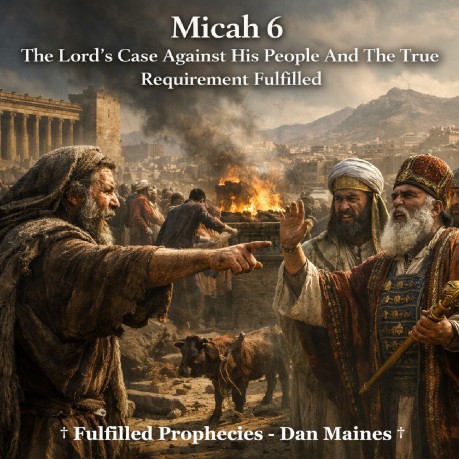
Micah 6 The Lord's Case
Against His People And The True Requirement Fulfilled Introduction † Micah 6 presents the Lord bringing a covenant
lawsuit against Israel, calling creation as witness to His
faithfulness and exposing their rebellion (Micah 6:1-2). † This isn't about future judgment, it's about
the present covenant failure of Israel leading up to the first
century fulfillment. † The chapter shows that God never desired
empty ritual, He required righteousness, mercy, and humility, all of
which were fulfilled and established in Christ. Micah 6:1-2 † God is bringing a legal case against Israel,
just like in Deuteronomy covenant language where heaven and earth are
witnesses. † This shows covenant accountability, Israel
was under obligation and failed it, leading to judgment fulfilled in
AD 70. † Jesus continued this same covenant lawsuit
against that generation in Matthew 23, showing continuity. Micah 6:3-5 † God reminds them of His faithfulness,
deliverance from Egypt, leadership, and protection. † Their rebellion wasn't because God failed, it
was because they rejected Him despite His proven faithfulness. † This same pattern appears in Acts 7, where
Stephen recounts Israel's history and exposes their continual
resistance. Micah 6:6-7 † Israel thought outward sacrifice could
replace obedience. † This exposes the corruption of their worship
system, especially in the first century temple leadership. † Hebrews 10 confirms that sacrifices never
removed sin, they pointed to Christ. Micah 6:8 † This is the heart of the covenant, not ritual
but righteousness. † Jesus echoed this in Matthew 23:23, rebuking
leaders for neglecting justice, mercy, and faithfulness. † The fulfilled kingdom restores this standard
through Christ, not temple sacrifice. Micah 6:9-12 † Corruption was everywhere, economic
injustice, violence, and deception. † This describes the exact condition of first
century Jerusalem leaders. † Jesus confirmed this corruption in Matthew
23, calling them hypocrites and blind guides. Micah 6:13-16 † This is covenant curse language straight from
Deuteronomy 28. † These judgments were fulfilled in the
destruction of Jerusalem, famine, sword, and desolation. † Jesus directly tied these covenant curses to
that generation in Luke 21. Historical References † Josephus describes famine, internal
corruption, and destruction in Jerusalem exactly matching Micah's
warnings. † Eusebius records the judgment upon Jerusalem
as fulfillment of prophetic warnings. † Tacitus confirms the devastation and moral
decay leading to Jerusalem's fall. How It Applies To Us Today † God has never wanted empty religion, He wants
obedience from the heart (Micah 6:8). † We don't return to ritual, we've been brought
into fulfillment through Christ where righteousness is the standard. † We walk in justice, mercy, and humility now,
not to earn salvation, but because it's already fulfilled in Him. † The warning still stands, outward religion
without inward truth is worthless. † We live as the restored people of God, not
under law, but in the fulfilled kingdom reality. Q & A Appendix Q: Was Micah 6 about a future generation
thousands of years later? Q: Does God require sacrifices today? Q: What does God require now? Q: Was the judgment described literal? Q: Are we still under the same covenant Israel
was under? † This is the fulfilled perspective we proclaim at
Fulfilled Prophecies † Source Index † Micah 6:1-16 † Josephus, Wars of the Jews Book 5-6;
Eusebius, Ecclesiastical History Book 3; Tacitus, Histories Book 5
By Dan Maines
Hear now what the LORD is
saying: Arise, plead your case before the mountains, And let the
hills hear your voice. Listen, you mountains, to the indictment of
the LORD, And you enduring foundations of the earth, Because the LORD
has a case against His people; Even with Israel He will dispute.
My people, what have I done to
you, And how have I wearied you? Answer Me. Indeed, I brought you up
from the land of Egypt And ransomed you from the house of slavery,
And I sent before you Moses, Aaron, and Miriam. My people, remember
now What Balak king of Moab counseled And what Balaam son of Beor
answered him, And from Shittim to Gilgal, So that you might know the
righteous acts of the LORD.
With what shall I come to the
LORD And bow myself before the God on high? Shall I come to Him with
burnt offerings, With yearling calves? Does the LORD take delight in
thousands of rams, In ten thousand rivers of oil? Shall I present my
firstborn for my rebellious acts, The fruit of my body for the sin of
my soul?
He has told you, O man, what is
good; And what does the LORD require of you But to do justice, to
love kindness, And to walk humbly with your God?
The voice of the LORD will call
to the city, And it is sound wisdom to fear Your name: Hear, O tribe.
Who has appointed its time? Is there yet a man in the wicked house,
Along with treasures of wickedness And a short measure that is
cursed? Can I justify wicked scales And a bag of deceptive weights?
For the rich men of the city are full of violence, Her residents
speak lies, And their tongue is deceitful in their mouth.
So also I will make you sick,
striking you down, Desolating you because of your sins. You will eat,
but you will not be satisfied, And your vileness will be in your
midst. You will try to remove for safekeeping, But you will not
preserve anything, And what you do preserve I will give to the sword.
You will sow but you will not reap, You will tread the olive but will
not anoint yourself with oil, And the grapes but you will not drink
wine. The statutes of Omri And all the works of the house of Ahab are
observed, And in their devices you walk. Therefore I will give you up
for destruction And your inhabitants for derision, And you will bear
the reproach of My people.
A: No, it was
directed at Israel under the covenant, fulfilled in their judgment in
AD 70 (Matthew 23:36).
A:
No, Christ fulfilled all sacrifice once for all (Hebrews 10:10-14).
A:
To walk in justice, mercy, and humility as fulfilled in Christ (Micah
6:8).
A:
Yes, fulfilled in the destruction of Jerusalem as recorded by
Josephus (Luke 21:20-22).
A: No, that covenant ended, we now
live in the fulfilled kingdom established by Christ (Hebrews 8:13).
© Fulfilled Prophecies - Dan
Maines.
Links