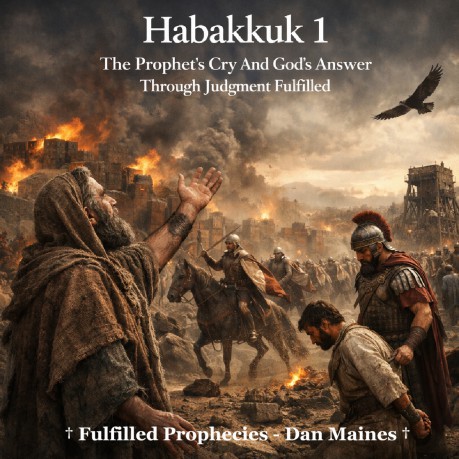
Habakkuk 1 The Prophet's Cry
And God's Answer Through Judgment Fulfilled Introduction † Habakkuk opens with a question that many
people still ask today, why does God allow injustice to continue
without immediate judgment Habakkuk 1:1 The pronouncement which Habakkuk the prophet saw. † The word burden shows this message is heavy,
it's not light encouragement, it's a warning of judgment Habakkuk 1:2-4 How long, LORD, will I call for help, And You do not hear? I cry
out to You, Violence! Yet You do not save. Why do You make me see
wrongdoing, And cause me to look at trouble? Yes, destruction and
violence are before me; Strife exists and contention arises.
Therefore the Law is ignored And justice is never upheld. For the
wicked surround the righteous; Therefore justice comes out confused. † Habakkuk is describing covenant breakdown,
law ignored, justice twisted, violence everywhere Habakkuk 1:5-6 Look among the nations! Observe! Be astonished! Wonder! Because I
am doing something in your days, You would not believe if you were
told. For behold, I am raising up the Chaldeans, That fierce and
impetuous people Who march throughout the earth To take possession of
dwelling places that are not theirs. † God answers clearly, judgment is coming
within their days, not thousands of years later Habakkuk 1:7-11 They are dreaded and feared; Their justice and authority originate
with themselves. Their horses are faster than leopards And quicker
than wolves in the evening. Their horsemen come galloping, Their
horsemen come from afar; They fly like an eagle swooping down to
devour. All of them come for violence. Their horde of faces moves
forward. They gather captives like sand. They make fun of kings And
laugh at rulers; They laugh at every fortress And heap up rubble to
capture it. Then they will sweep through like the wind and pass on.
But they will be held guilty, They whose strength is their god. † This describes a ruthless invading force,
unstoppable, swift, and destructive Habakkuk 1:12-13 Are You not from everlasting, LORD, my God, my Holy One? We will
not die. You, LORD, have appointed them to judge; And You, Rock, have
destined them to punish. Your eyes are too pure to approve evil, And
You cannot look at harm favorably. Why do You look favorably On those
who deal treacherously? Why are You silent when the wicked swallow up
Those more righteous than they? † Habakkuk recognizes God is using a nation as
an instrument of judgment Habakkuk 1:14-17 Why have You made people like the fish of the sea, Like crawling
things that have no ruler over them? The Chaldeans bring all of them
up with a hook, Drag them away with their net, And gather them
together in their fishing net. Therefore they rejoice and are glad.
Therefore they offer a sacrifice to their net And burn incense to
their fishing net; Because through these things their catch is large,
And their food is plentiful. Will they therefore empty their net And
continually kill nations without sparing? † The invading power becomes arrogant,
attributing success to itself instead of God Historical References † Josephus, Wars of the Jews, Book 6, describes
the brutality of Rome against Jerusalem, matching Habakkuk's imagery
of total destruction How It Applies To Us Today † God's timing is perfect, even when it seems
delayed, judgment always comes at the appointed time Q & A Appendix Q If Habakkuk said this would happen in their
days, why do people still push fulfillment into the future? Q Who do the Chaldeans represent in
fulfillment? Q Why does God use wicked nations to judge? Q Does this mean God approves of those nations? Q What does this teach us about God's justice
today? † This is the fulfilled perspective we proclaim at
Fulfilled Prophecies † Source Index † Habakkuk
By Dan Maines
† From the
fulfilled perspective, this isn't about some distant future, it's
about what was happening in Judah leading up to the destruction that
Jesus later said would come on that generation, Matthew 23:36
†
Habakkuk is seeing the corruption inside covenant Israel, and he's
struggling with how long God will allow it to continue
†
This vision is about covenant accountability, God isn't ignoring sin,
He's preparing to deal with it
† Prophetic
burdens always point to real historical judgment, not symbolic future
speculation
†
This matches exactly what Jesus said about His own generation, that
they had filled up the measure of their fathers, Matthew 23:32
†
The delay in judgment doesn't mean God isn't acting, it means He's
allowing time until the appointed moment
†
Paul quotes this in Acts 13:41 to show it was being fulfilled in his
own time
† Just like Babylon came against
Judah, Rome came against Jerusalem, the pattern is identical
† Rome
fits this description perfectly in AD 70, surrounding and crushing
Jerusalem
† The eagle imagery lines up with
Roman standards, showing continuity between prophecy and fulfillment
† This same
principle appears when God uses Rome against Jerusalem, Luke
21:20-22
† God's holiness doesn't change, but
His methods include using nations to bring covenant justice
†
This is exactly what Rome did, elevating its own power and demanding
worship
† But just like Babylon fell, Rome's
role was temporary, God uses nations, then judges them
† Tacitus, Histories
5.13, confirms the overwhelming force and dominance of Rome during
this period
† Eusebius, Ecclesiastical
History 3.5, records the fulfillment of Jesus' warnings about
Jerusalem's fall
†
We're not waiting for future fulfillment, we're living in the reality
that these judgments have already been carried out
†
This should give us confidence, not fear, because the system of
condemnation has already been removed
† It
reminds us that God sees injustice, and He acts, even when it doesn't
look immediate
† We're not under that
covenant judgment system anymore, we're in the fulfilled kingdom
where access to God has been restored
A
Because they ignore the time statements. Acts 13:41 shows it was
already being fulfilled in the first century.
A They represent the same role
Rome played, a foreign nation used by God to judge covenant Israel,
Luke 21:20-22.
A
Because He controls all nations and uses them as instruments of
justice, Isaiah 10:5-6.
A
No, He uses them temporarily, then judges them as well, Habakkuk 2:8.
A That His justice has already been
revealed and completed in that covenant transition, Romans 3:25-26.
© Fulfilled Prophecies - Dan
Maines.
† Josephus,
Wars of the Jews, Book 6; Tacitus, Histories 5.13; Eusebius,
Ecclesiastical History
Links