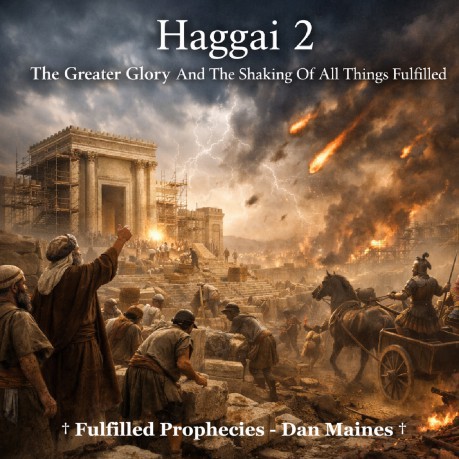
Haggai 2 The Greater Glory
And The Shaking Of All Things Fulfilled Introduction † Haggai 2 continues the call to rebuild, but
now it goes deeper, it shifts from physical rebuilding to covenantal
fulfillment. † The people saw a lesser temple, but God was
pointing to something far greater that was about to come. † From the fulfilled perspective, this chapter
isn't about a future temple, it's about the transition from the old
covenant system to the unshakable kingdom in Christ. Haggai 2:1-3 † The people were discouraged because the
second temple didn't compare to Solomon's temple, they were focused
on outward glory instead of what God was about to accomplish (Haggai
2:3). † This shows their expectation was still tied
to physical structure, not covenant fulfillment. † The disappointment reveals how easily people
miss what God is doing when they measure by appearance instead of
purpose. Haggai 2:4-5 † God reassures them that His presence hasn't
left, even though the structure seemed smaller (Haggai 2:4). † The covenant is still in effect, but it's
moving toward fulfillment, not permanence in its current form. † The focus is on God's presence, not the
building, pointing forward to God dwelling with His people in Christ
(John 1:14). Haggai 2:6-7 † This is a direct promise of covenantal
shaking, God declares He will shake heaven and earth (Haggai 2:6). † Hebrews 12:26-28 shows this was fulfilled in
the first century, removing the old covenant system. † The glory promised isn't physical splendor,
it's the presence of Christ and the establishment of the new covenant
reality. Haggai 2:8-9 † God makes it clear that material wealth isn't
the issue, He owns it all (Haggai 2:8). † The greater glory was fulfilled when Christ
entered the temple, bringing the true presence of God (Matthew 12:6). † The peace promised is fulfilled in Christ,
not in a structure, but in reconciliation (Ephesians 2:14-16). Haggai 2:10-14 † Holiness doesn't transfer outwardly, but
uncleanness does, exposing the weakness of the old system (Haggai
2:13). † External rituals couldn't produce true
righteousness, they only revealed impurity. † This points to the need for true cleansing,
which comes through the new covenant (Hebrews 10:1-4). Haggai 2:15-19 † Their lack of blessing was tied to covenant
disobedience, not chance (Haggai 2:17). † God calls them to recognize a turning point,
from this day forward, blessing begins. † This anticipates the greater blessing
fulfilled in Christ. Haggai 2:20-23 † Zerubbabel is identified as a signet ring,
representing authority and covenant identity (Haggai 2:23). † This ultimately points to Christ, who comes
through this line as the true chosen ruler (Matthew 1:12-16). † The shaking of kingdoms points to the fall of
the old order and the establishment of Christ's kingdom. Historical References † Josephus records the rebuilding of the temple
and the struggles of the returning exiles, confirming the historical
context of Haggai. † Eusebius describes the transition from
temple-centered worship to Christ-centered fulfillment in the first
century. † Early Christian writers consistently saw
these prophecies fulfilled in Christ and the end of the old covenant
system. How It Applies To Us Today † We're not waiting for another temple, God has
already established His dwelling with His people. † The kingdom we belong to can't be shaken
because it's already been established in Christ. † Our focus isn't on outward systems, but on
the reality of God's presence fulfilled in us. † Everything that could be shaken has been
shaken, what remains is the eternal kingdom. Q & A Appendix Q Was the shaking of heaven and earth future to
us? Q What is the greater glory of the temple? Q Why did the second temple seem inferior? Q What does the shaking of nations mean? Q Is Zerubbabel the final fulfillment? † This is the fulfilled perspective we proclaim at
Fulfilled Prophecies † Source Index † Haggai † Josephus, Antiquities of the Jews; Eusebius,
Ecclesiastical History
By Dan Maines
On the twenty-first day of the
seventh month, the word of the Lord came by Haggai the prophet,
saying, Speak now to Zerubbabel the son of Shealtiel, governor of
Judah, and to Joshua the son of Jehozadak, the high priest, and to
the remnant of the people, saying, Who is left among you who saw this
temple in its former glory? And how do you see it now? Does it not
seem to you like nothing in comparison?
But now take courage,
Zerubbabel, declares the Lord, take courage also, Joshua son of
Jehozadak, the high priest, and all you people of the land take
courage, declares the Lord, and work; for I am with you, declares the
Lord of armies. As for the promise which I made you when you came out
of Egypt, My Spirit is remaining in your midst; do not fear.
For this is what the Lord of
armies says: Once more in a little while, I am going to shake the
heavens and the earth, the sea also and the dry land. I will shake
all the nations; and they will come with the wealth of all nations,
and I will fill this temple with glory, says the Lord of armies.
The silver is Mine and the gold
is Mine, declares the Lord of armies. The latter glory of this temple
will be greater than the former, says the Lord of armies, and in this
place I will give peace, declares the Lord of armies.
On the twenty-fourth of the
ninth month, in the second year of Darius, the word of the Lord came
to Haggai the prophet, saying, This is what the Lord of armies says:
Ask the priests for a ruling: If someone carries holy meat in the
fold of his garment and touches bread with this fold, or cooked food,
wine, oil, or any other food, will it become holy? And the priests
answered, No. Then Haggai said, If one who is unclean from a corpse
touches any of these, will the latter become unclean? And the priests
answered, It will become unclean. Then Haggai said, So is this
people. And so is this nation before Me, declares the Lord, and so is
every work of their hands; and what they offer there is unclean.
But now, do consider from
this day onward: before one stone was placed on another in the temple
of the Lord, from that time when one came to a grain heap of twenty
measures, there would be only ten; and when one came to the wine vat
to draw fifty measures, there would be only twenty. I struck you and
every work of your hands with scorching wind, mildew, and hail; yet
you did not come back to Me, declares the Lord. Do consider from this
day onward, from the twenty-fourth day of the ninth month; from the
day when the temple of the Lord was founded, consider: Is the seed
still in the barn? Even including the vine, the fig tree, the
pomegranate, and the olive tree, it has not borne fruit. Yet from
this day on I will bless you.
Then the word of the Lord
came a second time to Haggai on the twenty-fourth day of the month,
saying, Speak to Zerubbabel governor of Judah, saying, I am going to
shake the heavens and the earth. I will overthrow the thrones of
kingdoms and destroy the power of the kingdoms of the nations; and I
will overthrow the chariots and their riders, and the horses and
their riders will go down, everyone by the sword of another. On that
day, declares the Lord of armies, I will take you, Zerubbabel, son of
Shealtiel, My servant, declares the Lord, and I will make you like a
signet ring, for I have chosen you, declares the Lord of armies.
A No, Hebrews 12:26-28 shows it was
fulfilled in the first century with the removal of the old covenant
system.
A
It was Christ Himself entering it and fulfilling what the temple
pointed to, Matthew 12:6.
A
Because they were focused on physical appearance instead of covenant
fulfillment, Haggai 2:3.
A
It refers to the judgment and removal of the old covenant world and
the establishment of Christ's kingdom, Haggai 2:6-7.
A
No, he points forward to Christ, who is the true chosen ruler in his
lineage, Matthew 1:12-16.
© Fulfilled Prophecies - Dan
Maines.
Links