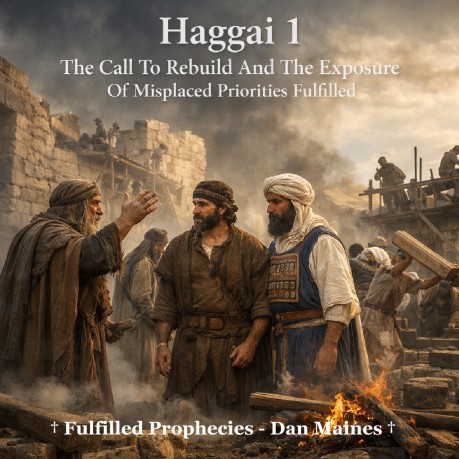
Haggai 1 The Call To Rebuild
And The Exposure Of Misplaced Priorities Fulfilled Introduction † Haggai 1 exposes a people who claimed to
follow God, yet their priorities proved otherwise, and this wasn't
just about a building, it was about covenant faithfulness. † They had returned from exile, they were back
in the land, yet the house of God remained neglected while they
focused on their own comfort. † From the fulfilled perspective, this points
forward to the final days of the Old Covenant system, where God again
exposed a people who honored Him with their lips but not with their
lives. Haggai 1:1 In the second year of King Darius, on the first day of the sixth
month, the word of the Lord came by Haggai the prophet to Zerubbabel
the son of Shealtiel, governor of Judah, and to Joshua the son of
Jehozadak, the high priest, saying, † God speaks at a precise moment in history,
showing that His covenant dealings are rooted in real time and real
people, not vague future speculation (Daniel 9:25). † Zerubbabel and Joshua represent civil and
priestly leadership, showing that both government and religion had
failed to prioritize God's house (Ezra 5:1-2). † This sets the stage for accountability,
because leadership always bears responsibility for the condition of
the people (Malachi 2:7-8). Haggai 1:2 This is what the Lord of armies says: This people says, The time
has not come, the time for the house of the Lord to be rebuilt. † The people didn't deny God, they delayed
obedience, and that's how compromise always works (Ecclesiastes
8:11). † Saying it's not time was an excuse, not a
lack of ability, they had time for themselves but not for God
(Matthew 6:33). † This reflects the same mindset seen in the
first century, where people claimed devotion but rejected the
fulfillment right in front of them (John 1:11). Haggai 1:3-4 Then the word of the Lord came by Haggai the prophet, saying, Is
it time for you yourselves to live in your paneled houses while this
house lies desolate? † God exposes their hypocrisy directly, they
had resources for comfort but none for covenant responsibility
(Isaiah 1:2-4). † Paneled houses show they were not poor, they
were prioritizing themselves over God (Amos 6:4-6). † This mirrors the condition of Israel before
AD 70, where religious activity continued while true obedience was
absent (Matthew 23:27-28). Haggai 1:5-6 Now then, this is what the Lord of armies says: Consider your
ways! You have sown much, but harvest little, you eat, but there is
not enough to be satisfied, you drink, but there is not enough to
become drunk, you put on clothing, but no one is warm enough, and the
one who earns, earns wages to put into a money bag with holes. † God calls them to examine themselves, not
their circumstances, because the problem wasn't external, it was
covenant disobedience (Lamentations 3:40). † Their lack wasn't random, it was covenant
judgment, just as the Law warned would happen (Deuteronomy 28:38-40). † This principle carries into the first
century, where Israel experienced increasing turmoil because they
rejected the Messiah (Luke 19:41-44). Haggai 1:7-8 This is what the Lord of armies says: Consider your ways! Go up to
the mountains, bring wood, and rebuild the temple, that I may be
pleased with it and be glorified, says the Lord. † God repeats the call, showing urgency,
delayed obedience is still disobedience (Hebrews 3:15). † The command is simple, act on what God has
already said, no new revelation is needed (James 1:22). † The purpose is God's glory, not their
comfort, and that's always the foundation of covenant life (1
Corinthians 10:31). Haggai 1:9-11 You look for much, but behold, it amounts to little, when you
bring it home, I blow it away. Why? declares the Lord of armies.
Because of My house which lies desolate, while each of you runs to
his own house. Therefore, because of you the sky has withheld its dew
and the earth has withheld its produce. And I called for a drought on
the land, on the mountains, on the grain, on the new wine, on the
oil, on what the ground produces, on people, on cattle, and on all
the labor of your hands. † God directly ties their hardship to their
priorities, this isn't coincidence, it's covenant response (Leviticus
26:19-20). † He says He blew on their efforts, meaning He
actively opposed what they were building apart from Him (Psalm
127:1). † This same judgment pattern is seen leading up
to AD 70, where everything Israel trusted in was removed (Hebrews
8:13). Haggai 1:12 Then Zerubbabel the son of Shealtiel, and Joshua the son of
Jehozadak, the high priest, with all the remnant of the people,
obeyed the voice of the Lord their God and the words of Haggai the
prophet, as the Lord their God had sent him. And the people showed
reverence for the Lord. † This is the turning point, obedience replaces
excuse, and that's always where restoration begins (2 Chronicles
7:14). † The remnant responds, showing that not
everyone hardened their heart, God always preserves a faithful people
(Romans 11:5). † Reverence for the Lord returns, not terror,
but submission and respect (Proverbs 1:7). Haggai 1:13-15 Then Haggai, the messenger of the Lord, spoke by the commission of
the Lord to the people, saying, I am with you, declares the Lord. So
the Lord stirred up the spirit of Zerubbabel the son of Shealtiel,
governor of Judah, and the spirit of Joshua the son of Jehozadak, the
high priest, and the spirit of all the remnant of the people. And
they came and worked on the house of the Lord of armies, their God,
on the twenty fourth day of the sixth month, in the second year of
King Darius. † God's presence is tied to obedience, not
empty profession, I am with you comes after they respond (John
14:23). † God stirs their spirit, showing that
obedience is both commanded and empowered by Him (Philippians 2:13). † They act quickly, showing real repentance
produces real change (Acts 26:20). Historical References † Josephus records the struggles of the
returning Jews and the delay in rebuilding the temple, showing this
wasn't just spiritual laziness but real historical resistance and
distraction, Antiquities of the Jews, Book 11. † Ezra confirms the timeline and the role of
Haggai in stirring the people to rebuild, Ezra 5:1-2. † The pattern of delayed obedience followed by
prophetic correction is consistent throughout Israel's history, seen
also in Nehemiah's time, Nehemiah 2:17-18. How It Applies To Us Today † This chapter isn't about a physical temple
for us, it's about priorities, what we're building reveals what we
truly value (1 Corinthians 3:16-17). † It's easy to say we'll serve God later, but
delayed obedience is still disobedience, and it produces emptiness
(Luke 12:16-21). † God still calls us to consider our ways, not
blame circumstances, but examine our hearts (2 Corinthians 13:5). † The fulfilled reality is that the true house
has been built in Christ, and we're part of it now, so neglecting
that reality is the same mistake in a different form (Ephesians
2:19-22). Q & A Appendix Q Was this only about rebuilding a physical
temple? Q Why were they struggling financially and
agriculturally? Q Does God still work this way today? Q What does consider your ways mean for us? Q How does this connect to the fulfilled
perspective? † This is the fulfilled perspective we proclaim at
Fulfilled Prophecies † Source Index † Haggai 1 † Josephus, Antiquities of the Jews, Book 11;
Ezra; Nehemiah
By Dan Maines
A No, it exposed covenant priorities,
and that same principle carries forward into the new covenant reality
where we are the temple (1 Corinthians 3:16-17).
A Because of covenant
disobedience, exactly as warned in the Law (Deuteronomy 28:38-40).
A
The principle remains, God opposes misplaced priorities and blesses
obedience, but it's fulfilled in Christ, not tied to land or crops
(Matthew 6:33).
A
It means examine your life honestly in light of God's word, not your
own reasoning (Lamentations 3:40; 2 Corinthians 13:5).
A Just like they neglected the
temple before its completion, first century Israel neglected Christ
and the true temple, leading to judgment in AD 70 (John 2:19-21; Luke
19:41-44).
© Fulfilled Prophecies - Dan
Maines.
Links