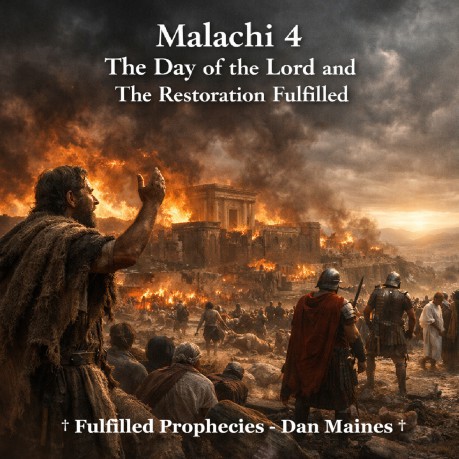
Malachi 4 The Day Of The Lord
And The Restoration Fulfilled Introduction † Malachi 4 closes the Old Covenant with a
clear promise of judgment and restoration, and it doesn't leave the
timing open ended. Malachi 4:1 For behold, the day is coming, burning like a furnace, and all the
arrogant and every evildoer will be chaff, and the day that is coming
will set them ablaze, says the Lord of armies, so that it will leave
them neither root nor branches. † This is the Day of the Lord, a covenant
judgment against the wicked in Israel, not a future global
destruction. (Malachi 4:1) Malachi 4:2 But for you who fear My name, the sun of righteousness will rise
with healing in its wings, and you will go forth and skip about like
calves from the stall. † This speaks of Christ, the Sun of
righteousness, bringing healing through the New Covenant. (Malachi
4:2) Malachi 4:3 And you will crush the wicked, for they will be ashes under the
soles of your feet on the day which I am preparing, says the Lord of
armies. † The righteous would witness the judgment of
the wicked, especially in the fall of Jerusalem in AD 70. (Malachi
4:3) Malachi 4:4 Remember the Law of Moses My servant, even the statutes and
ordinances which I commanded him in Horeb for all Israel. † This call to remember the Law shows the
transition point, the Law was still in effect until its fulfillment.
(Malachi 4:4) Malachi 4:5 Behold, I am going to send you Elijah the prophet before the
coming of the great and terrible day of the Lord. † This prophecy is fulfilled in John the
Baptist, who came in the spirit and power of Elijah. (Malachi 4:5) Malachi 4:6 And he will turn the hearts of the fathers back to their children,
and the hearts of the children to their fathers, so that I will not
come and strike the land with complete destruction. † John the Baptist's ministry was about
restoration, calling Israel to repentance before judgment. (Malachi
4:6) Historical References † Josephus records the destruction of Jerusalem
in AD 70 as a fiery judgment that consumed the city and temple,
matching the language of Malachi. How It Applies To Us Today † The Day of the Lord already happened, so
we're not waiting for that kind of judgment anymore. Q & A Appendix Q: Was Malachi 4 talking about the end of the
world? Q: Who is the Elijah in Malachi 4:5? Q: What is the Day of the Lord here? Q: What does the Sun of righteousness refer
to? Q: What does it mean that the wicked become
ashes? † This is the fulfilled perspective we proclaim at
Fulfilled Prophecies † Source Index † Malachi 4 † Josephus, Wars of the Jews Book 6; Eusebius,
Ecclesiastical History Book 3; Tacitus, Histories Book 5
By Dan Maines
† It's pointing directly
to the coming Day of the Lord that would burn against the wicked and
bring healing to the righteous.
† From the
fulfilled perspective, we understand this wasn't about the end of the
physical world, it was about the end of the Old Covenant age and the
judgment on Israel.
† Jesus and the apostles
confirm this timing, showing it was fulfilled in their generation.
† Jesus identifies
this same judgment in His generation, pointing to the destruction of
Jerusalem. (Matthew 23:36)
† The language of
fire and burning is consistent with prophetic judgment language used
throughout the Old Testament. (Isaiah 66:15-16)
† The healing is covenantal, restoring
access to God that was lost under the Law. (Hebrews 10:19-22)
†
Those who believed in Christ experienced this freedom and life as the
Old Covenant passed away. (John 8:36)
† Jesus said His followers would see
these things come to pass in their generation. (Luke 21:20-22)
†
The imagery of ashes shows total destruction, meaning the Old
Covenant system would be completely removed. (Hebrews 8:13)
† Jesus came to fulfill the
Law, not to continue it indefinitely. (Matthew 5:17)
†
Once fulfilled, the Law would pass away with the Old Covenant system.
(Romans 10:4)
†
Jesus clearly identifies John as Elijah who was to come. (Matthew
11:13-14)
† This places the Day of the Lord
in the first century, not thousands of years later. (Luke 1:16-17)
† Those who responded were restored,
those who rejected were judged. (Matthew 3:7-12)
†
The curse refers to covenant judgment, fulfilled in the destruction
of Jerusalem. (Deuteronomy 28:15-68)
† Eusebius
confirms that believers fled Jerusalem before its destruction,
showing the separation between the righteous and the wicked.
†
Tacitus describes the Roman destruction as overwhelming and total,
aligning with the prophetic imagery of complete burning.
†
Christ has already brought healing and access to God, we now live in
that reality.
† The Old Covenant system is
gone, so we don't go back to law based righteousness.
†
We're living in the fulfilled kingdom, where access to God is fully
restored through Christ.
A: No, it was about covenant judgment on
Israel, fulfilled in AD 70 (Matthew 23:36, Luke 21:20-22).
A:
John the Baptist, as confirmed by Jesus (Matthew 11:13-14, Luke
1:16-17).
A:
The judgment on Jerusalem and the end of the Old Covenant age
(Malachi 4:1, Matthew 24:34).
A: Jesus Christ bringing healing and
restoration through the New Covenant (Malachi 4:2, Hebrews 10:19-22).
A: It refers to total destruction of the
Old Covenant system and those who rejected Christ (Malachi 4:3,
Hebrews 8:13).
© Fulfilled Prophecies - Dan
Maines.
Links