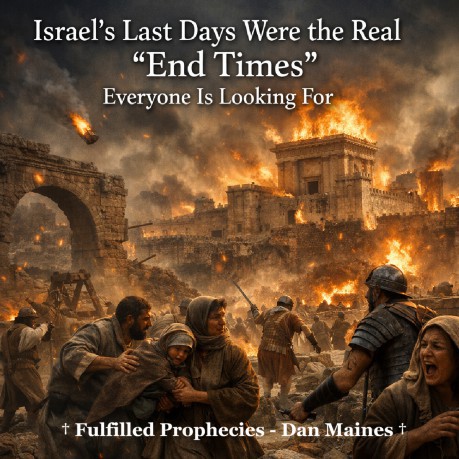
Israel's
Last Days Were the Real "End Times" Everyone Is Looking For Introduction † Most people
hear "end times" and think about the end of the planet, but
that's not how the Bible uses that language. Hebrews 1:1-2
God, after He spoke long ago to the fathers in the prophets in many
portions and in many ways, in these last days has spoken to us in His
Son, whom He appointed heir of all things, through whom He also made
the world.
† The writer
of Hebrews says God has spoken at the end of these days, not at the
end of our days thousands of years later. Acts 2:16-17 but this is
what has been spoken through the prophet Joel: 'And
it shall be in the last days,' God says, † Peter
doesn't say this will happen thousands of years later, he says this
is that, meaning Joel's last days prophecy was being fulfilled right
then (Acts 2:16). 1 Corinthians 10:11
Now these things happened to them as an example, and they were
written for our instruction, upon whom the ends of the ages have
come.
† Paul says
the ends of the ages had already come upon them, not upon a future
generation thousands of years later. Matthew 24:34
Truly I say to you, this generation will not pass away until all
these things take place.
† Jesus tied
all end time events to this generation, the one he was speaking to,
not a future generation 2000 years later. 2 Timothy 3:1 But realize this, that in the last days
difficult times will come.
† Paul tells
Timothy about last days conditions as something relevant to his own
time, not thousands of years later. Historical References † Eusebius
records that the destruction of Jerusalem in AD 70 fulfilled the
warnings given by Christ about that generation. How it applies to us
today † We're not
waiting for the last days, we're living in what came after them, the
fulfilled kingdom reality. Q&A Appendix Q:
Doesn't last days mean the end of the world? Q:
What about all the destruction language? Q:
Are we still waiting for end times? Q:
What about 2 Peter 3 and the heavens and earth passing away? Q:
What about the phrase end of the age? Q:
Why do so many people still think it's future? Q:
Did anything actually end? Q:
Are we living in the last days now? Q:
What did the last days lead into? Q:
Does this remove fear about the future? † This is the fulfilled
perspective we proclaim at Fulfilled Prophecies † Source Index † Josephus,
Wars of the Jews, Book 5-6; Eusebius, Ecclesiastical History Book 3;
Tacitus, Histories 5.13
By Dan Maines
†
The Bible defines its own terms, and when it speaks about "last
days," it's talking about the last days of something specific,
not the destruction of the physical world.
†
If we let scripture interpret scripture, we'll see clearly that the
apostles said they were already living in the last days.
†
That means what people are still waiting for has already happened,
and it happened in the first century.
†
The last days were not the end of the world, they were the end of
Israel's covenant age.
†
He places himself and his audience in the last days, showing this
wasn't future to us, it was present to them (Hebrews 1:2).
†
The contrast is between the old covenant prophets and the final
revelation in the Son, meaning the old covenant age was coming to its
end (Hebrews 8:13).
'That
I will pour out My Spirit on all mankind;
And
your sons and your daughters will prophesy,
And
your young men will see visions,
And
your old men will have
dreams;
†
The outpouring of the Spirit marked the beginning of the last days,
not the end of the planet (Joel 2:28-32).
†
The apostles understood they were living in the last days of Israel's
covenant world, not waiting for a distant future event (1 Peter
1:20).
†
This shows multiple covenant ages were reaching their climax in the
first century, specifically the old covenant age (Matthew 24:3).
†
The phrase ends of the ages confirms that what was ending was a
covenantal system, not the physical creation (2 Corinthians 5:17).
†
That means the last days had a clear time limit, and they were
fulfilled within that generation (Luke 21:32).
†
This completely removes the idea of a distant, still-future end times
scenario (Matthew 16:27-28).
†
When you read the context, those exact behaviors were already present
in the first century church (2 Timothy 3:5-7).
†
This shows the last days were not future to us, they were already
unfolding in their lifetime.
†
Josephus, an eyewitness, describes the fall of Jerusalem as a
catastrophic end of the Jewish age, exactly matching the language of
judgment Jesus used.
†
Josephus describes the temple's destruction and the end of the Jewish
system, confirming this was the end of that age, not the end of the
world.
†
Tacitus also confirms the devastation of Judea, showing this wasn't
symbolic speculation, it was real historical fulfillment.
†
The fear-driven end times mindset disappears when we understand those
events already happened.
†
Our focus isn't on escaping a future destruction, it's on living in
the completed work of Christ.
†
We've moved beyond the old covenant world into the fullness of what
Christ established.
A:
No, the Bible defines it as the last days of the old covenant age,
and the apostles said they were already in it (Hebrews 1:2, Acts
2:16-17).
A:
That language was covenant judgment language used by the prophets,
and it was fulfilled in the destruction of Jerusalem (Matthew 24:34,
Luke 21:20-22).
A:
No, the end times already happened in the first century, they were
the last days of Israel's covenant system (1 Corinthians 10:11).
A:
Peter was using Old Testament prophetic language for covenant
judgment, just like Isaiah did, and he said it was about to happen in
his audience's lifetime (2 Peter 3:10-12, Isaiah 34:4).
A:
Jesus used that phrase to describe the end of the age they were
living in, and he said it would happen in that generation (Matthew
24:3, Matthew 24:34).
A:
Because they redefine words like generation and ignore the time
statements that clearly place these events in the first century
(Matthew 16:27-28, Luke 21:22).
A:
Yes, the old covenant system, the temple, the sacrifices, and the
entire Jewish age came to its end in AD 70 (Hebrews 8:13, Luke
21:20).
A:
No, the last days ended with the destruction of Jerusalem, we're now
living in the fulfilled kingdom that came after (1 Corinthians
10:11).
A:
They led into the fully established kingdom of Christ, where access
to God is no longer tied to the old covenant system (Hebrews 12:28).
A:
Yes, because we're not waiting for global destruction, we're living
in the finished work of Christ and the kingdom that cannot be shaken
(Hebrews 12:27-28).
©
Fulfilled Prophecies - Dan Maines.
Links