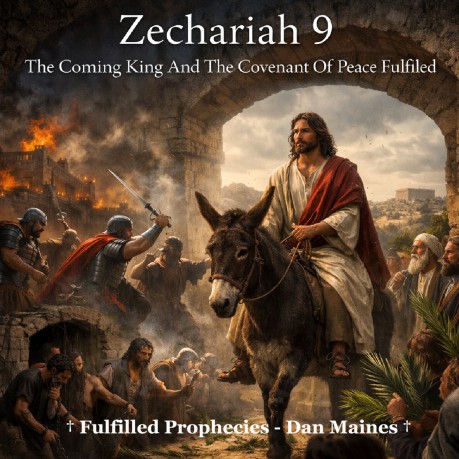
Zechariah 9 The Coming King
And The Covenant Of Peace Fulfilled Introduction † Zechariah 9 shifts from restoration language
into clear Messianic fulfillment, showing the judgment of surrounding
nations and the arrival of the true King. This isn't future, it's
fulfilled in Christ's first coming and the events leading to AD 70. † The chapter connects directly to the
transition from the old covenant system into the reign of Christ,
where the nations are brought under His rule, not by military
conquest, but by covenant victory. † What we're seeing here is the overthrow of
the old order and the establishment of the Kingdom that Jesus said
was at hand. Zechariah 9:1-2 The pronouncement of the word of the Lord is against the land of
Hadrach, with Damascus as its resting place (for the eyes of mankind,
especially of all the tribes of Israel, are toward the Lord), and
Hamath also, which borders on it; Tyre and Sidon, though they are
very wise. † This is a declaration of judgment against the
surrounding nations, showing that God wasn't only dealing with
Israel, but with all nations in that generation (Matthew 24:30). † The phrase eyes of mankind and of all the
tribes of Israel are toward the Lord shows a turning point, where
attention is shifting toward God's unfolding plan, fulfilled in
Christ (Luke 2:30-32). † These regions historically fell under
judgment through successive empires, culminating in Roman dominance,
setting the stage for the Messiah's arrival. Zechariah 9:3-4 For Tyre built herself a fortress and piled up silver like dust,
and gold like the mud of the streets. Behold, the Lord will
dispossess her and throw her wealth into the sea; and she will be
consumed with fire. † Tyre represents human strength and wealth,
yet God shows that no earthly power can stand against His plan (Acts
17:24-26). † This was historically fulfilled in Alexander
the Great's destruction of Tyre, demonstrating that God was already
preparing the world stage before Christ came. † It proves that prophecy isn't vague, it's
rooted in real historical events leading up to Christ's kingdom. Zechariah 9:5-7 Ashkelon will see it and be afraid. Gaza also will writhe in great
pain; and Ekron, because her expectation has been confounded.
Moreover, the king will perish from Gaza, and Ashkelon will not be
inhabited. And a people of mixed origins will live in Ashdod, and I
will eliminate the pride of the Philistines. I will remove their
blood from their mouth and their detestable things from between their
teeth. Then they also will be a remnant for our God, and be like a
clan in Judah, and Ekron like a Jebusite. † The judgment of the Philistine cities shows
the removal of pagan dominance, making way for inclusion into God's
covenant people. † Notice even here, there's mercy, a remnant
shall be for our God, showing Gentile inclusion, fulfilled in the
gospel (Ephesians 2:11-19). † Ekron as a Jebusite points to former enemies
becoming part of God's people, just like the nations brought into
Christ. Zechariah 9:8 But I will camp around My house because of an army, so that no one
will pass through or return; and no oppressor will pass over them
anymore, for now I have seen with My eyes. † God promises protection over His true house,
not the physical temple, but His people (Hebrews 12:22-24). † This was fulfilled when the church was
preserved while judgment fell on Jerusalem in AD 70 (Luke 21:20-22). † The true house of God wasn't destroyed, it
was established. Zechariah 9:9 Rejoice greatly, daughter of Zion! Shout in triumph, daughter of
Jerusalem! Behold, your king is coming to you; He is righteous and
endowed with salvation, humble, and mounted on a donkey, even on a
colt, the foal of a donkey. † This is directly fulfilled in Jesus' entry
into Jerusalem (Matthew 21:4-5). † The King didn't come as a military conqueror,
but as the one bringing salvation through covenant fulfillment. † This proves the Kingdom wasn't physical and
political, but spiritual and covenantal. Zechariah 9:10 I will eliminate the chariot from Ephraim and the horse from
Jerusalem; and the bow of war will be eliminated. And He will speak
peace to the nations; and His dominion will be from sea to sea, and
from the River to the ends of the earth. † This shows the end of physical warfare as the
means of God's kingdom, replaced by peace through Christ (John
18:36). † His dominion from sea to sea is fulfilled
through the spread of the gospel across the known world in the first
century (Colossians 1:23). † This isn't waiting for the future, it's
already happened. Zechariah 9:11-12 As for you also, because of the blood of My covenant with you, I
have set your prisoners free from the waterless pit. Return to the
stronghold, you prisoners who have hope; this very day I am declaring
that I will restore double to you. † The blood of My covenant points directly to
Christ's sacrifice (Matthew 26:28). † The prisoners being set free is fulfilled in
spiritual deliverance from sin and death (Romans 6:6-7). † This is covenant language, not future
speculation. Zechariah 9:13-15 For I will bend Judah as My bow, I will fill the bow with Ephraim;
and I will stir up your sons, Zion, against your sons, Greece, and I
will make you like a warrior's sword. Then the Lord will appear over
them, and His arrow will go forth like lightning; and the Lord God
will blow the trumpet, and will march in the storm winds of the
south. The Lord of armies will defend them; and they will devour and
trample on the sling stones; and they will drink and be boisterous as
with wine; and they will be filled like a sacrificial basin, drenched
like the corners of the altar. † This reflects the conflict between Jewish
believers and the Greek world, fulfilled during the spread of the
gospel into Gentile territories (Acts 17). † The imagery is symbolic of covenant victory,
not literal warfare. † God was actively establishing His Kingdom
through His people. Zechariah 9:16-17 And the Lord their God will save them on that day as the flock of
His people; for they are like the stones of a crown, sparkling in His
land. For what comeliness and beauty will be theirs! Grain will make
the young men flourish, and new wine the virgins. † This is the salvation of God's people in that
generation, fulfilled through Christ (Luke 21:28). † The imagery of a crown shows honor and
restoration, fulfilled in the church (1 Peter 2:9). † This is the beauty of the fulfilled Kingdom,
not something we're still waiting on. Historical References † Josephus recorded the destruction of
Jerusalem and the surrounding regions, confirming the judgment spoken
of in the prophets. † Eusebius wrote that believers fled Jerusalem
before its destruction, showing God's protection over His people. † Tacitus confirms the widespread upheaval and
fulfillment of judgment during that period. How It Applies To Us Today † We're not waiting for a coming King, He
already came and established His Kingdom. † We're living in the peace He brought, not
looking for a future earthly rule. † The covenant has already been fulfilled, and
we're part of that completed work. † Our identity isn't tied to physical Israel,
but to Christ and His Kingdom. † We walk in the freedom purchased by the blood
of the covenant. Q & A Appendix Q When was Zechariah 9:9 fulfilled? Q What does dominion from sea to sea mean? Q Who are the prisoners set free? Q Is this talking about a future kingdom? Q Are the nations included in this promise? † This is the fulfilled perspective we proclaim at
Fulfilled Prophecies † Source Index † Zechariah 9
By Dan Maines
A
Matthew 21:4-5 shows Jesus entering Jerusalem on a donkey, fulfilling
this directly.
A
Colossians 1:23 shows the gospel had already gone into all the world
in that generation.
A
Romans 6:6-7 shows believers freed from sin through Christ.
A
Luke 21:32 shows all these things were fulfilled in that generation.
A
Ephesians 2:13-19 shows Gentiles brought near and made part of God's
people.
© Fulfilled Prophecies - Dan
Maines.
†
Josephus, Wars of the Jews; Eusebius, Ecclesiastical History;
Tacitus, Histories
Links