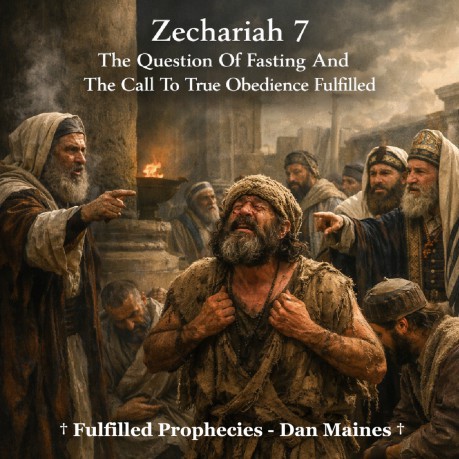
Zechariah 7 The Question Of
Fasting And The Call To True Obedience Fulfilled Introduction † The people came asking about religious
practice, but God answered their heart condition instead (Zechariah
7:1-3) † This chapter exposes empty religion, outward
acts without inward obedience, which had already been judged in their
history (Isaiah 58:3-7) † From the fulfilled perspective, this points
directly to the first century generation that kept traditions while
rejecting Christ (Matthew 23:27-28) Zechariah 7:1-3 In the fourth year of King Darius, the word of the Lord came to
Zechariah on the fourth day of the ninth month, which is Chislev. Now
the town of Bethel had sent Sharezer and Regem-melech and their men
to seek the favor of the Lord, speaking to the priests who belong to
the house of the Lord of armies, and to the prophets, saying, Should
I weep in the fifth month and abstain, as I have done these many
years? † They asked about fasting, but missed the
whole point of why judgment came in the first place (Jeremiah 7:5-7) † Their concern was ritual, not righteousness,
which is the same problem Jesus confronted (Matthew 15:8-9) † This shows religion can continue outwardly
even after judgment if the heart hasn't changed (Ezekiel 33:31) Zechariah 7:4-6 Then the word of the Lord of armies came to me, saying, Say to all
the people of the land and to the priests, When you fasted and
mourned in the fifth and seventh months these seventy years, was it
actually for Me that you fasted? And when you eat and drink, do you
not eat for yourselves and drink for yourselves? † God exposes that their fasting was never
truly for Him, it was self-centered (Isaiah 1:11-13) † Even their religious acts were about
themselves, not about obedience or justice (Micah 6:6-8) † This directly connects to the hypocrisy of
the Pharisees, who fasted to be seen by men (Matthew 6:16-18) Zechariah 7:7 Are these not the words which the Lord proclaimed by the former
prophets, when Jerusalem was inhabited and prosperous along with its
cities around it, and the Negev and the foothills were inhabited? † God points them back to what was already
spoken, they didn't lack knowledge, they lacked obedience (Jeremiah
25:4-7) † The prophets had already warned them before
destruction came (2 Chronicles 36:15-16) † This shows that judgment wasn't sudden or
unfair, it was the result of long rejection (Luke 13:34-35) Zechariah 7:8-10 Then the word of the Lord came to Zechariah, saying, The Lord of
armies has said this: Dispense true justice, practice kindness and
compassion each to his brother, and do not oppress the widow or the
orphan, the stranger or the poor, and do not devise evil in your
hearts against one another. † This is what God actually required, justice,
mercy, and truth (Hosea 6:6) † Their failure wasn't lack of fasting, it was
lack of righteousness (Isaiah 58:6-7) † Jesus repeated this exact standard, exposing
their failure again in His generation (Matthew 23:23) Zechariah 7:11-12 But they refused to pay attention and turned a stubborn shoulder
and plugged their ears so that they would not hear. They also made
their hearts as hard as diamond so that they could not hear the Law
and the words which the Lord of armies had sent by His Spirit through
the former prophets; therefore great wrath came from the Lord of
armies. † Their rebellion was willful, they chose not
to hear (Acts 7:51) † Hardness of heart is what brings judgment,
not ignorance (Hebrews 3:7-8) † This same hardened condition existed in the
first century leading to Jerusalem's destruction in AD 70 (Matthew
13:14-15) Zechariah 7:13-14 And just as He called and they would not listen, so they called
and I would not listen, says the Lord of armies; but I scattered them
with a storm wind among all the nations whom they have not known. So
the land is desolated behind them so that no one went back and forth,
for they made the pleasant land desolate. † This is the direct result of rejecting God's
voice, He turns away when they cry (Proverbs 1:24-28) † The scattering was fulfilled historically,
showing God keeps His word in judgment (Deuteronomy 28:64) † This pattern repeats in the fulfilled
destruction of Jerusalem, where those who rejected Christ faced the
same outcome (Luke 21:20-24) Historical References † Josephus records the destruction of Jerusalem
as the result of internal corruption and rejection of truth,
confirming the same pattern seen in Zechariah † Eusebius wrote that the early Christians fled
Jerusalem before its destruction, showing they understood the
warnings and obeyed them † Tacitus described the devastation of Judea,
confirming the historical reality of scattering and desolation How It Applies To Us Today † God isn't looking for empty religious
routines, He's looking for obedience and truth (John 4:23-24) † It's easy to fall into outward religion while
ignoring the heart, just like they did (2 Timothy 3:5) † We must examine whether what we do is truly
for God or for ourselves (Galatians 1:10) † The warning still stands, if we refuse to
hear, judgment follows, but if we listen, there's life (Hebrews
12:25) Q & A Appendix Q What was wrong with their fasting? Q What did God actually require instead? Q Why did judgment come upon them? Q How does this connect to the first century? Q What should we learn from this today? † This is the fulfilled perspective we proclaim at
Fulfilled Prophecies † Source Index † Zechariah 7
By Dan Maines
A
It wasn't done for God, it was self-centered and empty, Isaiah 58:3-5
A
Justice, mercy, and compassion, Micah 6:8
A
They refused to listen and hardened their hearts, Zechariah 7:11-12
A
The same rejection of truth led to Jerusalem's destruction, Matthew
23:37-38
A
True obedience matters more than religious activity, John 14:15
© Fulfilled Prophecies - Dan
Maines.
†
Josephus, Eusebius, Tacitus
Links