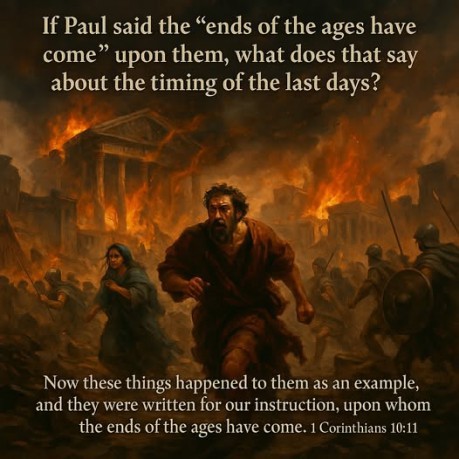
If
Paul said the "ends of the ages have come" upon them, what
does that say about the timing of the last days (1 Corinthians
10:11)? This tells us plainly that they were
living in the time of the end, not us. The "last days"
weren't stretched out for thousands of years, they were the final
days of the Old Covenant age, which was about to be fully removed in
their generation (Hebrews 8:13). It means the last days were not about
the end of the physical planet, but the end of the covenantal age.
The first-century believers were the ones upon whom the culmination
of all previous ages had come. That's why Peter could say, "the
end of all things is at hand" (1 Peter 4:7), and the writer of
Hebrews said, "He has appeared once for all at the consummation
of the ages" (Hebrews 9:26). So if the end of the ages had come upon
them, it cannot be about our future. It was their present. Audience Relevance Matters: Paul was
writing to first-century Corinthians, not to us. He said "upon
whom the ends of the ages have come," meaning it was their
generation experiencing the transition from the Old Covenant to the
New. If the end had come upon them, then we are not in the last days,
they were. This Matches Jesus' Timeline: Jesus
said "this generation will not pass away until all these things
take place" (Matthew 24:34). Paul's statement confirms Jesus'
prophecy was unfolding in their time. It Confirms Imminence Was Real: Many
futurists try to water down the meaning of "at hand,"
"soon," or "about to be," but Paul's words here
prove that the early church truly expected and was experiencing the
end of the age. It Ties to Daniel's Prophecy: Daniel
spoke of the "time of the end" (Daniel 12:4, 9), not the
end of time, but the time when the Old Covenant system would come to
a close. Paul is confirming that time had arrived. The Word "Ages" Is Plural:
Paul says "ends of the ages," implying that multiple prior
covenantal ages were reaching their fulfillment in that generation,
not just the end of one era, but the climax of redemptive history
that had been unfolding since Adam. Cross Reference with Hebrews 1:2: God
"has spoken to us in His Son... in these last days", not
"He will speak in some future last days." They were already
in them.
By Dan Maines
Links