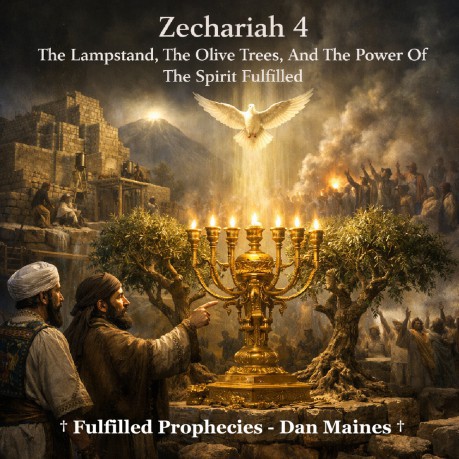
Zechariah 4 The Lampstand,
The Olive Trees, And The Power Of The Spirit Fulfilled Introduction † Zechariah 4 shows how God's work is
accomplished, not by human strength, but by His Spirit, and this was
fulfilled in the restoration of God's people and ultimately in Christ
establishing the true temple (Zechariah 4:6; Ephesians 2:21-22). † The vision was given in the days of
Zerubbabel, but it pointed beyond the physical temple to the
spiritual reality fulfilled in Christ and His body (Zechariah 4:9; 1
Corinthians 3:16). † From the fulfilled perspective, this chapter
shows that God's presence and power were never dependent on a
building, but on His Spirit dwelling in His people (Acts 1:8; John
7:38-39). Zechariah 4:1-3 † The lampstand represents God's people as His
light in the world, sustained by Him (Revelation 1:20; Matthew 5:14). † The seven lamps show completeness, meaning
God's provision is full and lacking nothing (James 1:17; Psalm
18:30). † The olive trees show a constant supply of
oil, pointing to the Spirit as the source of life and power (Romans
8:9; John 7:38-39). Zechariah 4:4-6 † This is the central truth, God's work is done
by His Spirit, not by human strength (Zechariah 4:6; Acts 1:8). † Zerubbabel's work pointed forward to Christ,
who builds the true temple (Zechariah 6:12-13; Ephesians 2:21-22). † The kingdom didn't come through political
force, but through the Spirit working through Christ (John 18:36;
Acts 2:1-4). Zechariah 4:7 † The mountain represents opposition and
obstacles, but God removes them (Isaiah 40:4; Matthew 17:20). † What stands against God's purpose is leveled
by His authority (Psalm 46:1-3; Daniel 2:35). † Grace is both the foundation and the
completion of God's work (Ephesians 2:8-9; Romans 11:6). Zechariah 4:8-10 † What God begins, He completes (Philippians
1:6; Hebrews 12:2). † God uses small beginnings to accomplish great
things (1 Corinthians 1:27; Matthew 13:31-32). † The eyes of the Lord show His full awareness
and authority over all things (2 Chronicles 16:9; Proverbs 15:3). Zechariah 4:11-14 † The two anointed ones refer to Zerubbabel and
Joshua, representing king and priest (Haggai 1:1; Zechariah 3:1). † This finds its fulfillment in Christ, who
unites both roles (Hebrews 7:1-2; Psalm 110:4). † The flowing oil shows the continual supply of
the Spirit (John 7:38-39; Romans 5:5). Historical References † Josephus confirms the rebuilding of the
temple under Zerubbabel (Josephus, Antiquities of the Jews, Book 11). † Eusebius connects the temple imagery to
Christ and the church as God's dwelling (Eusebius, Ecclesiastical
History). † Irenaeus teaches that the Spirit is the life
of the church, aligning with the oil imagery (Irenaeus, Against
Heresies). How It Applies To Us Today † God's work in us isn't by our strength, it's
by His Spirit (Zechariah 4:6; Romans 8:11). † Obstacles don't stop God's plan, He removes
them in His time (Matthew 17:20; Isaiah 54:17). † We are now the temple where God dwells (1
Corinthians 3:16; Ephesians 2:22). † What seems small in our lives is still part
of God's finished work (Philippians 1:6; Zechariah 4:10). † Everything begins and ends with grace
(Ephesians 2:8-9; Romans 5:2). Q & A Appendix Q What does the lampstand represent? Q What does Not by might nor by power mean? Q Who are the two olive trees? Q What is the great mountain? Q How is this fulfilled? † This is the fulfilled perspective we proclaim at
Fulfilled Prophecies † Source Index † Zechariah 4
By Dan Maines
Then the angel who was
speaking with me returned and woke me, as a man who is awakened from
his sleep.
And he said to me, What do you see? And I said, I
see, and behold, a lampstand all of gold with its bowl on the top of
it, and its seven lamps on it with seven spouts belonging to each of
the lamps which are on the top of it;
also two olive trees by
it, one on the right side of the bowl and the other on its left side.
Then I said to the angel who
was speaking with me, saying, What are these, my lord?
So the
angel who was speaking with me answered and said to me, Do you not
know what these are? And I said, No, my lord.
Then he said to
me, This is the word of the Lord to Zerubbabel saying, Not by might
nor by power, but by My Spirit, says the Lord of armies.
What are you, you great
mountain? Before Zerubbabel you will become a plain; and he will
bring out the top stone with shouts of Grace, grace to it.
Also the word of the Lord
came to me, saying,
The hands of Zerubbabel have laid the
foundation of this house, and his hands will finish it. Then you will
know that the Lord of armies has sent me to you.
For who has
shown contempt for the day of small things? But these seven will be
glad when they see the plumb line in the hand of Zerubbabel, these
are the eyes of the Lord roaming throughout the earth.
Then I said to him, What
are these two olive trees on the right of the lampstand and on its
left?
And I said to him the second time, What are the two olive
branches which are beside the two golden pipes, which empty the
golden oil from themselves?
So he answered me, saying, Do you
not know what these are? And I said, No, my lord.
Then he said,
These are the two anointed ones who are standing by the Lord of the
whole earth.
A
It represents God's people as His light in the world (Revelation
1:20; Matthew 5:14).
A
It means God's work is accomplished by His Spirit, not human strength
(Zechariah 4:6; Acts 1:8).
A
They represent God's anointed servants, fulfilled in Christ as King
and Priest (Zechariah 4:14; Hebrews 7:1-2).
A
It represents obstacles that God removes (Zechariah 4:7; Isaiah
40:4).
A
It was fulfilled in the temple restoration and fully in Christ
establishing the true temple (Ephesians 2:21-22; 1 Corinthians 3:16).
© Fulfilled Prophecies - Dan
Maines.
†
Josephus, Antiquities of the Jews, Book 11; Eusebius, Ecclesiastical
History; Irenaeus, Against Heresies
Links