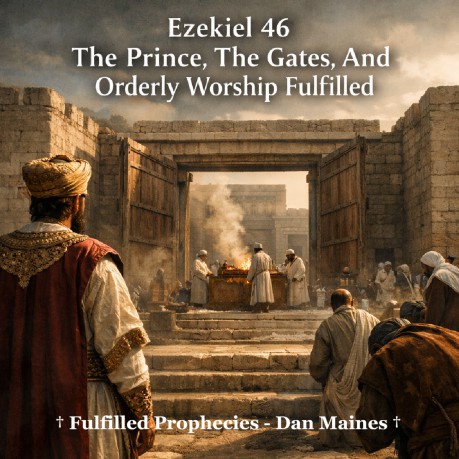
Ezekiel 46 The Prince, The
Gates, And Orderly Worship Fulfilled Introduction † Ezekiel 46 continues the vision of ordered
worship, showing access, sacrifice, and leadership under God's
authority (Ezekiel 46:1) † The focus is on the prince, the people, and
the gates, revealing structure, reverence, and access that all point
forward to Christ and the New Covenant reality (Ezekiel 46:2) † From the fulfilled perspective, this isn't
about a future temple system, it's about Christ establishing true
access and proper worship, completed by the end of the Old Covenant
age in AD 70 (John 4:21-24) Ezekiel 46:1-3 † The gate being opened at appointed times
shows controlled access, pointing to how access to God was restricted
under the Old Covenant (Hebrews 9:8) † The prince standing at the threshold shows a
mediator role, but not full access, pointing forward to Christ who
would bring full access (Hebrews 10:19-20) † The people worshiping at the gate shows
distance, but in Christ, that distance is removed and we draw near
directly (Ephesians 2:13) Ezekiel 46:4-7 † These repeated offerings show the
insufficiency of the Old Covenant system, it had to be done
continually (Hebrews 10:1-3) † The requirement of spotless offerings points
directly to Christ as the perfect sacrifice once for all (1 Peter
1:18-19) † The prince offering sacrifices shows he
himself isn't the final solution, Christ alone fulfills that role
completely (Hebrews 7:27) Ezekiel 46:8-10 † This order shows reverence and structure in
approaching God, not casual access (1 Corinthians 14:40) † Entering one way and leaving another shows
transformation, you don't come to God and leave the same (2
Corinthians 5:17) † The prince being among the people shows
identification, fulfilled in Christ who dwells among His people (John
1:14) Ezekiel 46:11-15 † The daily sacrifice shows constant need for
atonement, pointing to the unfinished nature of that system (Hebrews
10:11) † The freewill offering shows voluntary
devotion, fulfilled in Christ who willingly gave Himself (John 10:18) † The continual offering is fulfilled in
Christ's one sacrifice that ended all others (Hebrews 10:12-14) Ezekiel 46:16-18 † This shows protection of inheritance,
pointing to God's faithfulness to preserve His people (1 Peter 1:4) † The year of liberty reflects Jubilee
principles, fulfilled in Christ bringing true freedom (Luke 4:18-19) † The prince not oppressing the people
contrasts with corrupt leaders, fulfilled when Christ removes unjust
leadership (Matthew 23:37-38) Ezekiel 46:19-24 † These preparation areas show separation
between holy and common, emphasizing holiness (Leviticus 10:10) † The structure reflects order in sacrifice,
but also shows complexity that pointed forward to something better
(Hebrews 8:5) † All of this is fulfilled in Christ, who
removed the need for physical sacrifice systems entirely (Hebrews
9:11-12) Historical References † Josephus records the strict temple
regulations and priestly duties, showing how seriously these
structures were taken in the first century (Josephus, Antiquities of
the Jews, Book 15) † Eusebius notes the destruction of the temple
in AD 70 as the end of the sacrificial system (Eusebius,
Ecclesiastical History, Book 3) † Tacitus describes the fall of Jerusalem and
the temple, confirming the historical fulfillment of the end of that
system (Tacitus, Histories 5.13) How It Applies To Us Today † We don't approach God through gates, rituals,
or priests, we have direct access through Christ (Hebrews 4:16) † Worship isn't about physical structures, it's
about spirit and truth (John 4:23-24) † The order and reverence still matter, but now
it's internal, not tied to a building (1 Corinthians 3:16) † Christ has fulfilled all sacrifice, so we
don't return to shadows when the reality has come (Colossians
2:16-17) † Our inheritance is secure, not in land, but
in the kingdom that cannot be shaken (Hebrews 12:28) Q & A Appendix Q Was Ezekiel describing a future physical
temple? Q Who is the prince in Ezekiel 46? Q Why were sacrifices still required in this
vision? Q What do the gates represent? Q When was this fulfilled? † This is the fulfilled perspective we proclaim at
Fulfilled Prophecies † Source Index † Ezekiel 46
By Dan Maines
This is what the Lord GOD
says: The gate of the inner courtyard facing east shall be shut the
six working days, but it shall be opened on the Sabbath day and
opened on the day of the new moon. The prince shall enter by way of
the porch of the gate from the outside and stand by the post of the
gate. Then the priests shall provide his burnt offering and his peace
offerings, and he shall worship at the threshold of the gate and then
go out, but the gate shall not be shut until evening. The people of
the land shall also worship at the doorway of that gate before the
LORD on the Sabbaths and on the new moons.
The burnt offering which the
prince shall offer to the LORD on the Sabbath day shall be six lambs
without blemish and a ram without blemish; and the grain offering
shall be an ephah with the ram, and the grain offering for the lambs
shall be what he is able to give, and a hin of oil with an ephah. On
the day of the new moon he shall offer a bull without blemish, and
six lambs and a ram; they shall be without blemish. And he shall
provide a grain offering, an ephah with the bull and an ephah with
the ram, and for the lambs as much as he is able, and a hin of oil
with an ephah.
When the prince enters, he
shall go in by way of the porch of the gate and go out by the same
way. But when the people of the land come before the LORD at the
appointed feasts, the one who enters by way of the north gate to
worship shall go out by way of the south gate; and the one who enters
by way of the south gate shall go out by way of the north gate. He
shall not return by way of the gate by which he entered, but shall go
out straight ahead. When they go in, the prince shall go in among
them; and when they go out, he shall go out.
At the festivals and the
appointed feasts the grain offering shall be an ephah with a bull and
an ephah with a ram, and for the lambs as much as one is able to
give, and a hin of oil with an ephah. When the prince provides a
voluntary offering, a burnt offering or peace offerings as a
voluntary offering to the LORD, the gate facing east shall be opened
for him. And he shall provide his burnt offering and his peace
offerings as he does on the Sabbath day. Then he shall go out, and
after he goes out the gate shall be shut. And you shall provide a
lamb a year old without blemish as a burnt offering to the LORD
daily; morning by morning you shall provide it. You shall also
provide a grain offering with it morning by morning, a sixth of an
ephah, and a third of a hin of oil to moisten the fine flour, a grain
offering to the LORD continually by a permanent ordinance. So they
shall provide the lamb, the grain offering, and the oil, morning by
morning, for a continual burnt offering.
This is what the Lord GOD
says: If the prince gives a gift out of his inheritance to any of his
sons, it shall belong to his sons; it is their possession by
inheritance. But if he gives a gift from his inheritance to one of
his servants, it shall be his until the year of liberty; then it
shall return to the prince. His inheritance shall be only his sons';
it shall belong to them. The prince shall not take any of the
people's inheritance, driving them out of their possession; he shall
give his sons inheritance from his own possession so that My people
will not be scattered, anyone from his possession.
Then he brought me through
the entrance, which was at the side of the gate, into the holy
chambers for the priests, which faced north; and behold, there was a
place at the extreme rear toward the west. He said to me, This is the
place where the priests shall boil the guilt offering and the sin
offering and where they shall bake the grain offering, so that they
do not bring them out into the outer courtyard to transmit holiness
to the people. Then he brought me out into the outer courtyard and
had me pass by the four corners of the courtyard; and behold, in
every corner of the courtyard there was a courtyard. In the four
corners of the courtyard there were enclosed courtyards, forty cubits
long and thirty wide; these four corner areas had the same
measurement. There was a row of masonry all around in them, around
the four of them, and boiling places were made under the rows all
around. Then he said to me, These are the boiling places where the
ministers of the house shall boil the sacrifices of the people.
A No, this vision pointed forward to
fulfillment in Christ and the end of the Old Covenant system, Hebrews
8:5; Hebrews 10:1
A
The prince represents a leadership role pointing toward Christ, but
not equal to Him in the shadow system, fulfilled in Jesus as the true
ruler, John 18:37
A Because it reflects the Old Covenant
system which was incomplete, pointing forward to Christ's final
sacrifice, Hebrews 10:12
A
Controlled access to God under the Old Covenant, fulfilled in Christ
giving full access, Hebrews 10:19-20
A
This was fulfilled through Christ's work and finalized in AD 70 when
the temple system ended, Matthew 24:1-2
© Fulfilled Prophecies - Dan
Maines.
†
Josephus, Antiquities of the Jews, Book 15; Eusebius, Ecclesiastical
History, Book 3; Tacitus, Histories 5.13
Links