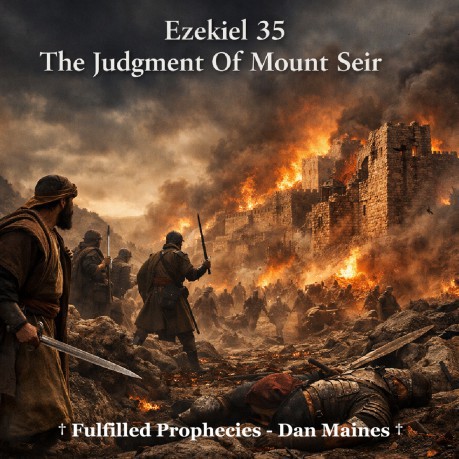
Ezekiel 35 The Judgment Of
Mount Seir Introduction † Ezekiel 35 is a direct judgment against Mount
Seir, representing Edom, the long-standing enemy of Israel (Genesis
36:8). † Edom rejoiced over Israel's fall and sought
to take possession of their land, showing hatred that went back to
Esau and Jacob (Obadiah 10-12). † This judgment was fulfilled in the first
century when God removed the old covenant enemies and fully judged
those who stood against His people, culminating in AD 70 (Luke
21:22). Ezekiel 35:1-4 † God Himself declares He is against Mount
Seir, this isn't just political judgment, it's divine judgment
(Isaiah 34:5). † The desolation shows total covenant judgment,
just like what came upon Jerusalem later (Matthew 23:38). † The purpose is clear, they would know that He
is the Lord, judgment reveals His authority and truth (Ezekiel 6:7). Ezekiel 35:5-9 † Edom's sin is clearly stated, perpetual
hatred, they never let it go (Amos 1:11). † They took advantage of Israel's fall, showing
they were enemies of God's covenant people (Psalm 137:7). † The phrase time of their final punishment
points to covenant judgment reaching its full measure, which we see
completed in the first century (Matthew 23:32). Ezekiel 35:10-13 † Edom thought the land was theirs, but God
says He was there, ownership was always His (Leviticus 25:23). † Their pride and arrogance weren't just
against Israel, they were against God Himself (Proverbs 16:18). † God heard every word, nothing escapes Him,
judgment comes based on truth, not assumption (Ecclesiastes 12:14). Ezekiel 35:14-15 † Edom rejoiced over Israel's fall, and God
turns that same judgment back on them (Galatians 6:7). † This is a reversal principle, what they
celebrated becomes their own destruction (Obadiah 15). † This again shows covenant justice, not random
events, but measured judgment (Romans 2:6). Historical References † Josephus records the Idumeans being involved
in the destruction of Jerusalem and then being destroyed themselves
shortly after, showing this judgment reached its full expression in
the first century (Josephus, Wars of the Jews, Book 4-5). † Eusebius notes the disappearance of Edom as a
distinct people, confirming the prophecy of perpetual desolation
(Eusebius, Ecclesiastical History). † Tacitus records the destruction and upheaval
in Judea and its surrounding regions, aligning with the fulfillment
period (Tacitus, Histories 5). How It Applies To Us Today † God still judges pride and hatred, nothing
has changed, He sees everything (James 4:6). † Rejoicing in someone else's fall is
condemned, we're called to righteousness, not revenge (Proverbs
24:17). † God keeps His word completely, what He said
about Edom came to pass, and that builds our confidence in everything
He has promised (2 Peter 3:9). † The fulfilled judgment shows we're not
waiting for these things, they've already happened, and we now live
in the established kingdom (Hebrews 12:28). † It reminds us that opposing God's people is
ultimately opposing God Himself (Acts 9:4). Q & A Appendix Q Who was Mount Seir referring to? Q What was Edom's main sin? Q When was this judgment fulfilled? Q Why does God emphasize you shall know that I am
the Lord? Q What does this teach us today? † This is the fulfilled perspective we proclaim at
Fulfilled Prophecies † Source Index † Ezekiel 35
By Dan Maines
Now the word of the Lord came
to me, saying, Son of man, set your face against Mount Seir and
prophesy against it and say to it, This is what the Lord God says:
Behold, I am against you, Mount Seir, and I will stretch out My hand
against you and make you a waste and a desolation. I will turn your
cities into ruins and you will become a desolation. Then you will
know that I am the Lord.
Because you have had
everlasting hostility and have handed over the sons of Israel to the
power of the sword at the time of their disaster, at the time of
their final punishment, therefore as I live, declares the Lord God, I
will give you over to bloodshed, and bloodshed will pursue you; since
you have not hated bloodshed, therefore bloodshed will pursue you. So
I will make Mount Seir a waste and a desolation, and I will cut off
from it one who passes through and returns. I will fill its mountains
with its slain; on your hills, in your valleys, and in all your
streams, those slain by the sword will fall. I will make you an
everlasting desolation, and your cities will not be inhabited. Then
you will know that I am the Lord.
Because you have said,
These two nations and these two lands will be mine, and we will
possess them, although the Lord was there, therefore as I live,
declares the Lord God, I will deal with you according to your anger
and according to your envy which you showed because of your hatred
against them; so I will make Myself known among them when I judge
you. Then you will know that I, the Lord, have heard all your insults
which you have spoken against the mountains of Israel, saying, They
are laid desolate; they have been given to us as food. And you have
spoken arrogantly against Me and have multiplied your words against
Me; I have heard it.
This is what the Lord God
says: As all the earth rejoices, I will make you a desolation. Just
as you rejoiced over the inheritance of the house of Israel because
it was desolate, so I will deal with you. You will be a desolation,
Mount Seir, and all Edom, all of it. Then they will know that I am
the Lord.
A
It refers to Edom, descendants of Esau (Genesis 36:8).
A
Perpetual hatred and rejoicing over Israel's destruction (Amos 1:11;
Obadiah 12).
A
It reached fulfillment in the first century, culminating around AD 70
with the fall of Jerusalem and the destruction of surrounding enemies
(Luke 21:22).
A Because judgment reveals His
authority and confirms His word (Ezekiel 6:7).
A
That God is just, He sees everything, and He repays according to
actions (Romans 2:6).
© Fulfilled Prophecies - Dan
Maines.
†
Josephus, Wars of the Jews, Book 4-5; Eusebius, Ecclesiastical
History; Tacitus, Histories 5
Links