The
Nature of the Resurrection and the Error of Hymenaeus and Philetus As a Preterist, I believe the
resurrection spoken of in scripture was not physical, not the
reanimation of corpses or the return of flesh and blood from the
grave. The dead were raised in new, individual, glorious, spiritual
bodies, not the same bodies that were laid in the dust. As Paul
explained, "what you sow does not come to life unless it dies...
you do not sow the body which is to be, but a bare grain" (1
Corinthians 15:36-37). Let me address the common question
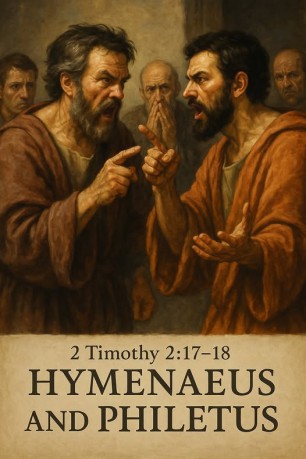
raised from 2 Timothy 2:17-18, "Were Hymenaeus and Philetus
right?" The answer is: They were wrong in timing, not in
nature. 2 Timothy 2:17-18 (NASB): "and their talk
will spread like gangrene. Among them are Hymenaeus and Philetus, men
who have gone astray from the truth, saying that the resurrection has
already taken place, and they upset the faith of some." Paul condemned their teaching
because it said the resurrection had already occurred while
the Temple still stood, implying the Old Covenant and New
Covenant systems overlapped completely. That was the error, mixing
Law and Grace. But Paul did not
rebuke them for claiming the resurrection was spiritual.
If Paul had taught a physical resurrection, he could have easily
exposed them. He could have said, "Go to the cemetery, the
bodies are still there." But Paul gave no such argument. That
silence reveals that the resurrection was not
expected to be seen with the physical eye. 2 Corinthians 4:18 (NASB)
says, "while we look not at the things which are seen, but at
the things which are not seen; for the things which are seen are
temporary, but the things which are not seen are eternal." The
resurrection was eternal and unseen, not subject to physical
verification. 1 Corinthians 15:44 (NASB)
teaches, "It is sown a natural body, it is raised a spiritual
body. If there is a natural body, there is also a spiritual body."
That is the resurrection Paul taught. 1 Corinthians 15:49 (NASB)
says, "Just as we have borne the image of the earthy, we will
also bear the image of the heavenly." It is a transformation
into the image of Christ, not a return to life in the same fleshly
body. If the early church believed in a
physical resurrection, no one would have listened to Hymenaeus and
Philetus. Their claim would have been absurd. The fact that some
believers were shaken shows that the early church expected a
spiritual resurrection, and that it would not be
confirmed by physical evidence. They also must have believed that life on earth would
continue after the resurrection. They did not expect to live on a
new physical earth. If they had, Hymenaeus and Philetus would have
been easily refuted. The resurrection was real. It was a
spiritual body, given by God, not the one buried. It was the raising
of the dead out of the Old Covenant system into the life and
immortality of the New Covenant in Christ. 2 Timothy 1:10 (NASB):
"but has now been revealed by the appearing of our Savior Christ
Jesus, who abolished death and brought life and immortality to light
through the gospel," That is the true hope we now live in. Here is a further clarification for
those who ask: Yes, the dead were not raised in the
same physical bodies. They were raised in spiritual bodies, new,
individual, glorious, immortal, and imperishable. 1 Corinthians 15:36-38 (NASB):
"What you sow does not come to life unless it dies. When you
sow, you do not sow the body which is to be, but a bare grain... but
God gives it a body just as He wished." The natural body was sown in death. God
gave each one a new spiritual body as He determined. It was not flesh
and blood, because: 1 Corinthians 15:50 (NASB):
"Now I say this, brothers and sisters, that flesh and blood
cannot inherit the kingdom of God, nor does the perishable inherit
the imperishable." That is why there were no eyewitnesses.
The spiritual body is not visible to the natural eye. Paul wrote: 2 Corinthians 4:18 (NASB):
"while we look not at the things which are seen, but at the
things which are not seen; for the things which are seen are
temporary, but the things which are not seen are eternal." The resurrection was not seen because
it belonged to the eternal realm, not the visible one. But it was
real, and it fulfilled the hope of Israel. Amen.
By Dan Maines
Links