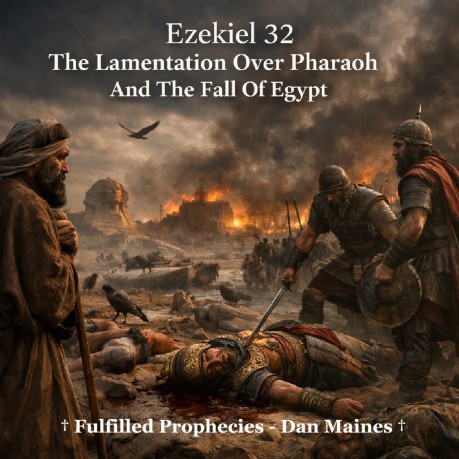
Ezekiel 32 The Lamentation
Over Pharaoh And The Fall Of Egypt Introduction † Ezekiel 32 brings the final word of judgment
against Egypt and Pharaoh, showing that even the greatest kingdoms
fall when they exalt themselves against God (Ezekiel 32:1-2). † This chapter uses imagery of a great sea
monster and a fallen lion, showing how Egypt saw itself as powerful,
yet God shows that pride leads to destruction (Ezekiel 32:2). † From the fulfilled perspective, this judgment
points forward to the complete end of the old covenant world system,
culminating in AD 70 when all opposition to Christ was fully brought
low (Matthew 24:2). Ezekiel 32:1-2 † Pharaoh is called a lion and a sea monster,
showing both power and chaos, but God exposes that his strength only
brought destruction (Ezekiel 32:2). † This mirrors how Rome and Jerusalem both saw
themselves as powerful, yet both were judged when they opposed God's
purposes (Revelation 17:10). † Pride always blinds nations, they think they
control the waters, but God's the one who rules the seas and sets
their limits (Psalm 93:4). Ezekiel 32:3-4 † God says He'll cast Pharaoh down and expose
him publicly, showing that judgment isn't hidden, it's visible for
all to see (Ezekiel 32:4). † This same imagery is used in Revelation,
where judgment leaves bodies exposed, showing total defeat
(Revelation 19:17-18). † When God judges, He brings down what seemed
untouchable, proving that no kingdom stands against Him (Daniel
2:44). Ezekiel 32:7-8 † This is prophetic judgment language, not
literal cosmic collapse, but the fall of a ruling power (Isaiah
13:10). † The same language is used by Jesus in Matthew
24 to describe the fall of Jerusalem in AD 70 (Matthew 24:29). † From the fulfilled perspective, this shows
that Egypt's fall is part of a larger pattern of covenant judgment
that culminates in the end of the old covenant age. Ezekiel 32:11-12 † Babylon's the instrument of judgment, just as
Rome later became the instrument against Jerusalem (Luke 21:24). † God uses nations to judge nations, showing
His sovereignty over history (Habakkuk 1:6). † Pride's always the target, God brings down
those who exalt themselves (James 4:6). Ezekiel 32:17-18 † Egypt joins the nations already judged,
showing that no kingdom escapes death and judgment (Ezekiel 32:18). † This descent into the pit represents the
realm of the dead, showing total defeat and loss of power (Isaiah
14:9). † From the fulfilled perspective, this connects
to the final defeat of all opposing powers by the time of Christ's
kingdom (1 Corinthians 15:25). Ezekiel 32:21 † The fallen nations are pictured as speaking
from Sheol, showing that all earthly power ends the same way (Ezekiel
32:21). † This is a reminder that death's the equalizer
of all kings and empires (Ecclesiastes 3:20). † Christ's victory over death later fulfills
this reality, bringing life where death once ruled (2 Timothy 1:10). Historical References † Josephus records how powerful nations like
Egypt and others fell under greater empires, confirming the pattern
of judgment seen in Ezekiel. † Herodotus also documented Egypt's decline and
conquest, showing that its power didn't last. † Tacitus describes how Rome itself, though
dominant, eventually faced internal collapse, proving that all
kingdoms follow the same path. How It Applies To Us Today † Pride still destroys, individuals and nations
that exalt themselves will be brought low. † God is still sovereign over all rulers,
nothing happens outside His authority. † We should trust in God's kingdom, not earthly
systems, because those systems always fall. † Christ's kingdom is the only one that
remains, and it was fully established when the old system ended. Q & A Appendix Q When was this prophecy fulfilled? Q Is the darkening of the sun literal? Q Why is Pharaoh called a sea monster? Q What does going down to the pit mean? Q How does this connect to the New Testament? † This is the fulfilled perspective we proclaim at
Fulfilled Prophecies † Source Index † Ezekiel 32 † Josephus, Antiquities of the Jews; Herodotus,
Histories; Tacitus, Annals
By Dan Maines
Now in the twelfth year, in
the twelfth month, on the first of the month, the word of the Lord
came to me, saying, Son of man, take up a lamentation over Pharaoh
king of Egypt and say to him, You compared yourself to a young lion
of the nations, yet you are like the monster in the seas; and you
burst forth in your rivers and muddied the waters with your feet and
fouled their rivers.
This is what the Lord God
says: Now I will spread My net over you with an assembly of many
peoples, and they will lift you up in My net. I will leave you on the
land, I will throw you on the open field, and I will make all the
birds of the sky settle on you and satisfy the animals of the whole
earth with you.
When I extinguish you, I will
cover the heavens and darken their stars; I will cover the sun with a
cloud and the moon will not give its light. All the shining lights in
the heavens I will darken over you and will set darkness on your
land, declares the Lord God.
For this is what the Lord
God says: The sword of the king of Babylon will come upon you. I will
make your multitude fall by the swords of the mighty ones, all of
them ruthless nations. And they will devastate the pride of Egypt,
and all its multitude will be destroyed.
Now in the twelfth year, on
the fifteenth of the month, the word of the Lord came to me, saying,
Son of man, wail for the multitude of Egypt and bring it down, her
and the daughters of the powerful nations, to the lower parts of the
earth, with those who go down to the pit.
The strong among the mighty
ones will speak of him and his helpers from the midst of Sheol, They
have gone down, they lie still, the uncircumcised, slain by the
sword.
A
It was fulfilled historically through Babylon's conquest of Egypt,
and prophetically it points forward to the complete judgment of all
opposing powers culminating in AD 70 (Matthew 24:2).
A
No, it's symbolic language used for the fall of nations (Isaiah
13:10; Matthew 24:29).
A
It represents chaos and pride, showing how Egypt disturbed the
nations (Ezekiel 32:2).
A
It refers to death and the end of power, joining other fallen nations
(Ezekiel 32:18).
A
It follows the same judgment pattern seen in the fall of Jerusalem
and the establishment of Christ's kingdom (Luke 21:24; 1 Corinthians
15:25).
© Fulfilled Prophecies - Dan
Maines.
Links