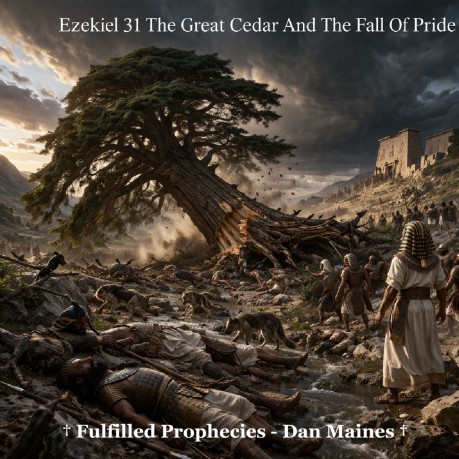
Ezekiel 31 The Great Cedar
And The Fall Of Pride Introduction † This chapter shows us a powerful picture of
pride, power, and downfall through the image of a great tree. God
compares Pharaoh and Egypt to Assyria, showing that even the greatest
kingdoms fall when they exalt themselves. † The message is simple and direct, no nation,
no ruler, no man stands when they lift themselves above God. † This wasn't just history, it was a warning
that was fulfilled in their generation and still speaks clearly
today. Scripture Ezekiel 31:1-2 † God begins by confronting Pharaoh directly,
asking who he thinks he is like in greatness. This is a challenge to
pride. † This question exposes the illusion of power.
Pharaoh thought he stood above others, but God brings him into
comparison. † This sets the tone, no ruler is beyond
accountability, no matter how great they appear. Ezekiel 31:3 † Assyria is pictured as a massive cedar,
strong, beautiful, and towering above all others. † This represents worldly power at its peak,
nations that dominate and seem untouchable. † But the focus isn't just on strength, it's on
how that strength led to pride. Ezekiel 31:4-5 † The growth of Assyria came from abundant
provision, God allowed it to rise. † Its expansion and influence spread far,
affecting many nations. † This shows that even worldly success
ultimately comes under God's control. Ezekiel 31:6 † Nations depended on Assyria, just like
creatures depend on a great tree. † This shows political and economic dominance,
others lived under its protection. † Yet this also reveals how fragile that system
is when the source is removed. Ezekiel 31:7-9 † God makes it clear, He was the one who made
Assyria great. † The comparison to Eden shows unmatched beauty
and prominence. † Yet even what God builds can fall when pride
enters. Ezekiel 31:10 † The problem is identified clearly, pride. † The issue wasn't strength, it was the heart
being lifted up. † Pride is always the turning point before
judgment. Ezekiel 31:11-12 † God handed Assyria over to destruction
through other nations. † What once stood tall was cut down and
scattered. † This shows how quickly power collapses when
God removes protection. Ezekiel 31:13-14 † The fallen tree becomes a place of ruin
instead of life. † This serves as a warning to all nations,
don't exalt yourself. † Death is the equalizer, every man and nation
faces it. Ezekiel 31:15-17 † The fall of Assyria shook the nations. † Those who depended on it fell with it. † This shows the ripple effect of judgment. Ezekiel 31:18 † God brings it back to Pharaoh, this is your
future. † Egypt would follow the same path as Assyria. † Pride always ends the same way, brought down
to the grave. Historical References † Josephus records the fall of Assyria and the
rise of Babylon, confirming the shift of power exactly as Ezekiel
described, Antiquities of the Jews, Book 10. † Herodotus writes of Egypt's decline and
foreign domination, showing Pharaoh's loss of power. † Eusebius confirms the historical sequence of
these empires and their downfall. How It Applies To Us Today † Pride still brings people down, just like it
brought down nations. † God still resists the proud and humbles those
who exalt themselves, James 4:6. † No position, wealth, or influence makes
anyone untouchable. † We're called to walk humbly, knowing
everything we have comes from God. † This reminds us that earthly greatness
doesn't last, but what God builds in Christ does. Q & A Appendix Q: Who was the cedar in Ezekiel 31? Q: Why did God judge Assyria? Q: What was the warning to Pharaoh? Q: When was this fulfilled? Q: What lesson does this teach us? † This is the fulfilled perspective we proclaim at
Fulfilled Prophecies † Source Index † Ezekiel 31
By Dan Maines
Now in the eleventh year, in
the third month, on the first of the month, the word of the Lord came
to me, saying, Son of man, say to Pharaoh king of Egypt and to his
hordes, Whom are you like in your greatness?
Behold, Assyria was a cedar in
Lebanon with beautiful branches and forest shade, and very high, and
its top was among the clouds.
The waters made it grow, the
deep made it high. With its rivers it continually extended all around
its planting place, and sent out its channels to all the trees of the
field. Therefore its height was loftier than all the trees of the
field, and its boughs became many and its branches long because of
many waters as it spread them out.
All the birds of the sky nested
in its boughs, and under its branches all the animals of the field
gave birth, and all great nations lived under its shade.
So it was beautiful in its
greatness, in the length of its branches, for its roots extended to
many waters. The cedars in God's garden could not match it, the
junipers could not compare with its boughs, and the plane trees were
not like its branches. No tree in God's garden could compare with it
in its beauty. I made it beautiful with the multitude of its
branches, and all the trees of Eden, which were in the garden of God,
were jealous of it.
Therefore this is what the
Lord God says: Because it is high in stature and has set its top
among the clouds, and its heart is haughty in its loftiness,
Therefore I will hand it
over to a mighty one of the nations; he will thoroughly deal with it.
According to its wickedness I have driven it away. Foreigners, the
most ruthless of the nations, have cut it down and left it; on the
mountains and in all the valleys its branches have fallen, and its
boughs have been broken in all the ravines of the land. And all the
peoples of the earth have gone down from its shade and left it.
All the birds of the sky
will dwell on its ruins, and all the animals of the field will be on
its fallen branches, so that none of all the trees by the waters will
be exalted in their stature nor set their tops among the clouds, and
their mighty ones will not stand in their height. For they have all
been given over to death, to the earth below, among the sons of
mankind, with those who go down to the pit.
This is what the Lord God
says: On the day when it went down to Sheol I caused mourning; I
closed the deep over it and held back its rivers. And its many waters
were stopped, and I made Lebanon mourn for it, and all the trees of
the field wilted away on account of it. I made the nations quake at
the sound of its fall when I made it go down to Sheol with those who
go down to the pit; and all the well-watered trees of Eden, the
choicest and best of Lebanon, were comforted in the earth below. They
also went down with it to Sheol to those who were killed by the
sword; and those who were its strength lived under its shade among
the nations.
To which among the trees of
Eden are you thus equal in glory and greatness? Yet you will be
brought down with the trees of Eden to the earth below; you will lie
in the midst of the uncircumcised, with those killed by the sword. So
is Pharaoh and all his hordes, declares the Lord God.
A:
Assyria, representing a powerful empire, Ezekiel 31:3.
A:
Because of pride and self-exaltation, Ezekiel 31:10.
A:
That he would fall the same way as Assyria, Ezekiel 31:18.
A:
Assyria fell around 612 BC, and Egypt declined soon after under
Babylonian pressure, Jeremiah 46:2.
A:
God humbles the proud and no earthly power lasts, James 4:6.
© Fulfilled Prophecies - Dan
Maines.
†
Josephus, Antiquities of the Jews Book 10; Herodotus, Histories;
Eusebius, Ecclesiastical History
Links