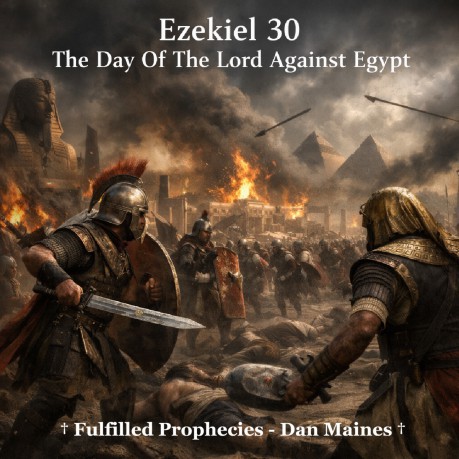
Ezekiel 30 The Day Of The
Lord Against Egypt Introduction † Ezekiel 30 continues the judgment against
Egypt, showing that God's wrath wasn't limited to Jerusalem but
extended to all nations that opposed Him (Ezekiel 30:3) Ezekiel 30:1-3 † The Day of the Lord here is clearly tied to
Egypt and surrounding nations, not the end of the physical world
(Ezekiel 30:3) Ezekiel 30:4-5 † God's judgment extends beyond Egypt to allied
nations, showing the interconnected nature of judgment (Ezekiel
30:5) Ezekiel 30:6-9 † The phrase they will know that I am the Lord
shows the purpose of judgment, revelation of God's authority (Ezekiel
30:8) Ezekiel 30:10-12 † This clearly identifies the historical
fulfillment through Nebuchadnezzar, not a symbolic future event
(Ezekiel 30:10) Ezekiel 30:13-19 † The destruction of idols shows God's judgment
targets false worship systems (Ezekiel 30:13) Ezekiel 30:20-26 † Breaking Pharaoh's arm symbolizes total loss
of power and military strength (Ezekiel 30:21) Historical References † Flavius Josephus records how nations rose and
fell under divine providence, confirming the pattern seen in
Ezekiel How It Applies To Us Today † God still rules over nations, nothing happens
outside His authority (Daniel 4:17) Q & A Appendix Q When was Ezekiel 30 fulfilled Q What is the Day of the Lord in this chapter Q Does this connect to AD 70 Q Why does God judge nations Q What does breaking Pharaoh's arm mean † This is the fulfilled perspective we proclaim at
Fulfilled Prophecies † Source Index † Ezekiel
By Dan Maines
†
This chapter focuses on the Day of the Lord, not in a distant future,
but in the historical judgment that came upon Egypt through Babylon
(Ezekiel 30:10)
† From the fulfilled
perspective, we see that God was already demonstrating His authority
over all nations long before AD 70, preparing the stage for the final
covenant judgment
Now the word of the Lord came
again to me, saying, Son of man, prophesy and say, This is what the
Lord God says: Wail, Alas for the day. For the day is near, even the
day of the Lord is near, it will be a day of clouds, a time of doom
for the nations.
† This shows that the phrase
Day of the Lord is used throughout scripture for historical
judgments, not just one final event (Isaiah 13:6)
†
This directly supports that Matthew 24 speaks of a similar covenantal
judgment, fulfilled in AD 70, not a future global destruction
(Matthew 24:34)
A sword will come upon Egypt,
and anguish will be in Cush when the slain fall in Egypt, they take
away her wealth, and her foundations are torn down. Cush, Put, Lud,
all Arabia, Libya, and the people of the land that is in league will
fall with them by the sword.
† This mirrors Revelation where
judgment spreads across the Roman world, not just one city
(Revelation 18:9-11)
† It proves God judges
entire systems and alliances that stand against Him
This is what the Lord says:
Indeed, those who support Egypt will fall, and the pride of her power
will come down, from Migdol to Syene they will fall within her by the
sword, declares the Lord God. They will be desolate in the midst of
desolated lands, and her cities will be in the midst of devastated
cities. And they will know that I am the Lord, when I set a fire in
Egypt and all her helpers are shattered. On that day messengers will
go forth from Me in ships to frighten secure Cush, and anguish will
be on them as on the day of Egypt, for behold, it is coming.
† This same phrase appears repeatedly
in Ezekiel, proving judgment is revelatory, not random
†
In the fulfilled perspective, AD 70 served the same purpose,
revealing Christ's authority over the Old Covenant world (Luke 21:22)
This is what the Lord God
says: I will also eliminate the hordes of Egypt by the hand of
Nebuchadnezzar king of Babylon. He and his people with him, the most
ruthless of the nations, will be brought in to destroy the land, and
they will draw their swords against Egypt and fill the land with the
slain. Moreover, I will make the Nile canals dry and sell the land
into the hands of evil men, and I will make the land desolate and all
that is in it by the hand of strangers, I the Lord have spoken.
† God uses nations as
instruments of judgment, just as Rome was used in AD 70 (Luke
21:20)
† The drying of the Nile shows
economic collapse, not cosmic destruction
This is what the Lord God
says: I will also destroy the idols and make the images cease from
Memphis. And there will no longer be a prince in the land of Egypt,
and I will put fear in the land of Egypt. I will make Pathros
desolate, set a fire in Zoan and execute judgments on Thebes. I will
pour out My wrath on Sin, the stronghold of Egypt, I will also cut
off the hordes of Thebes. I will set a fire in Egypt, Sin will writhe
in anguish, Thebes will be breached, and Memphis will have distresses
daily. The young men of On and of Pi-beseth will fall by the sword,
and the women will go into captivity. In Tehaphnehes the day will be
dark when I break there the yoke bars of Egypt, then the pride of her
power will cease in her, as for her, a cloud will cover her, and her
daughters will go into captivity. This is how I will execute
judgments on Egypt, and they will know that I am the Lord.
†
The repeated phrase I will shows God's direct sovereignty over
history
† This parallels Revelation where
Babylon's idols and system are destroyed (Revelation 18:2)
Now in the eleventh year,
in the first month, on the seventh of the month, the word of the Lord
came to me, saying, Son of man, I have broken the arm of Pharaoh king
of Egypt, and behold, it has not been bound up for healing or wrapped
with a bandage that it may be strong to hold the sword. Therefore
this is what the Lord God says: Behold, I am against Pharaoh king of
Egypt and will break his arms, both the strong and the broken, and I
will make the sword fall from his hand. I will scatter the Egyptians
among the nations and disperse them among the lands. For I will
strengthen the arms of the king of Babylon and put My sword in his
hand, and I will break the arms of Pharaoh so that he will groan
before him with the groanings of a mortally wounded man. So I will
strengthen the arms of the king of Babylon, but the arms of Pharaoh
will fall, then they will know that I am the Lord, when I put My
sword into the hand of the king of Babylon and he stretches it out
against the land of Egypt. When I scatter the Egyptians among the
nations and disperse them among the lands, then they will know that I
am the Lord.
†
God strengthening Babylon shows He controls both sides of history
(Ezekiel 30:24)
† Scattering Egypt mirrors
covenantal judgment language later used for Israel (Luke 21:24)
† Eusebius of Caesarea notes that God
used empires like Babylon and Rome to carry out judgment according to
His plan
† Irenaeus of Lyons affirms that
prophetic judgments were fulfilled in real historical events, not
postponed indefinitely
†
Judgment always exposes false security, Egypt trusted in power, but
it failed (Ezekiel 30:6)
† We're reminded
that the Day of the Lord already happened many times in history,
culminating in AD 70 (Luke 21:22)
† This
gives us confidence that prophecy is fulfilled, not waiting for
completion
† It calls us to trust Christ's
finished work, not fear future destruction
A
It was fulfilled historically through Nebuchadnezzar's invasion of
Egypt around 568 to 567 BC (Ezekiel 30:10)
A
It refers to a historical judgment on Egypt, not the end of the world
(Ezekiel 30:3)
A
Yes, it shows the same pattern of covenantal judgment later fulfilled
in AD 70 (Luke 21:22)
A
To reveal His authority and bring down pride (Ezekiel 30:8)
A
It represents total loss of power and military defeat (Ezekiel 30:21)
© Fulfilled Prophecies - Dan
Maines.
† Flavius
Josephus, Antiquities of the Jews
† Eusebius
of Caesarea, Ecclesiastical History
†
Irenaeus of Lyons, Against Heresies
Links