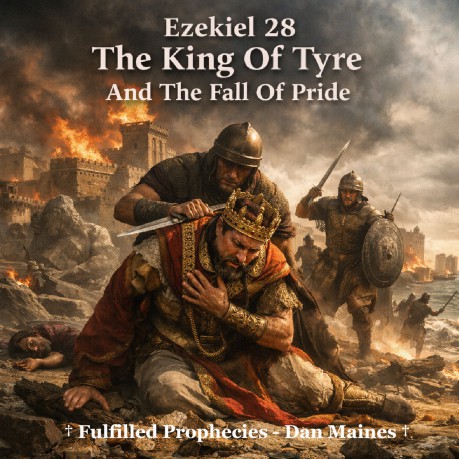
Ezekiel 28 The King Of Tyre
And The Fall Of Pride Introduction † Ezekiel 28 continues the judgment against
Tyre, but now it focuses on the ruler himself, exposing the heart
behind the power. † This chapter reveals pride, self-deification,
and the downfall that always follows when man exalts himself as God. † From the fulfilled perspective, this isn't
about some future figure, it's about real historical judgment that
already took place, showing God's consistent pattern. The Prince Of Tyre Exalts Himself As God Ezekiel 28:1-2 † The ruler of Tyre claimed divinity, which
shows the ultimate rebellion, man placing himself in God's position. † This isn't symbolic of Satan, it's a real
king with a real problem, pride that led to destruction (Isaiah
14:13-14). † God immediately corrects him, you are a man,
not God, reminding us that no matter how powerful someone becomes,
they are still accountable (Acts 12:21-23). Ezekiel 28:3-5 † Wealth and success became the fuel for his
pride, showing how prosperity can lead to spiritual blindness. † Tyre was known for trade and wealth, and this
king believed his success came from himself, not God (Deuteronomy
8:17-18). † The same pattern shows up in Israel later,
prosperity leads to pride, and pride leads to judgment (Hosea 13:6). Ezekiel 28:6-8 † Judgment comes through nations, not mystical
forces, showing how God uses history to accomplish His will. † The Babylonians and later empires brought
Tyre down, fulfilling this exactly in history. † The phrase death of those killed in the seas
connects directly to Tyre's maritime identity, showing the judgment
fits the crime (Galatians 6:7). The King Of Tyre Brought Low Ezekiel 28:9-10 † When judgment comes, the illusion of power
disappears instantly. † The one who claimed divinity is exposed as
mortal, powerless before death (Psalm 82:6-7). † This shows that pride always collapses when
confronted with reality, no one can stand against God. The Lament Over The King Of Tyre Ezekiel 28:12-13 † This language is poetic and symbolic, not
literal placement in Eden. † It describes his position of privilege,
beauty, and blessing, similar to how Eden represents perfection
(Genesis 2:8). † This isn't Satan, it's a human king being
described in elevated language to show how far he fell. Ezekiel 28:14-15 † The cherub imagery represents a position of
protection and authority, not literal angelic identity. † Kings were often described in divine or
temple imagery, showing their role as guardians of their kingdom. † His fall came from within, unrighteousness
was found in him, not forced on him (James 1:14-15). Ezekiel 28:16-17 † His success led to corruption, showing that
external blessing without humility leads to internal destruction. † Violence and greed filled his kingdom, which
is often the fruit of unchecked pride. † God cast him down, showing that exaltation
without God always ends in humiliation (Proverbs 16:18). Ezekiel 28:18-19 † The judgment is complete and public, everyone
sees the fall. † Fire from within shows that his own
corruption led to his destruction. † This is historical judgment, not future
prophecy, Tyre was brought down and never regained its former glory. Judgment Against Sidon Ezekiel 28:22-23 † Sidon receives the same pattern of judgment,
showing God is not limited to one nation. † The purpose of judgment is always the same,
that they will know that I am the Lord. † This matches what we see throughout
scripture, God reveals Himself through both mercy and judgment
(Ezekiel 6:7). Restoration For Israel Ezekiel 28:25-26 † After judgment comes restoration, which is
always God's pattern. † This ultimately points forward to the
fulfillment in Christ and the gathering of God's people. † From the fulfilled perspective, this
restoration is seen in the completed work of Christ and the
establishment of His kingdom. Historical References † Josephus records the fall and weakening of
Tyre through successive empires, confirming the fulfillment of
Ezekiel's prophecy. † Eusebius notes how Tyre lost its former glory
and influence, aligning with the permanent judgment described here. † Secular history confirms that Tyre never
returned to its previous dominance, just as Ezekiel said. How It Applies To Us Today † Pride is still the root issue, when man
exalts himself, judgment follows. † Wealth, success, and influence can easily
lead to spiritual blindness if we're not grounded in God. † God resists the proud but gives grace to the
humble, that's still true today (James 4:6). † We don't wait for future fulfillment, we see
God's pattern already completed and continuing in history. Q & A Appendix Q Was the king of Tyre Satan? Q What does Eden represent here? Q When was this fulfilled? Q Why is cherub language used? Q What is the main message of this chapter? † This is the fulfilled perspective we proclaim at
Fulfilled Prophecies † Source Index † Ezekiel 28
By Dan Maines
Now the word of the Lord came
to me, saying, Son of man, say to the leader of Tyre, Thus says the
Lord God, Because your heart is arrogant And you have said, I am a
god, I sit in the seat of gods In the heart of the seas; Yet you are
a human and not God, Although you make your heart like the heart of
God
Behold, you are wiser than
Daniel; There is no secret that is hidden from you. By your wisdom
and understanding You have acquired riches for yourself And have
acquired gold and silver for your treasuries. By your great wisdom,
by your trade You have increased your riches, And your heart is
arrogant because of your riches
Therefore this is what the
Lord God says: Because you have made your heart Like the heart of
God, Therefore, behold, I am going to bring strangers upon you, The
most ruthless of the nations. And they will draw their swords Against
the beauty of your wisdom And defile your splendor. They will bring
you down to the pit, And you will die the death of those who are
killed In the heart of the seas
Will you still say, I am a
god, In the presence of your killer, Although you are a human and not
God, In the hands of those who wound you? You will die the death of
the uncircumcised By the hand of strangers, For I have spoken,
declares the Lord God
Son of man, take up a
lamentation over the king of Tyre and say to him, Thus says the Lord
God, You had the seal of perfection, Full of wisdom and perfect in
beauty. You were in Eden, the garden of God; Every precious stone was
your covering: The ruby, the topaz, and the diamond; The beryl, the
onyx, and the jasper; The lapis lazuli, the turquoise, and the
emerald; And the gold, the workmanship of your settings and sockets,
Was in you. On the day that you were created They were prepared
You were the anointed
cherub who covers, And I placed you there. You were on the holy
mountain of God; You walked in the midst of the stones of fire. You
were blameless in your ways From the day you were created Until
unrighteousness was found in you
By the abundance of your
trade You were internally filled with violence, And you sinned;
Therefore I have cast you as profane From the mountain of God. And I
have destroyed you, O covering cherub, From the midst of the stones
of fire. Your heart was haughty because of your beauty; You corrupted
your wisdom by reason of your splendor
By the multitude of your
wrongdoings, In the unrighteousness of your trade You profaned your
sanctuaries. Therefore I have brought fire from the midst of you; It
has consumed you, And I have turned you to ashes on the earth In the
eyes of all who see you. All who know you among the peoples Are
appalled at you; You have become terrified And you will cease to be
forever
and say, This is what the
Lord God says: Behold, I am against you, Sidon, And I will be
glorified in your midst. Then they will know that I am the Lord when
I execute judgments in her, And I will reveal My holiness in her. For
I will send a plague to her And blood to her streets, And the wounded
will fall in her midst By the sword upon her on every side; Then they
will know that I am the Lord
This is what the Lord God
says: When I gather the house of Israel from the peoples among whom
they are scattered, and reveal My holiness in them in the sight of
the nations, then they will live on their land which I gave to My
servant Jacob. And they will live securely on it, and they will build
houses, plant vineyards, and live securely when I execute judgments
upon all those who despise them around them. Then they will know that
I am the Lord their God
A
No, the text says he is a human, not God (Ezekiel 28:2), and he dies
like a man (Ezekiel 28:8-10).
A
It represents a place of blessing and perfection, not literal
presence (Genesis 2:8).
A
Historically through Babylon and later empires that destroyed Tyre
(Ezekiel 26-28).
A
It describes position and authority in symbolic terms, not literal
angelic identity (Ezekiel 28:14).
A
Pride leads to destruction, and God will bring down anyone who exalts
themselves (Proverbs 16:18).
© Fulfilled Prophecies - Dan
Maines.
†
Josephus, Antiquities of the Jews
† Eusebius,
Ecclesiastical History
Links