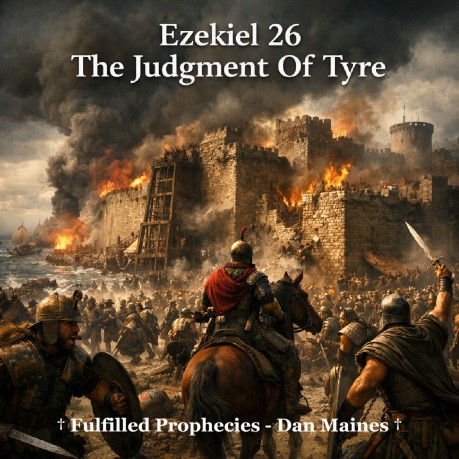
Ezekiel 26 The Judgment Of
Tyre Introduction † Ezekiel 26 speaks directly to the judgment of
Tyre, a proud coastal city that rejoiced when Jerusalem fell. God
doesn't overlook that kind of heart. When His covenant people were
judged, Tyre saw opportunity instead of warning. This chapter shows
that God judges not only His own people, but also the nations that
rise up in pride and take advantage of His judgment. † This prophecy was spoken before the fall of
Jerusalem, yet it looks ahead to the fall of Tyre through multiple
waves of judgment. From the fulfilled perspective, we see how God
used historical powers, especially Babylon and later forces, to bring
this prophecy to pass. † This chapter also lines up with the larger
pattern of covenant judgment, where those who opposed God's people
were themselves brought down, leading ultimately to the full judgment
seen in AD 70. Ezekiel 26:1 † This places the prophecy right before the
fall of Jerusalem, showing God was already addressing the nations
watching and reacting to Israel's judgment (Ezekiel 26:1) † God doesn't just deal with Israel, He
addresses every nation that interacts with His covenant people (Amos
1:3-2:3) † This shows divine timing, nothing is random,
God speaks before judgment unfolds (Isaiah 46:10) Ezekiel 26:2 † Tyre rejoiced over Jerusalem's fall, seeing
it as economic gain, not tragedy (Ezekiel 26:2) † This reveals a heart of pride and greed,
valuing profit over righteousness (Proverbs 17:5) † God judges not only actions, but motives and
attitudes (Jeremiah 17:10) Ezekiel 26:3 † God declares direct opposition, I am against
you, showing divine judgment is personal (Ezekiel 26:3) † The imagery of waves shows repeated
invasions, not just one event (Daniel 2:21) † This was fulfilled through successive powers,
beginning with Babylon and continuing afterward (Jeremiah 27:6) Ezekiel 26:4 † This shows total devastation, not partial
judgment (Ezekiel 26:4) † The phrase bare rock shows complete removal
of former glory (Isaiah 23:1) † This was fulfilled historically as Tyre was
reduced and rebuilt differently over time Ezekiel 26:5 † The city once known for trade becomes a place
for fishermen, showing complete reversal (Ezekiel 26:5) † God's word guarantees fulfillment, for I have
spoken (Numbers 23:19) † This demonstrates that no nation, no matter
how wealthy, escapes judgment (Psalm 49:6-12) Ezekiel 26:7 † God specifically names Nebuchadnezzar,
showing this isn't vague prophecy (Ezekiel 26:7) † Babylon was God's instrument, even though it
was a pagan empire (Jeremiah 25:9) † This shows God uses nations to accomplish His
purposes (Isaiah 10:5) Ezekiel 26:10-11 † This describes a full military invasion,
overwhelming and unstoppable (Ezekiel 26:10-11) † The imagery shows total domination, not a
minor defeat (Nahum 3:13) † This mirrors how Jerusalem was also
overtaken, showing consistent judgment patterns (Luke 19:43-44) Ezekiel 26:14 † This emphasizes finality, you will not be
rebuilt in its former glory (Ezekiel 26:14) † God's authority stands behind the prophecy, I
the Lord have spoken (Isaiah 55:11) † Tyre's power would never return to what it
once was, showing irreversible judgment (Ezekiel 27:36) Ezekiel 26:19-21 † This language points beyond physical
destruction to covenantal removal from significance (Ezekiel
26:19-21) † Being brought down to the pit reflects
complete downfall and loss of identity (Isaiah 14:15) † This mirrors the final judgment language used
later for Jerusalem in AD 70 (Matthew 23:38) Historical References † Josephus records the campaigns of
Nebuchadnezzar and the weakening of Tyre, confirming the historical
fulfillment † Eusebius notes the long-term decline of
Tyre's prominence after repeated invasions † Tacitus confirms Tyre's fall through multiple
waves, aligning with the waves imagery in the prophecy How it applies to us today † God sees how people respond to the downfall
of others, and He judges pride and opportunism (Proverbs 24:17-18) † Wealth and influence don't protect anyone
from God's judgment (James 5:1-3) † God is sovereign over nations, raising and
bringing down according to His purpose (Daniel 4:17) † We need to examine our hearts, are we
grieving over sin, or benefiting from it (Ezekiel 18:30-32) † This reminds us that fulfillment is real, God
did exactly what He said, and that gives us confidence in everything
else He has fulfilled (Matthew 5:18) Q and A Appendix Q When was Ezekiel 26 fulfilled? Q Why did God judge Tyre? Q What does the waves imagery mean? Q Did Tyre completely disappear? Q How does this connect to AD 70? † This is the fulfilled perspective we proclaim at
Fulfilled Prophecies † Source Index † Ezekiel 26 † Josephus, Antiquities of the Jews; Eusebius,
Ecclesiastical History; Tacitus, Histories
By Dan Maines
Now in the eleventh year, on
the first of the month, the word of the Lord came to me, saying,
Son of man, because Tyre has
said concerning Jerusalem, Aha, the gateway of the peoples is broken,
it has opened to me. I will be filled, now that she is laid waste,
therefore this is what the Lord
God says: Behold, I am against you, Tyre, and I will bring up many
nations against you, just as the sea brings up its waves.
They will destroy the walls of
Tyre and break down her towers, and I will scrape her debris from her
and make her a bare rock.
She will be a place for the
spreading of nets in the midst of the sea, for I have spoken,
declares the Lord God, and she will become plunder for the nations.
For this is what the Lord God
says: Behold, I am bringing upon Tyre from the north Nebuchadnezzar
king of Babylon, king of kings, with horses, chariots, cavalry, and a
great army.
Because of the multitude of
his horses, the dust raised by them will cover you; your walls will
shake at the noise of cavalry and wagons and chariots, when he enters
your gates as men enter a city that has been breached. With the hoofs
of his horses he will trample all your streets; he will kill your
people with the sword, and your strong pillars will come down to the
ground.
I will make you a bare rock;
you will be a place for the spreading of nets. You will not be
rebuilt, for I the Lord have spoken, declares the Lord God.
For this is what the Lord
God says: When I make you a desolate city, like cities that are not
inhabited, when I bring up the deep over you and the great waters
cover you, then I will bring you down with those who go down to the
pit, to the people of old, and I will make you dwell in the lower
parts of the earth, like the ancient ruins, with those who go down to
the pit, so that you will not be inhabited; but I will set glory in
the land of the living. I will bring terrors on you and you will be
no more; though you may be sought, you will never be found again,
declares the Lord God.
A
It began with Nebuchadnezzar's siege around 586 BC and continued
through successive invasions, ultimately fulfilling the prophecy over
time (Ezekiel 26:7, Daniel 2:21)
A
Because they rejoiced over Jerusalem's fall and acted in pride and
greed (Ezekiel 26:2, Proverbs 17:5)
A
It represents multiple nations coming in succession against Tyre
(Ezekiel 26:3, Jeremiah 25:9)
A
Its former power and identity were destroyed, even though the
location remained inhabited in different forms (Ezekiel 26:14, Isaiah
23:1)
A
It shows the same pattern of covenant judgment, where nations
opposing God's purposes are brought down, culminating in the
destruction of Jerusalem (Matthew 23:38, Luke 21:20-22)
© Fulfilled Prophecies - Dan
Maines.
Links