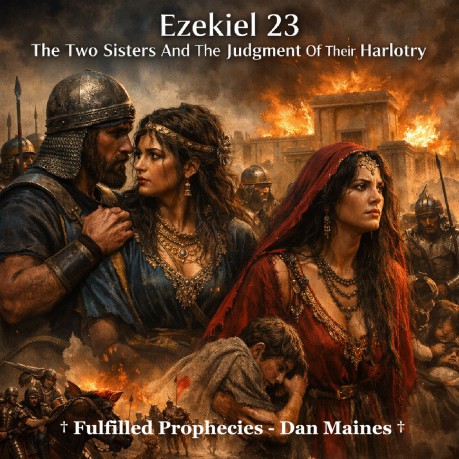
Ezekiel 23 The Two Sisters
And The Judgment Of Their Harlotry Introduction † Ezekiel 23 exposes the spiritual adultery of
Samaria and Jerusalem, showing how both kingdoms turned from God to
the nations. (Ezekiel 23:1-4) † This chapter builds on the same covenant
reality seen throughout Ezekiel, Israel was in a relationship with
God, and their idolatry is described as unfaithfulness. (Jeremiah
3:6-10) † From the fulfilled perspective, this judgment
reaches its climax in the first century when Jerusalem faced complete
destruction for the same pattern of rebellion. (Matthew 23:37-38) Ezekiel 23:1-4 † God clearly identifies Samaria and Jerusalem
as belonging to Him, showing covenant relationship, not mere
political identity. (Ezekiel 23:4) † Their sin began in Egypt, meaning their
rebellion wasn't new, it was a pattern carried throughout their
history. (Ezekiel 20:7-8) † This proves that covenant unfaithfulness
existed long before AD 70, and judgment was always tied to that
relationship. (Deuteronomy 28:15) Ezekiel 23:5-10 † Samaria trusted in Assyria instead of God,
showing that idolatry often includes political alliances over faith.
(2 Kings 17:7-8) † God judged Samaria through the very nation
she trusted, proving that reliance on the world leads to destruction.
(2 Kings 17:18) † This sets a pattern, covenant unfaithfulness
brings covenant judgment, not random punishment. (Leviticus 26:25) Ezekiel 23:11-21 † Jerusalem saw the judgment of Samaria and
still followed the same path, showing willful rebellion. (Jeremiah
3:8-10) † This proves that knowledge of judgment does
not guarantee repentance, the heart must turn. (Romans 2:4-5) † Their attraction to Babylon shows how easily
God's people are drawn to worldly power and influence. (Isaiah 31:1) Ezekiel 23:22-35 † Just as with Samaria, God uses the nations
Jerusalem trusted to bring judgment. (2 Kings 25:1-2) † This is covenant justice, not arbitrary
wrath, exactly what was warned in the Law. (Deuteronomy 28:49-50) † This pattern continues into the first century
when Rome becomes the instrument of judgment. (Luke 21:20) Ezekiel 23:36-49 † Their sin included idolatry and bloodshed,
showing that false worship always leads to moral corruption. (Ezekiel
22:2-4) † Child sacrifice reveals how far covenant
people can fall when they abandon God. (2 Kings 21:6) † This same generation of Jerusalem later
filled up the measure of their fathers, leading to final judgment.
(Matthew 23:32-36) Historical References † Josephus records the moral corruption and
violence in Jerusalem before its destruction, confirming the same
sins described in Ezekiel. (Josephus, Wars of the Jews Book 5) † Eusebius connects the fall of Jerusalem with
divine judgment for covenant unfaithfulness. (Eusebius,
Ecclesiastical History 3.5) † Irenaeus speaks of Israel's repeated pattern
of rebellion and judgment throughout history. (Irenaeus, Against
Heresies 4.36) How It Applies To Us Today † This chapter shows that being in covenant
with God doesn't mean automatic protection if there is
unfaithfulness. (Romans 11:20-22) † It warns us not to trust in worldly systems,
power, or alliances instead of God. (Psalm 20:7) † It reminds us that judgment is always tied to
accountability, those who know God are held responsible. (Luke 12:47) † From the fulfilled perspective, we've already
seen the full judgment of Jerusalem, confirming that God keeps His
word exactly as promised. (Matthew 24:34) † Now we live in the established kingdom,
called to faithfulness, not fear of future judgment. (Hebrews 12:28) Q & A Appendix Q Who are Oholah and Oholibah? Q What was their main sin? Q Why was Jerusalem judged more severely? Q How did God bring judgment? Q When is this pattern ultimately fulfilled? † This is the fulfilled perspective we proclaim at
Fulfilled Prophecies † Source Index † Ezekiel 23
By Dan Maines
Now the word of the Lord came
to me, saying, Son of man, there were two women, the daughters of one
mother; and they played the prostitute in Egypt. They played the
prostitute in their youth; there their breasts were handled and their
virgin bosom was fondled. Their names were Oholah the older and
Oholibah her sister. And they became Mine, and they bore sons and
daughters. And as for their names, Samaria is Oholah and Jerusalem is
Oholibah.
Oholah played the prostitute
while she was Mine; and she lusted after her lovers, the Assyrians,
her neighbors, who were clothed in purple, governors and officials,
all of them desirable young men, horsemen riding on horses. She
bestowed her prostitution on them, all of them the choicest men of
Assyria; and with all those after whom she lusted, with all their
idols she defiled herself. She did not abandon her prostitution from
the time in Egypt; for in her youth men had slept with her and
handled her virgin bosom, and they poured out their lust on her.
Therefore, I handed her over to the power of her lovers, to the power
of the Assyrians, after whom she lusted. They uncovered her
nakedness; they took her sons and daughters, but they killed her with
the sword. So she became a byword among women, and they executed
judgments on her.
Now her sister Oholibah saw
this, yet she was more corrupt in her lust than she, and in her
prostitution she was worse than her sister. She lusted after the
Assyrians, governors and officials, neighbors who were splendidly
dressed, horsemen riding on horses, all of them desirable young men.
I saw that she had defiled herself; they both took the same way. So
she increased her prostitution; and she saw men portrayed on the
wall, images of the Chaldeans portrayed in red, girded with belts on
their waists, with flowing turbans on their heads, all of them
looking like officers, in the likeness of the Babylonians in Chaldea,
the land of their birth. When she saw them she lusted after them and
sent messengers to them in Chaldea.
Therefore, O Oholibah, this
is what the Lord God says: Behold, I will stir up your lovers against
you, from whom you were alienated, and I will bring them against you
from every side: the Babylonians and all the Chaldeans, Pekod, Shoa,
and Koa, and all the Assyrians with them; desirable young men,
governors and officials all of them, officers and men of renown, all
of them riding on horses.
Moreover, the Lord said to
me, Son of man, will you judge Oholah and Oholibah? Then declare to
them their abominations. For they have committed adultery, and blood
is on their hands; and they have committed adultery with their idols,
and they have even caused their sons, whom they bore to Me, to pass
through the fire to them.
A
They represent Samaria and Jerusalem. (Ezekiel 23:4)
A
Spiritual adultery through idolatry and alliances with pagan nations.
(Ezekiel 23:5-7)
A
She saw Samaria's judgment and still acted more corruptly. (Ezekiel
23:11)
A
He used the very nations they trusted, like Babylon. (Ezekiel
23:22-24)
A
In the destruction of Jerusalem in the first century. (Matthew
23:37-38; Luke 21:20)
© Fulfilled Prophecies - Dan
Maines.
†
Josephus, Wars of the Jews Book 5; Eusebius, Ecclesiastical History
3.5; Irenaeus, Against Heresies 4.36
Links