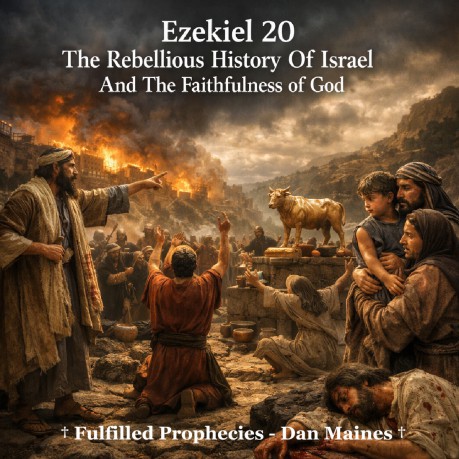
Ezekiel 20 The Rebellious
History Of Israel And The Faithfulness Of God
By Dan Maines
Introduction
†
Ezekiel 20 walks through Israel's entire history, showing a pattern
of rebellion from Egypt to the wilderness and into the land.
†
God repeatedly delivered them, gave them His statutes, and called
them to walk in His ways, yet they continually turned to idols.
†
This chapter proves that judgment wasn't random, it was the direct
result of covenant unfaithfulness.
† At the
same time, it shows God's mercy, because He restrained His wrath for
the sake of His name.
Ezekiel 20:1
Now in
the seventh year, in the fifth month, on the tenth day of the month,
some of the elders of Israel came to inquire of the LORD, and sat
before me.
† The elders came seeking God, but
their history shows they weren't truly seeking obedience, only
answers (Isaiah 29:13).
† This reflects a
pattern where Israel wanted guidance without submission (Jeremiah
42:20-21).
† It shows outward religion
without inward faithfulness, something God continually
rebuked.
Ezekiel 20:2-3
And the word of
the LORD came to me, saying, Son of man, speak to the elders of
Israel and say to them, This is what the Lord GOD says: Do you come
to inquire of Me? As I live, declares the Lord GOD, I will not let
you inquire of Me.
† God refuses to answer
because their hearts were corrupt, showing that access to God isn't
mechanical but relational (Proverbs 28:9).
†
This lines up with Psalm 66:18, if I regard wickedness in my heart,
the Lord will not hear.
† Their inquiry was
hypocritical, and God exposes it immediately.
Ezekiel
20:4
Will you judge them, will you judge them, son of
man? Make them know the abominations of their fathers.
†
God shifts the focus from inquiry to accountability.
†
Israel needed to understand their history of sin, not seek new
revelation.
† This shows that truth begins
with recognizing past rebellion (Nehemiah 9:16-17).
Ezekiel
20:5-6
And say to them, This is what the Lord GOD says:
On the day when I chose Israel and raised My hand in an oath to the
descendants of the house of Jacob, and made Myself known to them in
the land of Egypt, when I raised My hand in an oath to them, saying,
I am the LORD your God, on that day I raised My hand in an oath to
them to bring them out of the land of Egypt into a land that I had
selected for them, flowing with milk and honey, which is the glory of
all lands.
† God reminds them that He chose
them and delivered them first.
† Their
identity was rooted in grace, not merit (Deuteronomy 7:7-8).
†
This highlights that their rebellion came after receiving
blessings.
Ezekiel 20:7-8
And I said to
them, Each of you, get rid of the detestable things of your eyes, and
do not defile yourselves with the idols of Egypt; I am the LORD your
God. But they rebelled against Me and were not willing to listen to
Me; none of them got rid of the detestable things of their eyes, nor
did they abandon the idols of Egypt. Then I resolved to pour out My
wrath on them, to accomplish My anger against them in the midst of
the land of Egypt.
† Even in Egypt, Israel
clung to idols, proving their rebellion started early (Joshua
24:14).
† Deliverance didn't automatically
produce obedience.
† This shows that external
salvation doesn't change the heart without transformation.
Ezekiel
20:9
But I acted for the sake of My name, so that it
would not be profaned in the sight of the nations among whom they
lived.
† God spared them for His name, not
their righteousness.
† His reputation among
the nations was at stake (Exodus 32:12).
†
This reveals God's faithfulness even when His people are
unfaithful.
Ezekiel 20:10-12
So I brought
them out of the land of Egypt and led them into the wilderness. I
gave them My statutes and informed them of My ordinances, by which,
if a person follows them, then he will live. Also I gave them My
Sabbaths to be a sign between Me and them, so that they would know
that I am the LORD who sanctifies them.
† God
gave them the Law as a covenant standard.
†
The Sabbath was a sign of their relationship with Him (Exodus
31:13).
† Yet even with clear instruction,
they failed.
Ezekiel 20:13
But the house
of Israel rebelled against Me in the wilderness.
†
The wilderness became a place of testing, and they failed repeatedly
(Psalm 95:8-10).
† This shows that miracles
don't produce faith.
† Their rebellion
continued despite seeing God's power.
Ezekiel 20:14
But
I acted for the sake of My name, so that it would not be profaned in
the sight of the nations, in whose sight I had brought them out.
†
Again, God restrains judgment for His name.
†
This repeated phrase shows His consistent motive.
†
His faithfulness stands in contrast to their rebellion.
Ezekiel
20:18-21
But I said to their children in the
wilderness, Do not walk in the statutes of your fathers or keep their
ordinances or defile yourselves with their idols.
†
God gave the next generation a chance to walk differently.
†
Yet they repeated the same sins.
† This
proves that rebellion isn't just generational influence, it's a heart
issue.
Ezekiel 20:23-24
Also I raised My
hand in an oath to them in the wilderness, that I would scatter them
among the nations and disperse them among the lands.
†
God warned of future judgment long before it happened (Leviticus
26:33).
† The exile wasn't sudden, it was
promised due to disobedience.
† This shows
God's justice is consistent and predictable.
Ezekiel
20:32
What comes into your mind will not come about,
when you say, We will be like the nations, like the families of the
lands, serving wood and stone.
† Israel
wanted to become like the nations, rejecting their identity.
†
This is the root of idolatry, conforming to the world (1 Samuel
8:5).
† God rejects that desire
completely.
Ezekiel 20:33-34
As I live,
declares the Lord GOD, surely with a mighty hand and with an
outstretched arm and with wrath poured out, I will be king over
you.
† God declares His rule will stand,
whether through blessing or judgment.
† His
kingship isn't dependent on their obedience.
†
This points forward to Christ's ultimate reign.
Ezekiel
20:37-38
I will make you pass under the rod, and I will
bring you into the bond of the covenant. I will eliminate from you
the rebels and those who revolt against Me; I will bring them out of
the land where they reside as strangers, but they will not enter the
land of Israel.
† This is purification
language, separating the faithful from the rebels.
†
It anticipates judgment that refines (Malachi 3:2-3).
†
Ultimately fulfilled in the first century judgment where the old
covenant system was removed.
Ezekiel 20:39
As
for you, house of Israel, this is what the Lord GOD says: Go, serve
everyone his idols; but later you will certainly listen to Me, and My
holy name you will no longer profane with your gifts and with your
idols.
† God is giving them over to their
rebellion, similar to Romans 1:24, where persistent sin leads to
being handed over.
† This is judicial
language, not approval, but judgment for continued refusal to obey.
†
Even in this, God still defends His name, showing His holiness isn't
dependent on their obedience.
Ezekiel 20:40
For
on My holy mountain, on the high mountain of Israel, declares the
Lord GOD, there the whole house of Israel, all of them, will serve Me
in the land.
† This points to restoration,
not of physical land, but of true worship.
†
Fulfilled in the kingdom where all nations serve God (Hebrews
12:22-23).
† This is the reality of the
fulfilled kingdom.
Ezekiel 20:45-49
Now
the word of the LORD came to me, saying, Son of man, set your face
toward the south and speak out against the south and prophesy against
the forest land of the Negev, and say to the forest of the Negev,
Hear the word of the LORD: This is what the Lord GOD says: Behold, I
am about to kindle a fire in you, and it will consume every green
tree in you, as well as every dry tree; the blazing flame will not be
quenched, and every face from south to north will be scorched by it.
And all flesh will see that I, the LORD, have kindled it; it will not
be quenched. Then I said, Oh Lord GOD! They are saying of me, Is he
not just speaking in parables?
† The fire
represents coming judgment, specifically pointing to the destruction
of Jerusalem, which was total and unquenchable in its time (Jeremiah
21:14).
† Both green and dry trees show that
judgment would affect all, righteous and wicked within that system,
just as happened in AD 70 (Luke 23:31).
† The
people dismiss it as parables, showing they didn't take the warning
seriously, which matches the blindness Jesus spoke of in Matthew
13:14-15.
Historical References
†
Josephus records the continual rebellion of Israel leading up to AD
70 and the destruction of Jerusalem, confirming this pattern.
†
Eusebius writes that the judgment on Jerusalem was the result of
their rejection of God and His covenant.
†
Irenaeus speaks of Israel's repeated disobedience and God's
long-suffering patience.
How It Applies To Us Today
†
We don't approach God with hypocrisy, He sees the heart (Hebrews
4:13).
† We learn from Israel's history,
repeated rebellion leads to judgment (1 Corinthians 10:11).
†
God is faithful even when people are not, His purposes stand (2
Timothy 2:13).
† True worship isn't outward,
it's obedience from the heart (John 4:23).
†
The kingdom is established, and we live in it now under Christ's rule
(Colossians 1:13).
Q & A Appendix
Q
Why did God refuse to answer Israel?
A Because
their hearts were rebellious, Proverbs 28:9
Q
Did Israel begin rebelling only in the land?
A
No, they were already worshiping idols in Egypt, Joshua 24:14
Q
Why did God spare them repeatedly?
A For His
name's sake, Ezekiel 20:9
Q What was the
purpose of the Law?
A To give them life if
obeyed, Ezekiel 20:11
Q What does Ezekiel 20:39
show?
A God giving them over to their
rebellion, Romans 1:24
Q What do the burning
trees represent?
A Total judgment affecting
all, Luke 23:31
† This is the fulfilled perspective we
proclaim at Fulfilled Prophecies †
© Fulfilled
Prophecies - Dan Maines.
Source Index
†
Ezekiel 20
† Josephus, Antiquities of the
Jews Book 10-13; Eusebius, Ecclesiastical History; Irenaeus, Against
Heresies
Links