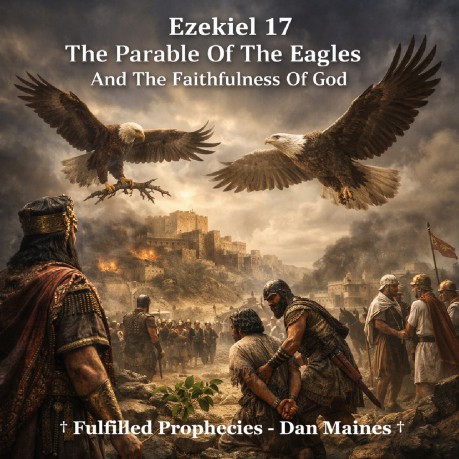
Ezekiel 17 The Parable Of The
Eagles And The Faithfulness Of God Introduction † Ezekiel 17 presents a parable that Israel
would have clearly understood, but they refused to accept its meaning
because it exposed their rebellion. (Ezekiel 17:1) † God uses imagery of eagles, a vine, and a
cedar to reveal what Judah had done politically and spiritually.
(Ezekiel 17:2-3) † This chapter shows that their alliances were
not just political mistakes, they were covenant unfaithfulness
against God. (Ezekiel 17:12-15) Scripture Ezekiel 17:1-2 † God is speaking directly, this isn't
Ezekiel's idea, it's divine revelation. (Ezekiel 17:1) † Israel is being addressed as a whole, showing
the responsibility of the nation. (Ezekiel 17:2) † The parable form shows that truth was being
given, but only those willing to hear would understand. (Ezekiel
17:2) Ezekiel 17:3-4 † The eagle represents Babylon, specifically
Nebuchadnezzar taking the king of Judah. (Ezekiel 17:12) † The cedar represents the royal house of
David, showing the removal of leadership. (Ezekiel 17:3) † This was God's judgment, not just a political
takeover. (Ezekiel 17:12) Ezekiel 17:5-6 † The new king was set up by Babylon, showing
dependence and submission. (Ezekiel 17:13) † The vine was meant to remain low, meaning
Judah was to stay under Babylon's authority. (Ezekiel 17:6) † God had allowed this arrangement for their
preservation, not destruction. (Ezekiel 17:5) Ezekiel 17:7-8 † The second eagle represents Egypt, whom Judah
turned to for help. (Ezekiel 17:15) † This shows rebellion against the authority
God had established. (Ezekiel 17:7) † Instead of trusting God's discipline, they
sought worldly alliances. (Ezekiel 17:8) Ezekiel 17:9-10 † God makes it clear, rebellion will not
succeed. (Ezekiel 17:9) † The east wind represents judgment coming from
Babylon again. (Ezekiel 17:10) † Their political strategy cannot override
God's decree. (Ezekiel 17:9) Ezekiel 17:11-14 † God removes all mystery, He explains the
parable plainly. (Ezekiel 17:12) † The covenant made with Babylon was binding,
breaking it was sin. (Ezekiel 17:13) † Stability depended on obedience, not
independence. (Ezekiel 17:14) Ezekiel 17:15-16 † Breaking the covenant was not just political
betrayal, it was rebellion against God. (Ezekiel 17:15) † God swears by Himself, showing the certainty
of judgment. (Ezekiel 17:16) † Zedekiah's fate was sealed because of this
rebellion. (Ezekiel 17:16) Ezekiel 17:17-18 † Egypt cannot save what God has judged.
(Ezekiel 17:17) † The oath was serious, this wasn't a small
matter. (Ezekiel 17:18) † Human alliances cannot undo divine judgment.
(Ezekiel 17:17) Ezekiel 17:19-21 † God calls it His covenant, showing His
authority over the situation. (Ezekiel 17:19) † Judgment is described as a trap, unavoidable
and precise. (Ezekiel 17:20) † The purpose is recognition, they will know
that God has spoken. (Ezekiel 17:21) Ezekiel 17:22-24 † God shifts to restoration, pointing to the
Messiah from David's line. (Ezekiel 17:22) † This kingdom will include all nations, shown
by the birds dwelling in it. (Ezekiel 17:23) † God reverses everything, He humbles and
exalts according to His will. (Ezekiel 17:24) Historical References † Josephus records the fall of Jerusalem and
the consequences of Zedekiah's rebellion, confirming this historical
fulfillment. † Eusebius notes the continuity of God's plan
through Christ as the fulfillment of the Davidic promise. † Irenaeus speaks of Christ as the true
planting of God, fulfilling the prophetic imagery of restoration. How It Applies To Us Today † We see that God is in control of nations and
leadership, nothing happens outside His authority. † Trusting in worldly systems instead of God
always leads to failure. † God's promises stand, even when man fails, He
fulfills His plan through Christ. Q & A Appendix Q Did Judah's alliance with Egypt succeed Q Who does the first eagle represent Q What was the covenant that was broken Q What does the tender twig represent Q What is the main lesson of this chapter † This is the fulfilled perspective we proclaim at
Fulfilled Prophecies † Source Index † Ezekiel 17
By Dan Maines
Now the word of the Lord came
to me, saying, Son of man, pose a riddle and tell a parable to the
house of Israel,
saying, This is what the Lord
God says: A great eagle with great wings, long pinions, and a full
plumage of many colors came to Lebanon and took away the top of the
cedar. He plucked off the topmost of its young twigs and brought it
to a land of merchants; he set it in a city of traders.
He also took some of the seed
of the land and planted it in fertile soil. He placed it beside
abundant waters; he set it like a willow. Then it sprouted and became
a low, spreading vine, with its branches turned toward him, but its
roots remained under it. So it became a vine and yielded shoots and
sent out branches.
But there was another great
eagle with great wings and much plumage; and behold, this vine bent
its roots toward him and sent out its branches toward him from the
beds where it was planted, so that he might water it. It was planted
in good soil beside abundant waters, so that it would produce
branches and bear fruit and become a splendid vine.
Say, This is what the Lord
God says: Will it thrive? Will he not pull up its roots and cut off
its fruit so that it withers, so that all its sprouting leaves
wither? And neither by great strength nor by many people can it be
raised from its roots again. Behold, though it is planted, will it
thrive? Will it not completely wither as soon as the east wind
strikes it, wither on the beds where it grew?
Moreover, the word of the
Lord came to me, saying, Say now to the rebellious house, Do you not
know what these things mean? Say, Behold, the king of Babylon came to
Jerusalem, took its king and officials, and brought them to him in
Babylon. He also took one of the royal family and made a covenant
with him, putting him under oath. He also took away the mighty of the
land, so that the kingdom would be in subjection, not exalting
itself, but keeping his covenant so that it might stand.
But he rebelled against him
by sending his envoys to Egypt so that they might give him horses and
many troops. Will he succeed? Will he who does such things escape?
Can he indeed break the covenant and escape? As I live, declares the
Lord God, surely in the country of the king who put him on the
throne, whose oath he despised and whose covenant he broke, in
Babylon he shall die.
Pharaoh with his mighty
army and great company will not help him in the war, when they cast
up siege ramps and build siege walls to cut off many lives. He
despised the oath by breaking the covenant, and behold, he pledged
his allegiance, yet did all these things; he shall not escape.
Therefore this is what the
Lord God says: As I live, surely My oath which he despised and My
covenant which he broke, I will inflict on his head. I will spread My
net over him, and he will be caught in My snare. Then I will bring
him to Babylon and enter into judgment with him there regarding the
unfaithful act which he has committed against Me. All the choicest of
his troops will fall by the sword, and the survivors will be
scattered to every wind; and you will know that I, the Lord, have
spoken.
This is what the Lord God
says: I will also take a sprig from the lofty top of the cedar and
set it out; I will pluck from the topmost of its young twigs a tender
one, and I will plant it on a high and lofty mountain. On the high
mountain of Israel I will plant it, that it may bring forth branches
and bear fruit and become a majestic cedar. And birds of every kind
will nest under it; they will nest in the shade of its branches. All
the trees of the field will know that I am the Lord; I bring low the
high tree, exalt the low tree, dry up the green tree, and make the
dry tree flourish. I, the Lord, have spoken and I will do it.
A
No, Ezekiel 17:15-17 shows they would not prosper and Egypt would not
deliver them
A
Babylon, Ezekiel 17:12 explains it clearly
A
The oath made with the king of Babylon, Ezekiel 17:13-18
A
The Messiah from David's line, Ezekiel 17:22-23
A
God brings down the proud and exalts the low, Ezekiel 17:24
© Fulfilled Prophecies - Dan
Maines.
†
Josephus, Antiquities of the Jews Book 10; Eusebius, Ecclesiastical
History; Irenaeus, Against Heresies
Links