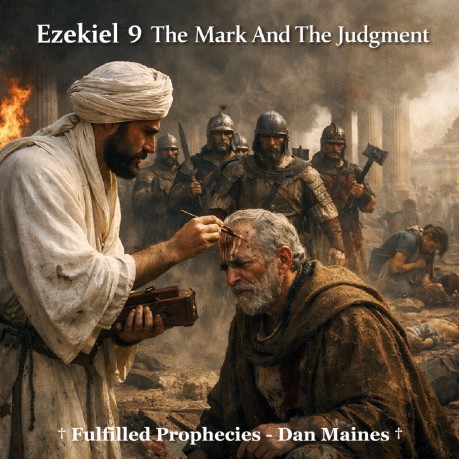
Ezekiel 9 The Mark And The
Judgment Introduction † Ezekiel 9 continues the vision of judgment
that began in chapter 8, showing that God had seen the abominations
in Jerusalem and was now acting. † This chapter reveals a separation, those who
grieve over sin are marked, those who don't are judged without mercy
(Ezekiel 9:4-6). † From the fulfilled perspective, this points
forward to the judgment that came upon Jerusalem in that generation,
just as Jesus warned (Matthew 23:36, Luke 21:22). Ezekiel 9:1-2 Then He cried out in my hearing with a loud voice saying, Come
near, executioners of the city, each with his weapon of destruction
in his hand. And behold, six men came from the direction of the upper
gate which faces north, each with his weapon for slaughter in his
hand, and among them was a certain man clothed in linen, with a
writing case at his waist. And they went in and stood beside the
bronze altar. † These executioners represent divine agents of
judgment, God is the one calling them, showing this isn't random
destruction, it's appointed justice (Isaiah 10:5-6). † The man clothed in linen stands apart, he's
not there to destroy, but to mark, showing God always distinguishes
His people before judgment falls (Exodus 12:13). † The altar being present shows this judgment
is connected to covenant violation, the place of sacrifice had been
defiled, so judgment begins there (1 Peter 4:17). Ezekiel 9:3 Then the glory of the God of Israel went up from the cherub on
which it had been, to the threshold of the temple. And He called to
the man clothed in linen at whose waist was the writing case. † The glory of God moving shows His departure
from the temple, just as later Jesus declared the house desolate
(Matthew 23:38). † God isn't dwelling with a corrupt system
anymore, His presence is leaving before judgment strikes. † This is covenant language, when God departs,
protection is gone, and judgment follows (Hosea 9:12). Ezekiel 9:4 The Lord said to him, Go through the midst of the city, even
through the midst of Jerusalem, and put a mark on the foreheads of
the people who groan and sigh over all the abominations which are
being committed in its midst. † The mark identifies those who are faithful,
those who mourn sin instead of participating in it (Psalm 34:18). † This directly connects to Revelation 7:3,
where God's servants are sealed before judgment. † It's not about outward religion, it's about
the heart, those who grieve over sin are set apart. Ezekiel 9:5-6 But to the others He said in my hearing, Go through the city after
him and strike; do not let your eye have pity and do not spare. Kill
utterly old men, young men, virgins, little children, and women, but
do not touch any person on whom is the mark; and you shall start from
My sanctuary. So they started with the elders who were before the
temple. † Judgment begins at the sanctuary, meaning
leadership is held accountable first (Ezekiel 8:11, 1 Peter 4:17). † No pity shows the severity of covenant
judgment, this is the result of persistent rebellion. † The marked are protected, showing again God
knows His people even in judgment (2 Timothy 2:19). Ezekiel 9:7 And He said to them, Defile the temple and fill the courtyards
with those who are killed. Go out! So they went out and struck people
in the city. † The temple being defiled shows it had already
lost its sanctity, judgment exposes what was already spiritually
corrupt. † This anticipates the destruction of Jerusalem
in AD 70, when the temple was physically destroyed. † What was once holy becomes a place of death
because of sin. Ezekiel 9:8 As they were striking the people and I alone was left, I fell on
my face and cried out saying, Oh, Lord God! Are You destroying the
entire remnant of Israel by pouring out Your wrath on Jerusalem? † Ezekiel intercedes, showing the heart of a
prophet, he pleads for mercy even when judgment is deserved (Jeremiah
14:7). † This reflects God's pattern, He always
preserves a remnant (Isaiah 10:20-22). † It shows that judgment is never about total
destruction, but about purification. Ezekiel 9:9-10 Then He said to me, The wrongdoing of the house of Israel and
Judah is very, very great, and the land is filled with bloodshed and
the city is full of perversion; for they say, The Lord has abandoned
the land, and the Lord does not see. But as for Me, My eye will have
no pity nor will I spare, but I will bring their conduct upon their
heads. † The people believed God didn't see, this is
the root of sin, denying accountability (Psalm 94:7-9). † God declares He sees everything, and judgment
is based on their own conduct. † This matches what Jesus said, that their
judgment was the result of filling up the measure of their fathers
(Matthew 23:32). Ezekiel 9:11 Then behold, the man clothed in linen at whose waist was the
writing case reported, saying, I have done just as You have commanded
me. † The marking is complete before judgment is
finished, showing God secures His people first. † This is consistent with every major judgment,
Noah, Passover, and Jerusalem, God preserves His own. † It confirms God's sovereignty, everything
happens exactly as He commands. Historical References † Josephus records that during the destruction
of Jerusalem, there were those who fled and escaped, showing a
remnant was preserved, Wars of the Jews, Book 6. † Eusebius writes that Christians fled
Jerusalem before its destruction, having been warned, Ecclesiastical
History 3.5. † This aligns perfectly with the marking
principle in Ezekiel 9, God separates His people before judgment. How It Applies To Us Today † God still sees sin, nothing is hidden from
Him, and He still judges righteously (Hebrews 4:13). † What matters is whether we grieve over sin or
become comfortable with it, that's what separates the marked from the
unmarked. † We've already seen the fulfillment of this
pattern in the destruction of Jerusalem, proving God's word is true
and reliable. † Today, it's not about escaping a future
judgment on Jerusalem, it's about living faithfully in the kingdom
that has already been established. Q & A Appendix Q: What does the mark on the forehead
represent? Q: Why does judgment begin at the temple? Q: Does God destroy everyone in judgment? Q: How does this connect to the New Testament? Q: What separates those who are spared from those
judged? † This is the fulfilled perspective we proclaim at
Fulfilled Prophecies † Source Index † Ezekiel 9:1-11
By Dan Maines
A: It represents those who are
faithful and grieve over sin, Ezekiel 9:4, Revelation 7:3.
A:
Because leadership and those closest to God are held accountable
first, Ezekiel 9:6, 1 Peter 4:17.
A:
No, He preserves a remnant, Ezekiel 9:4, Isaiah 10:20-22.
A:
It points to the judgment on Jerusalem in that generation, Matthew
23:36, Luke 21:22.
A: Their heart toward sin, whether they
mourn it or embrace it, Ezekiel 9:4, Psalm 34:18.
© Fulfilled Prophecies - Dan
Maines.
†
Josephus, Wars of the Jews, Book 6; Eusebius, Ecclesiastical History
3.5
Links