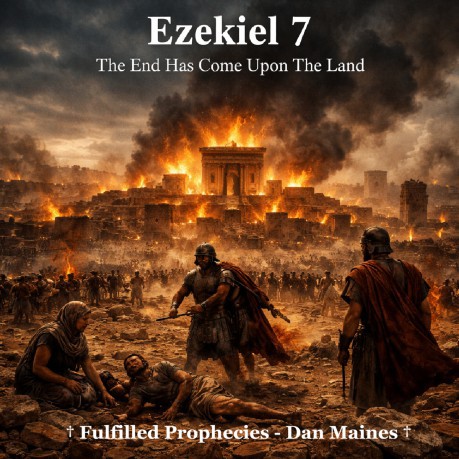
Ezekiel 7 The End Has Come
Upon The Land Introduction † Ezekiel 7 declares that the end had come upon
the land of Israel, not the end of the physical world, but the end of
the Old Covenant order centered in Jerusalem. † This chapter is about covenant judgment, the
same kind of judgment language we see later echoed by Jesus
concerning that generation. † God wasn't speaking in vague terms, He was
announcing a specific, imminent destruction tied to Israel's
rebellion. Ezekiel 7:1-4 And the word of the Lord came to me, saying, † The phrase an end is come shows finality,
this wasn't a warning of something far off, it was immediate (Ezekiel
7:2). † God ties judgment directly to their ways,
meaning their sin brought this upon them, not random disaster
(Ezekiel 7:3). † This matches Matthew 23:35-36 where Jesus
says all the righteous blood would come upon that generation. Ezekiel 7:5-9 This is what the Lord God says: A disaster, unique disaster,
behold, it is coming! † The repetition shows urgency, God is
emphasizing this isn't delayed, it's happening now (Ezekiel 7:6). † The day is near is covenant language, the
same kind of language Jesus used in Matthew 24:34. † This is the Day of the Lord against Israel,
not the end of the planet. Ezekiel 7:10-13 Behold, the day! Behold, it is coming! Your doom has gone forth;
the rod has budded, arrogance has blossomed. † Pride had matured into full rebellion, and
judgment was the natural result (Ezekiel 7:10). † Economic collapse is part of the judgment,
showing total societal breakdown (Ezekiel 7:12). † This parallels Revelation 18 where commerce
collapses under judgment. Ezekiel 7:14-18 They have blown the trumpet and made everything ready, but no one
is going to the battle; for My wrath is against all their
multitude. † No one could stand against this judgment,
even preparation for battle was useless (Ezekiel 7:14). † This is total devastation, sword, famine, and
pestilence, the same pattern seen in AD 70. † Josephus records these exact conditions
during the siege of Jerusalem. Ezekiel 7:19-22 They will throw their silver into the streets and their gold will
become an abhorrent thing; their silver and their gold will not be
able to save them on the day of the wrath of the Lord. They cannot
satisfy their appetite nor can they fill their stomachs, because
their wrongdoing has become a stumbling block to them. † Wealth couldn't save them, showing that
material things have no power against God's judgment (Ezekiel 7:19). † The temple itself would be defiled, which
happened in both Babylon's destruction and again in AD 70. † God turning His face away shows covenant
separation. Ezekiel 7:23-27 Make the chain, for the land is full of bloody crimes and the city
is full of violence. † The worst of the nations refers to invading
armies, historically Babylon, and later Rome. † Spiritual leadership collapses, no vision, no
law, no guidance (Ezekiel 7:26). † This connects to Amos 8:11, a famine of
hearing the word of the Lord. Historical References † Josephus, Wars of the Jews, describes famine,
internal violence, and total collapse during the Roman siege. † Eusebius records the destruction of Jerusalem
as fulfillment of Christ's warnings. † Tacitus confirms the devastation and chaos in
Judea under Roman conquest. How It Applies To Us Today † God's judgment always comes when sin reaches
its fullness, He's patient but not passive. † External religion can't save anyone, Israel
had the temple, sacrifices, and priests, yet they still fell. † We don't trust in systems, buildings, or
traditions, we trust in Christ alone. † Judgment language in scripture is covenantal
and historical, not about the end of the physical world. † We're called to recognize that all of this
has been fulfilled, and we're living in the reality of that completed
work. Q & A Appendix Q: Was this the end of the world? Q: Why was Israel judged? Q: Does this connect to Jesus' warnings? Q: Could wealth or religion save them? Q: When was this ultimately fulfilled? † This is the fulfilled perspective we proclaim at
Fulfilled Prophecies † Source Index † Ezekiel 7
By Dan Maines
And you, son of
man, this is what the Lord God says to the land of Israel: An end!
The end is coming on the four corners of the land.
Now the end
is upon you, and I will send My anger against you and judge you
according to your ways, and I will bring all your abominations upon
you.
For My eye will have no pity on you, nor will I spare you,
but I will bring your ways upon you, and your abominations will be
among you; then you will know that I am the Lord.
An end is coming; the end has come! It has
awakened against you; behold, it has come!
Your doom has come to
you, inhabitant of the land. The time has come, the day is near,
panic rather than joyful shouting on the mountains.
Now I will
shortly pour out My wrath on you and spend My anger against you,
judge you according to your ways and bring all your abominations upon
you.
My eye will show no pity, nor will I spare. I will bring
your ways upon you, and your abominations will be among you; then you
will know that I, the Lord, am striking.
Violence has grown
into a rod of wickedness. None of them will remain, none of their
people, none of their wealth, nor anything eminent among them.
The
time has come, the day has arrived. Let not the buyer rejoice nor the
seller mourn; for wrath is against all their multitude.
Indeed,
the seller will not return to what he sold as long as they both live;
for the vision regarding all their multitude will not be averted, nor
will any of them maintain his life by his wrongdoing.
The sword is outside and the plague and the famine
are inside. One who is in the field will die by the sword, and one
who is in the city, famine and plague will consume him.
Even
when their survivors escape, they will be on the mountains like doves
of the valleys, all of them moaning, each over his wrongdoing.
All
hands will hang limp and all knees will become like water.
They
will put on sackcloth and horror will cover them, and shame will be
on all faces and baldness on all their heads.
They
transformed the beauty of His ornaments into pride, and they made the
images of their abominations and their detestable things with it;
therefore I will make it an abhorrent thing to them.
I will give
it into the hands of strangers as plunder and to the wicked of the
earth as spoils, and they will profane it.
I will also turn My
face away from them, and they will profane My secret place; then
robbers will enter it and profane it.
Therefore I will bring the worst of the
nations, and they will take possession of their houses. I will also
put an end to the pride of the strong, and their holy places will be
profaned.
When anguish comes, they will seek peace, but there
will be none.
Disaster will come upon disaster and rumor will be
added to rumor; then they will seek a vision from a prophet, but the
Law will be lost from the priest and counsel from the elders.
The
king will mourn, the prince will be clothed with horror, and the
hands of the people of the land will tremble. According to their
conduct I will deal with them, and by their judgments I will judge
them. And they will know that I am the Lord.
A:
No, it was the end of the Old Covenant order in Israel, see Matthew
24:34.
A:
Because of their abominations and rebellion, see Ezekiel 7:3-4.
A:
Yes, Jesus warned of the same judgment in Matthew 23:35-36.
A:
No, silver and gold could not deliver them, see Ezekiel 7:19.
A:
In the destruction of Jerusalem in AD 70, see Luke 21:20-22.
© Fulfilled Prophecies - Dan
Maines.
† Josephus,
Wars of the Jews; Eusebius, Ecclesiastical History; Tacitus,
Histories
Links