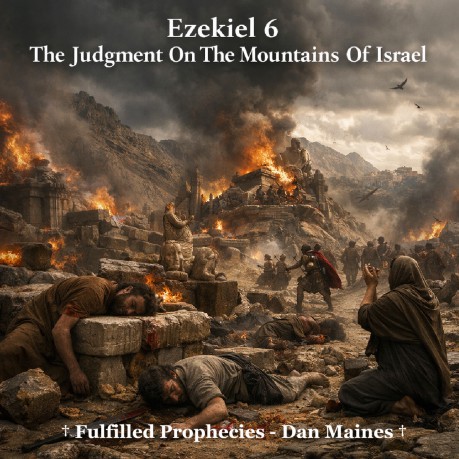
Ezekiel 6 The Judgment On The
Mountains Of Israel Introduction † Ezekiel 6 continues the warning that God was
bringing judgment on Israel because of their idolatry and rebellion,
it's not random destruction, it's covenant judgment. Ezekiel 6:1-3 † God isn't speaking to literal dirt and rocks,
He's addressing the places of worship where Israel sinned, those
locations represent their idolatrous system (Jeremiah 3:6). Ezekiel 6:4-5 † The idols couldn't save them, instead, their
worship becomes the place of their death, showing the complete
emptiness of false religion (Psalm 115:4-8). Ezekiel 6:6-7 † The purpose of judgment is clear, so that
they will know that I am the LORD, God reveals Himself through both
mercy and judgment (Isaiah 45:5-7). Ezekiel 6:8-10 † Even in judgment, God preserves a remnant, He
never completely destroys His people (Isaiah 10:20-22). Ezekiel 6:11-14 † This total judgment shows there was no escape
within that system, sword, famine, and plague cover every outcome
(Leviticus 26:25-26). Historical References † Josephus describes how the land and cities
were utterly devastated during the Roman siege, confirming the
pattern of sword, famine, and death (Josephus, Wars of the Jews, Book
5-6). How it applies to us today † God still judges false worship, just because
we aren't under the Old Covenant doesn't mean God tolerates idolatry
(1 Corinthians 10:14). Q & A Appendix Q: Why does God judge the mountains and high
places? Q: What is the purpose of the judgment? Q: Does God completely destroy His people? Q: How does this connect to the first century? Q: What lesson should we take today? † This is the fulfilled perspective we proclaim at
Fulfilled Prophecies † Source Index † Ezekiel 6:1-14
By Dan Maines
†
The mountains, hills, and high places were where Israel committed
spiritual adultery, so God directs His judgment right at those
places.
† From the fulfilled perspective,
this points forward to the same covenant judgment that reached its
climax in AD 70 when the system tied to those high places was
completely removed.
Now the word of the LORD came
to me, saying, Son of man, set your face toward the mountains of
Israel and prophesy against them, and say, Mountains of Israel,
listen to the word of the Lord GOD! This is what the Lord GOD says to
the mountains, the hills, the ravines, and the valleys: Behold, I
Myself am going to bring a sword upon you, and I will destroy your
high places.
†
The high places were where they rejected God's covenant and followed
other gods, so judgment begins exactly where sin was practiced
(Deuteronomy 12:2).
† This shows God's
justice is precise, He doesn't judge blindly, He targets the source
of rebellion.
So your altars will become
desolate and your incense altars will be smashed; and I will make
your slain fall in front of your idols. I will also lay the dead
bodies of the sons of Israel in front of their idols, and I will
scatter your bones around your altars.
†
This is a direct reversal, what they trusted in becomes the evidence
of their judgment.
† Historically, this
mirrors what happened in Jerusalem, where those trusting in the
temple system died around it in AD 70 (Luke 19:43-44).
In all your dwelling places
the cities will become ruins and the high places will be desolate, so
that your altars will become ruins and desolate, your idols will be
broken and brought to an end, your incense altars will be cut down,
and your works will be wiped out. The slain will fall among you, and
you will know that I am the LORD.
† Their
works, meaning their religious system, would be completely removed,
not reformed.
† This points to the full end
of the Old Covenant system, which couldn't stand because it was
corrupted (Hebrews 8:13).
However, I will leave a
remnant, for you will have those who escape the sword among the
nations when you are scattered among the countries. Then those of you
who escape will remember Me among the nations to which they will be
taken captive, how I have been hurt by their adulterous hearts which
turned away from Me, and by their eyes which played the prostitute
after their idols; and they will loathe themselves in their own sight
for the evils which they have committed, for all their abominations.
Then they will know that I am the LORD; I have not said in vain that
I would inflict this disaster on them.
†
The remnant comes to repentance, not through ease, but through
discipline.
† This remnant theme carries into
the first century, where a faithful remnant received Christ while the
system was judged (Romans 11:5).
This is what the Lord GOD
says: Clap your hands, stamp your foot and say, Alas, because of all
the evil abominations of the house of Israel, which will fall by the
sword, famine, and plague! The one who is far away will die by the
plague, and the one who is near will fall by the sword, and the one
who remains and is spared will die by the famine; so I will spend My
wrath on them. Then you will know that I am the LORD, when their
slain are among their idols around their altars, on every high hill,
on all the tops of the mountains, under every green tree and under
every leafy oak, the places where they offered soothing aroma to all
their idols. So throughout all their habitations I will stretch out
My hand against them and make the land more desolate and waste than
the wilderness toward Diblah; so they will know that I am the LORD.
† The repetition of
locations shows how widespread idolatry had become, it wasn't
isolated, it was everywhere.
† This again
connects directly to Jesus' warnings about the coming destruction in
that generation (Matthew 24:21-22).
† Eusebius records that believers
recognized the judgment and fled, showing the remnant principle in
action (Eusebius, Ecclesiastical History 3.5).
†
Tacitus confirms the widespread destruction and suffering during the
fall of Jerusalem, aligning with Ezekiel's pattern of judgment
(Tacitus, Histories 5.12-13).
† External religion
without truth leads to destruction, Israel had the system but
rejected God Himself.
† We need to examine
whether we're trusting in forms, traditions, or Christ alone.
†
The remnant principle still stands, God preserves those who are truly
His.
† This reminds us that God's word never
fails, what He said would happen did happen exactly as promised.
A: Because that's where Israel
practiced idolatry and false worship (Deuteronomy 12:2).
A:
So they will know that I am the LORD (Ezekiel 6:7).
A:
No, He preserves a remnant even in judgment (Isaiah 10:20-22).
A:
The same covenant judgment reached its fulfillment in the destruction
of Jerusalem (Luke 21:20-22).
A:
Don't trust in religious systems, trust in Christ alone (Colossians
2:13-14).
© Fulfilled Prophecies - Dan
Maines.
†
Josephus, Wars of the Jews, Book 5-6
†
Eusebius, Ecclesiastical History 3.5
†
Tacitus, Histories 5.12-13
Links