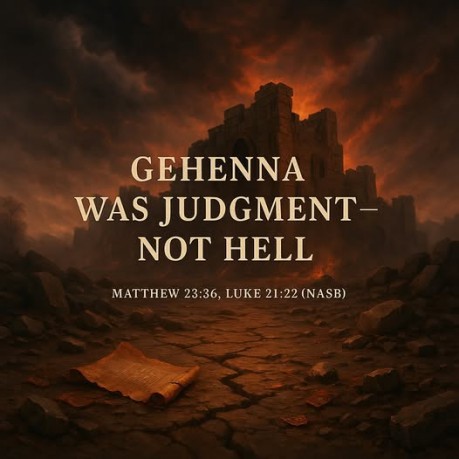
Hell
Is Not What You Were Told Let's be clear from the start:
the word most often translated as "Hell" in our English
Bibles is the Greek word Gehenna. It does not
refer to a place of eternal torment in the afterlife. Gehenna was a
literal valley outside Jerusalem - the Valley of Hinnom - known for
its history of child sacrifice (2 Kings 23:10) and became a symbol
of divine judgment. Jesus used Gehenna to warn first century
Judean Jews, not the world at large, and never Gentiles. It was a
national judgment coming upon Jerusalem. Matthew 5:22):
"But I say to you that
everyone who is angry with his brother shall be guilty before the
court... and whoever says, ‘You fool,' shall be guilty enough to
go into the fiery hell [Gehenna]." Gehenna was not a threat of afterlife torment. It was about
the devastation that would come upon that generation. Matthew 23:33:
"You
snakes, you offspring of vipers, how will you escape the sentence of
hell [Gehenna]?" Matthew 23:36:
"Truly I say
to you, all these things will come upon this generation." The only people ever threatened
with Gehenna were the Judean Jews of Jesus' generation. This
judgment was fulfilled in AD 70 when Jerusalem was destroyed. If we are honest with scripture, we must admit: the Bible
does not teach the popular concept of Hell.
What About John 3:16? John 3:16:
"For God so loved
the world, that He gave His only Son, so that everyone who believes
in Him will not perish, but have eternal life." Those who trust in Christ do not
perish. Those who do not trust in Christ will perish. That means
they die. If you're dead, you're dead - you are not alive somewhere
else being tormented. Jesus did not say unbelievers
would live forever in torment. He said they would perish.
If He wanted us to believe in eternal torment, this would be the
place to say so - but He didn't. The Greek word translated perish here is used
literally - it means to die. Romans 6:23:
"For the wages
of sin is death, but the gracious gift of God is eternal life in
Christ Jesus our Lord." The wages of sin is death.
Not eternal punishing. Not torment in flames. It's death - the
absence of life. The contrast is simple: death or eternal life. Not torment
versus eternal life. The faithful in Christ have eternal life. The
wicked do not have an afterlife at all.
Let's Be Honest: Remember, "hell"
is Gehenna. It is not eternal torment in an afterlife. The
wicked do not have an afterlife. Gehenna, or if you insist on
calling it "Hell", was a national judgment - not a cosmic
torture chamber. This came upon Jerusalem in the first century. The temple
was destroyed, the city burned, and the Old Covenant ended. That
was the context for all of Jesus' Gehenna warnings.
Let's Also Be Real: The concept of Hell can't
possibly be true. I cannot imagine how anyone came up with
something so horrific. The terrible pain of burning in fire, while
fully conscious, is made up by man, not God. It would take greed or sadism to
inflict something like that on anyone. That cannot be God. How
could such cruelty and sadism be consistent with a God of love? I don't buy it for a minute. Luke 21:22 :
"These are the days of
vengeance, so that all things which have been written will be
fulfilled." The judgment Jesus warned about was real, but it was
fulfilled. There is no more Gehenna judgment coming.
Final Thought: Jesus came to bring life. He came
to rescue us from death - not to send us into a torture pit. The message of scripture is not eternal torment. It is
simple: life in Christ, or death apart from Him. We serve a loving
God, not a cruel one.
By Dan Maines
Links