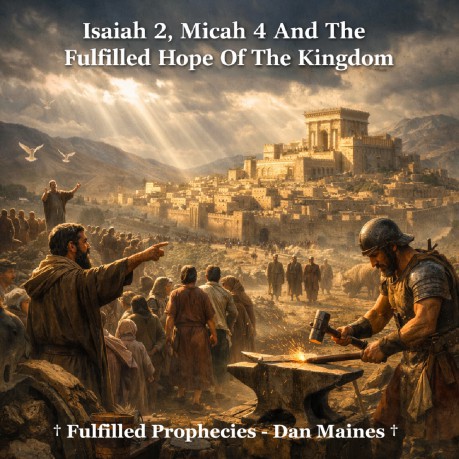
Isaiah 2, Micah 4 And The
Fulfilled Hope Of The Kingdom Introduction † What many call future hope, the prophets
already placed in the last days of their covenant world, not
thousands of years later (Hebrews 1:1-2) † Isaiah and Micah were not predicting a
distant modern age, they were pointing forward to the establishment
of Christ's kingdom in their future, which is now our past (Galatians
4:4) † The question isn't if these promises are
fulfilled, it's when and how, and the New Testament answers that
clearly (Luke 21:22) Isaiah 2:2-3 Now it will come about that in the last days The mountain of the
house of the Lord Will be established as the chief of the mountains,
And will be raised above the hills, And all the nations will stream
to it. And many peoples will come and say, Come, let us go up to the
mountain of the Lord, To the house of the God of Jacob, That He may
teach us about His ways And that we may walk in His paths. For the
law will go out from Zion And the word of the Lord from Jerusalem. † The latter days are defined in the New
Testament as the first century transition period, not our future
(Hebrews 1:1-2) † Peter explicitly says this is that which was
spoken by the prophet Joel, identifying the last days as already
present in the first century (Acts 2:16-17) † The mountain of the Lord is not physical
geography, it's the kingdom of God established through Christ
(Hebrews 12:22-24) † The mountain language matches Daniel's
prophecy where God's kingdom becomes a great mountain filling the
whole earth, which was established in the days of those kings (Daniel
2:35, 44) † The nations flowing to it is fulfilled in the
gospel going out to all nations beginning in Jerusalem (Acts 1:8) † The law going forth from Zion happened when
the gospel was first preached in Jerusalem and spread outward (Luke
24:47) † This was completed before Jerusalem's
destruction, exactly as Jesus said all things written would be
fulfilled (Luke 21:22) Micah 4:1-2 And it will come about in the last days That the mountain of the
house of the Lord Will be established as the chief of the mountains.
It will be raised above the hills, And the peoples will stream to it.
Many nations will come and say, Come and let us go up to the mountain
of the Lord And to the house of the God of Jacob, That He may teach
us about His ways And that we may walk in His paths. For from Zion
will go out the law, Even the word of the Lord from Jerusalem. † Micah repeats Isaiah almost word for word,
showing this is a central prophetic theme, not an isolated idea (2
Peter 1:20-21) † The identical language confirms the same
fulfillment timing, the last days of the Old Covenant age (Hebrews
8:13) † The nations coming in is fulfilled in Christ
breaking down the barrier between Jew and Gentile (Ephesians 2:14-16) † This is not a future mass pilgrimage to a
physical hill, it's the spiritual gathering of believers into the
kingdom (John 4:21-24) † We are already in that mountain now, not
waiting to enter it (Hebrews 12:22) Isaiah 2:4 And He will judge between the nations, And will mediate for many
peoples, And they will beat their swords into plowshares and their
spears into pruning hooks. Nation will not lift up sword against
nation, And never again will they learn war. † This is not teaching the end of all physical
war on earth, it's describing the peace of reconciliation in Christ
(Romans 5:1) † Christ Himself is our peace, who made both
groups into one and broke down the barrier of the dividing wall
(Ephesians 2:14) † The warfare that ended is the covenant
hostility between God and man, and between Jew and Gentile (Ephesians
2:16) † The kingdom brings peace in relationship with
God, not the removal of all earthly conflict (John 16:33) † The language is prophetic imagery, just like
many Old Testament passages describing covenant peace (Isaiah 11:6-9) † Christ already accomplished this peace
through the cross, not at a future event (Colossians 1:20) Historical References † Eusebius wrote that the prophecies of the
nations coming to Zion were fulfilled in the spread of Christianity
throughout the Roman world † Justin Martyr taught that the law going forth
from Jerusalem was fulfilled in the apostles preaching Christ to the
nations † Irenaeus connected the last days to the time
of Christ's appearing and the establishment of the Church † Josephus recorded the destruction of
Jerusalem in AD 70, confirming the end of that covenant age exactly
as Jesus said How It Applies To Us Today † We're not waiting for the kingdom to come,
we're living in it right now (Colossians 1:13) † The hope Isaiah and Micah spoke of isn't
future, it's present reality in Christ (Romans 14:17) † The nations have already been brought in, and
we are part of that fulfilled promise (Ephesians 3:6) † We are the fulfillment of what the prophets
saw, the nations gathered into one body in Christ (1 Corinthians
12:13) † Our peace isn't based on world conditions,
it's based on what Christ already accomplished (John 14:27) † Instead of looking for fulfillment, we live
out the fulfillment that has already been established (2 Corinthians
5:17) Q & A Appendix Q If this is fulfilled, why is there still evil
in the world? Q Are the nations still flowing to Zion today? Q Does beat their swords into plowshares mean no
more war at all? Q Are we already in the last days? Q If this was fulfilled in the first century, why
do many still expect it in the future? Q If Isaiah 2 and Micah 4 are fulfilled, why does
the world still look broken? Q Does all nations flowing to Zion mean every
person becomes a believer? Q Why do people expect a future golden age from
these passages? Q Is Zion still a physical place today? Q Did the apostles believe these prophecies were
being fulfilled in their time? Q What does it mean that the word went forth from
Jerusalem? Q Does the peace in Isaiah 2 mean no violence at
all? Q Are we still part of that prophecy today? † This is the fulfilled perspective we proclaim at
Fulfilled Prophecies † Source Index † Isaiah 2:2-4; Micah 4:1-2; Hebrews 1:1-2;
Acts 2:16-17; Hebrews 12:22-24; Daniel 2:35, 44; Acts 1:8; Luke
24:47; Luke 21:22; Hebrews 8:13; Ephesians 2:14-16; John 4:21-24;
Romans 5:1; John 16:33; Isaiah 11:6-9; Colossians 1:20; Colossians
1:13; Romans 14:17; Ephesians 3:6; 1 Corinthians 12:13; John 14:27; 2
Corinthians 5:17; Matthew 28:19-20; John 18:36; Revelation 5:9; Luke
24:44; Romans 16:26; Ephesians 2:19 † Eusebius, Ecclesiastical History; Justin
Martyr, First Apology; Irenaeus, Against Heresies; Josephus, Wars of
the Jews
By Dan Maines
A The kingdom deals with
reconciliation to God, not the removal of all human sin in the
physical world (John 16:33). Christ said we would still have
tribulation, but we have peace in Him.
A
Yes, through the ongoing preaching of the gospel, people from all
nations continue to come into the kingdom (Matthew 28:19-20).
A No, it speaks of covenant
peace with God and unity in Christ, not the end of all earthly
conflict (Ephesians 2:14-16).
A
The last days referred to the end of the Old Covenant age, which was
fulfilled in the first century (Hebrews 1:1-2).
A
Because many ignore the clear time statements and reinterpret
prophetic language as literal future events instead of recognizing
how the New Testament defines their fulfillment (Luke 21:22; Acts
2:16-17).
A Because the
kingdom is not about fixing the physical world, it's about restoring
relationship with God. Jesus said in John 18:36 My kingdom is not of
this world.
A No, it means the
gospel is open to all nations and people from every nation are
entering the kingdom. Revelation 5:9 shows people from every tribe
and nation redeemed.
A Because they read prophetic
imagery as literal future conditions instead of interpreting it
through the New Testament fulfillment. Luke 24:44 says all things
written were fulfilled in Christ.
A
No, Zion is now the heavenly reality of the kingdom. Hebrews 12:22
says we have come to Mount Zion.
A Yes, they
consistently taught that the promises were happening in their
generation. Acts 2:16-17 and Romans 16:26 show the prophetic promises
being made known to all nations in their time.
A The gospel began in Jerusalem and
spread outward exactly as prophesied. Luke 24:47 and Acts 1:8 show
the starting point and expansion of that fulfillment.
A No, it refers to peace with God and
unity in Christ. Romans 5:1 says we have peace with God.
A
Yes, we are living in the result of that fulfillment. Ephesians 2:19
says we are fellow citizens with the saints.
© Fulfilled Prophecies - Dan
Maines.
Links