THE
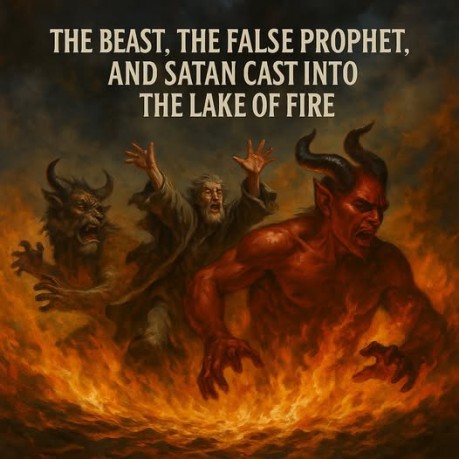
BEAST, THE FALSE PROPHET, AND SATAN CAST INTO THE LAKE OF FIRE
Introduction: The Final Judgment in Revelation
The
judgment of the Beast, the false prophet, and Satan in the lake of
fire is presented in Revelation as the complete and irreversible end
of God's covenant enemies. This is not a prophecy for our future but
describes the conclusion of the covenantal conflict in the first
century. The language comes from Old Testament judgment texts and
was fulfilled in the fiery destruction of Jerusalem in AD 70. The Text
Revelation
19:20 - And the beast was seized, and with him the false prophet who
performed the signs in his presence, by which he deceived those who
had received the mark of the beast and those who worshiped his
image. These two were thrown alive into the lake of fire, which
burns with brimstone. Revelation 20:10 - And the devil who
deceived them was thrown into the lake of fire and brimstone, where
the beast and the false prophet are also, and they will be tormented
day and night forever and ever. Revelation 20:14-15 - Then death and
Hades were thrown into the lake of fire. This is the second death,
the lake of fire. And if anyone's name was not found written in the
book of life, he was thrown into the lake of fire. Preterist Fulfillment The Beast represents the
persecuting Roman power, centered on the Caesars involved in the
Jewish War, particularly Nero, Vespasian, and Titus, who enforced
emperor worship and warred against the saints (Revelation 13:5-7). The false prophet represents the
apostate leadership of Israel who rejected Christ and misled the
people (Revelation 13:11-14). Satan, the adversary, worked through these powers to oppose
the church and the kingdom (Revelation 12:9, Revelation 20:2-3). The Lake of Fire and the
Second Death
Revelation defines the lake of fire as
the second death (Revelation 20:14). The second death is covenantal
death, final separation from God's presence and blessings. This is
not physical death, but irreversible removal from the covenant
community. Obadiah 1:16 - They will drink and
swallow and become as if they had never existed.
Malachi 4:1 -
For behold, the day is coming, burning like a furnace, and all the
arrogant and every evildoer will be chaff, and the day that is
coming will set them ablaze, says the Lord of armies, so that it
will leave them neither root nor branches. This judgment was permanent. Once the
old covenant order ended, these enemies had no place in God's
kingdom. The Fire Was Real in
Jerusalem
The lake of fire is vision language, but it
corresponds to real events in AD 70. Josephus records that Titus
ordered the temple and much of Jerusalem burned. The flames were so
intense that gold melted from the temple and ran between the stones
(Wars 6.4.5). The Old Testament links "brimstone"
(burning sulfur) to complete destruction in God's judgment (Genesis
19:24, Isaiah 34:9-10). Revelation's "burns with brimstone"
language comes directly from these passages, showing that the
imagery describes total and final ruin, not ongoing literal burning. The Elements That Were
Destroyed
The "elements" in 2 Peter 3:10-12
are not physical atoms but the ordinances and principles of the old
covenant system (Galatians 4:3, 4:9, Colossians 2:20). These existed
only in the earthly covenant order, not in the spiritual realm. In
AD 70 they were removed forever, making way for the new heavens and
new earth, the fully established new covenant (Hebrews 8:13). The Eternal Fire and Burning Sulfur
The
Bible uses "eternal fire" and "burning sulfur"
to describe irreversible judgment: Genesis 19:24 - The Lord rained
on Sodom and Gomorrah brimstone and fire. Jude 1:7 - Sodom and Gomorrah are
"exhibited as an example in undergoing the punishment of
eternal fire." The cities are not still burning, but their
destruction was permanent. Isaiah 34:8-10 - Edom's judgment
turns its land into burning pitch, "It will not be
extinguished night or day, its smoke will go up forever." Edom
is not burning now, but its destruction was total. Isaiah 66:24 - "Their worm
will not die and their fire will not be extinguished." Jeremiah 7:20 - God's wrath would be poured out "on
this place" — Jerusalem — burning the trees and crops, and
"it will not be extinguished." This same type of fire consumed
Jerusalem in AD 70. The flames no longer burn, but the result is
eternal. Gehenna, the Worm, and the
Lake of Fire
Gehenna is the Greek form of Ge-Hinnom,
the Valley of Hinnom, south of Jerusalem, where children were
sacrificed to Molech (2 Kings 23:10, Jeremiah 7:31). In later times
it became known as a cursed place where refuse and the bodies of
criminals were burned. By Jesus' day, Gehenna symbolized
God's coming judgment on the wicked. Jesus said in Matthew 23:33,
"How will you escape the sentence of Gehenna?" speaking to
the same corrupt leadership that Revelation calls the false prophet. Gehenna was a place where fires burned
continually and worms fed on dead bodies. Jesus drew this directly
from Isaiah 66:24:
"And they shall go forth and look at
the corpses of the people who have rebelled against Me. For their
worm will not die and their fire will not be extinguished, and they
will be an abhorrence to all mankind." This referred to national judgment.
The "fire not quenched" means a fire that cannot be put
out until it has done its work. The "worm" represents
decay and disgrace, corpses left unburied to be consumed. This was
fulfilled in AD 70 when Jerusalem was destroyed, and the dead were
left in the streets (Jeremiah 19:7, Lamentations 2:21). Jesus' warnings about Gehenna and
John's vision of the lake of fire describe the same irreversible
covenant judgment. Application for Today This judgment assures believers
that no power will ever rise again to oppose Christ's kingdom in
the same covenantal way. The second death warns that those
outside of Christ have no hope beyond this life. The kingdom is eternal, and its enemies are gone forever. Conclusion
The
casting of the Beast, the false prophet, and Satan into the lake of
fire was fulfilled in the events of AD 70. It was rooted in Old
Testament judgment imagery, carried out in the fiery destruction of
Jerusalem, defined by scripture as the second death, and warned of
by Jesus in His teaching on Gehenna. The judgment was total,
permanent, and irreversible, exactly as the scriptures declared.
By Dan Maines
Links