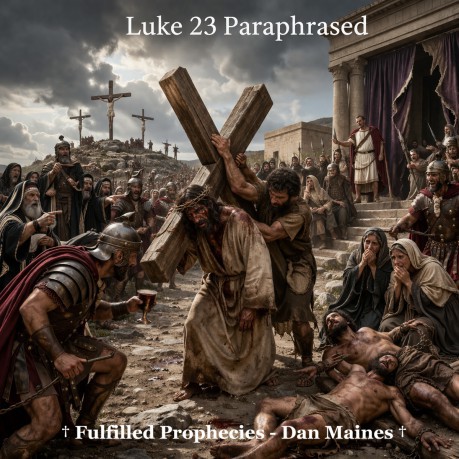
Luke 23
Paraphrased
By Dan Maines
Introduction
†
Jesus is now brought before Roman authority, showing the shift from
Jewish accusation to Gentile judgment.
† This
chapter reveals the rejection of the Messiah by that generation and
the fulfillment of what He said would happen to them.
†
Everything here is leading directly to the cross, exactly as foretold
in their lifetime (Luke 21:22).
Luke 23:1
The
whole group stood up and brought Him to Pilate.
†
The leadership acts together, showing unified rejection of Christ
(Psalm 2:1-2).
† This fulfills their earlier
plots against Him (Luke 22:2).
† They move
from religious trial to political accusation to secure
execution.
Luke 23:2
They began accusing
Him, saying He was misleading the nation, forbidding tribute to
Caesar, and claiming to be Christ, a king.
†
They twist His words into political rebellion (John 18:36).
†
This shows deliberate false testimony (Exodus 20:16).
†
Their rejection is not ignorance, it's intentional distortion.
Luke
23:3
Pilate asked Him, Are You the King of the Jews?
And He answered, It is as you say.
† Jesus
confirms His kingship, but not in a worldly sense (John 18:37).
†
This is a direct acknowledgment of His identity.
†
The truth stands even in the face of accusation.
Luke
23:4
Pilate said to the chief priests and the crowds, I
find no guilt in this man.
† A Gentile ruler
declares His innocence (Isaiah 53:9).
† This
exposes the injustice of the Jewish leaders.
†
Even the world sees what Israel refuses to see.
Luke
23:5
They kept insisting, saying He stirs up the
people, teaching all over Judea, starting from Galilee even here.
†
Their accusations escalate under pressure.
†
They appeal to fear of unrest.
† This shows
their desperation to have Him killed.
Luke 23:6
When
Pilate heard it, he asked if the man was a Galilean.
†
Pilate looks for jurisdiction to avoid responsibility.
†
This shows political maneuvering, not justice.
†
The truth is being pushed aside for convenience.
Luke
23:7
When he learned He belonged to Herod's
jurisdiction, he sent Him to Herod, who was also in Jerusalem at that
time.
† Jesus is passed around like a case,
not treated as a person.
† This fulfills the
humiliation of the Servant (Isaiah 53:7).
†
Authority figures avoid truth when it costs them.
Luke
23:8
Herod was very glad when he saw Jesus, because he
had wanted to see Him for a long time, hoping to see some miracle
done by Him.
† Herod seeks entertainment, not
truth.
† This reflects a hardened heart (Luke
13:32).
† Many want signs, not
repentance.
Luke 23:9
He questioned Him at
length, but He answered him nothing.
† Jesus
remains silent, fulfilling prophecy (Isaiah 53:7).
†
Silence becomes judgment against Herod.
†
Truth isn't given to those who mock it.
Luke 23:10
The
chief priests and the scribes stood there, accusing Him fiercely.
†
Their hatred continues without evidence.
†
This is relentless rejection of God's Messiah.
†
Their zeal is against truth, not for it.
Luke
23:11
Herod and his soldiers treated Him with contempt,
mocked Him, dressed Him in a robe, and sent Him back to Pilate.
†
Mockery replaces justice.
† The robe mocks
His kingship (Psalm 22:7-8).
† This is
fulfillment of prophetic humiliation.
Luke 23:12
Herod
and Pilate became friends that very day, though they had been enemies
before.
† Unity is formed in rejecting
Christ.
† This reflects Psalm 2:2.
†
The world unites against God's Anointed.
Luke
23:13
Pilate called together the chief priests, the
rulers, and the people.
† Public decision is
about to be made.
† This involves the whole
leadership.
† Responsibility is shared by
that generation.
Luke 23:14
He said to
them, You brought this man as one who misleads the people, but I
found no guilt in Him.
† Again, innocence is
declared.
† This exposes their false
charges.
† Truth is openly stated before
them.
Luke 23:15
No, nor has Herod, for he
sent Him back to us, and nothing deserving death has been done by
Him.
† Both rulers confirm innocence.
†
There is no legal basis for execution.
† Yet
they proceed anyway.
Luke 23:16
Therefore
I will punish Him and release Him.
†
Compromise begins.
† Pilate tries to satisfy
both sides.
† Justice is being diluted.
Luke
23:18
They cried out together, saying, Away with this
man, and release Barabbas for us.
† The crowd
chooses a criminal over Christ.
† This shows
the depth of rejection.
† Sin is preferred
over righteousness.
Luke 23:19
Barabbas
had been thrown into prison for an insurrection and murder.
†
The guilty is freed while the innocent is condemned.
†
This reflects substitution.
† It points to
the deeper meaning of the cross.
Luke 23:20
Pilate
addressed them again, wanting to release Jesus.
†
Pilate knows the right thing.
† Yet he lacks
the courage to do it.
† This is fear of man
(Proverbs 29:25).
Luke 23:21
They kept
shouting, saying, Crucify, crucify Him.
† The
demand becomes violent.
† This fulfills their
hardened state (Acts 7:52).
† The cry reveals
their true heart.
Luke 23:22
He said to
them the third time, Why, what evil has He done? I have found no
guilt in Him deserving death.
† Three times
innocence is declared.
† The case is clear.
†
Yet truth is rejected.
Luke 23:23
But they
were insistent, demanding with loud voices that He be crucified, and
their voices prevailed.
† The mob overrules
justice.
† This shows the power of collective
rebellion.
† Their will replaces
righteousness.
Luke 23:24
Pilate
pronounced sentence that their demand be granted.
†
Authority submits to pressure.
† This is
failure of leadership.
† The decision seals
their guilt.
Luke 23:25
He released the
man they were asking for, but he delivered Jesus to their will.
†
The exchange is complete.
† The innocent
suffers for the guilty.
† This is the heart
of redemption.
Luke 23:26
As they led Him
away, they seized a man named Simon of Cyrene and laid the cross on
him.
† Jesus is weakened from suffering.
†
Simon becomes part of the moment.
† This
shows the physical burden of the cross.
Luke 23:27
A
large crowd followed Him, including women mourning for Him.
†
There is sorrow among the people.
† Not all
rejected Him.
† Some recognized what was
happening.
Luke 23:28
Jesus turned and
said, Do not weep for Me, but for yourselves and your children.
†
He points to coming judgment (Luke 21:23).
†
The focus shifts to their future.
† This is
warning of AD 70.
Luke 23:29
For the days
are coming when they will say blessed are the barren.
†
This describes severe judgment.
† It connects
to covenant curses (Deuteronomy 28:53).
†
This was fulfilled in Jerusalem's destruction.
Luke
23:30
They will begin to say to the mountains, fall on
us.
† This language matches judgment imagery
(Hosea 10:8).
† It shows desperation in
destruction.
† Revelation echoes this same
language.
Luke 23:31
If they do these
things in the green tree, what will happen in the dry?
†
If the innocent suffers, the guilty will face worse.
†
Israel is the dry tree.
† Judgment is
certain.
Luke 23:32
Two criminals were led
away with Him to be put to death.
† Jesus is
numbered with transgressors (Isaiah 53:12).
†
He stands among sinners.
† This fulfills
prophecy exactly.
Luke 23:33
They came to
the place called the Skull and crucified Him there.
†
The cross becomes the center of redemption.
†
This is the climax of His mission.
† It
fulfills everything written beforehand.
Luke
23:34
Father forgive them, for they do not know what
they are doing.
† Jesus intercedes even in
suffering (Isaiah 53:12).
† This shows mercy
extended to that generation.
† Ignorance does
not remove accountability.
Luke 23:35
The
people stood looking on, and the rulers mocked Him.
†
Mockery continues even at the cross.
† This
fulfills Psalm 22:7.
† Their blindness is
complete.
Luke 23:36
The soldiers also
mocked Him, offering sour wine.
† Both Jews
and Gentiles participate.
† This shows
universal rejection.
† Yet it fulfills
prophecy.
Luke 23:37
They said, If You are
the King of the Jews, save Yourself.
† They
misunderstand His mission.
† The cross is not
failure, it's purpose.
† Salvation comes
through sacrifice.
Luke 23:38
There was
also an inscription above Him, This is the King of the Jews.
†
Truth is declared publicly.
† Even in
mockery, it's accurate.
† His kingship
stands.
Luke 23:39
One of the criminals
mocked Him.
† Even in death, rejection
continues.
† This reflects hardened hearts.
†
Not all respond the same.
Luke 23:40
But
the other rebuked him, saying do you not fear God.
†
Recognition of guilt begins.
† Fear of God is
restored.
† This shows repentance.
Luke
23:41
We are receiving what we deserve, but this man
has done nothing wrong.
† Innocence is
declared again.
† This time from a condemned
man.
† Truth comes from unexpected
places.
Luke 23:42
He said, Jesus remember
me when You come in Your kingdom.
† Faith is
expressed.
† He recognizes Christ as King.
†
This is trust in the midst of death.
Luke 23:43
Jesus
said, today you will be with Me in paradise.
†
Immediate assurance is given.
† This shows
presence with Christ after death.
† It
confirms the reality of His kingdom.
Luke 23:44
It
was about the sixth hour and darkness fell over the land.
†
Creation responds to the moment.
† This
reflects judgment imagery (Amos 8:9).
† The
cross shakes the world.
Luke 23:45
The sun
was darkened and the veil of the temple was torn in two.
†
Access to God is opened.
† The old system is
ending (Hebrews 10:19-20).
† This points to
covenant fulfillment.
Luke 23:46
Jesus
cried out, Father into Your hands I commit My spirit.
†
He willingly gives His life.
† This is not
taken from Him (John 10:18).
† His mission is
complete.
Luke 23:47
The centurion praised
God and said this man was innocent.
† A
Gentile recognizes the truth.
† This shows
the widening of understanding.
† Even
outsiders see what Israel missed.
Luke 23:48
The
crowds returned beating their breasts.
†
Conviction begins to fall.
† They realize
what has happened.
† This connects to later
repentance (Acts 2:37).
Luke 23:49
His
acquaintances stood at a distance watching.
†
His followers remain present.
† They witness
everything.
† This preserves testimony.
Luke
23:50
A man named Joseph, a member of the council, who
was good and righteous.
† Not all leaders
rejected Him.
† There were faithful among
them.
† This shows division within
leadership.
Luke 23:51
He had not
consented to their plan.
† He stands apart
from their actions.
† This shows personal
accountability.
† Righteousness can stand
alone.
Luke 23:52
He went to Pilate and
asked for the body of Jesus.
† Courage is
shown after His death.
† Joseph honors Him
publicly.
† This fulfills prophecy of burial
(Isaiah 53:9).
Luke 23:53
He wrapped Him
and laid Him in a tomb.
† Proper burial is
given.
† This confirms His death.
†
It sets up the resurrection account.
Luke 23:54
It
was the preparation day and the Sabbath was about to begin.
†
Timing is precise.
† Events align with Jewish
customs.
† This shows historical
accuracy.
Luke 23:55
The women followed
and saw the tomb.
† Witnesses confirm
location.
† This prevents later doubt.
†
Their role is crucial.
Luke 23:56
They
returned and prepared spices, and rested on the Sabbath.
†
They follow the law even in grief.
† This
shows devotion.
† The stage is set for what
comes next.
Historical References
†
Josephus records the destruction and suffering of Jerusalem,
confirming the warnings Jesus gave about that generation.
†
Eusebius writes about the fall of Jerusalem as fulfillment of
Christ's words.
† Tacitus describes the
brutality of Roman executions, aligning with crucifixion accounts.
†
Clement of Alexandria affirms the early understanding of Christ's
suffering and fulfillment.
How It Applies To Us Today
†
We see that rejecting truth leads to judgment, just as it did for
that generation.
† Christ's sacrifice shows
that redemption was completed, not waiting for a future age.
†
We're called to recognize fulfilled prophecy and live in the reality
of what He's already accomplished.
† The
cross shows both justice and mercy fully revealed.
†
We don't look forward to judgment on the world, we look back at what
was completed.
Q & A Appendix
Q:
Why was Jesus declared innocent multiple times?
A:
To show that His death was unjust and fulfilled prophecy of the
innocent suffering (Isaiah 53:9).
Q: What does
Barabbas represent?
A: The guilty being
released while the innocent is condemned, pointing to
substitution.
Q: What did Jesus mean about
weeping for themselves?
A: He was warning of
the coming destruction of Jerusalem in their generation (Luke
21:22-23).
Q: Why was the veil torn?
A:
It signified the end of the old covenant system and open access to
God (Hebrews 10:19-20).
Q: What does the thief
on the cross show?
A: Immediate entrance into
paradise with Christ, confirming presence after death.
†
This is the fulfilled perspective we proclaim at Fulfilled Prophecies
†
© Fulfilled Prophecies - Dan Maines.
Source
Index
† Luke 23
†
Josephus, Wars of the Jews
† Eusebius,
Ecclesiastical History
† Tacitus, Annals
†
Clement of Alexandria, Stromata
Links