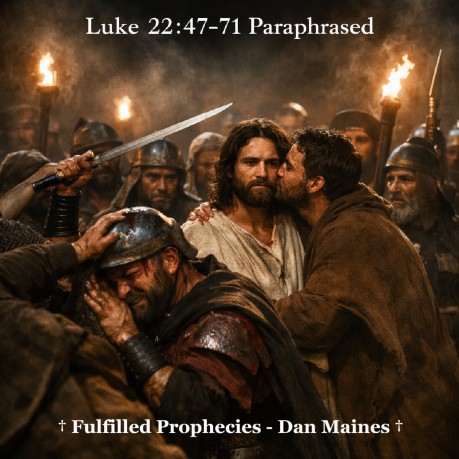
Luke 22:47-71
Paraphrased Luke 22:1-46 Paraphrased https://fulfilledprophecies.com/topics/1234.html
Luke 22:47-71 Paraphrased https://fulfilledprophecies.com/topics/1235.html
By Dan Maines
Introduction
†
Jesus is now entering the moment of betrayal and arrest, showing the
transition from His ministry to His suffering.
†
This section reveals the hardness of Israel's leaders and the
fulfillment of what was spoken beforehand.
†
Everything here is happening within that generation just as Jesus
said it would (Matthew 26:54).
Luke 22:47
While
He was still speaking, a crowd came, and the one called Judas, one of
the twelve, was leading them, and he came up to Jesus to kiss Him
†
Judas leads the crowd, showing betrayal from within Israel itself
(Psalm 41:9).
† The kiss was a sign of false
loyalty, turning something intimate into treachery.
†
Josephus records how betrayal was common during this period of unrest
in Judea, reflecting the corruption of the time.
Luke
22:48
But Jesus said to him, Judas, are you betraying
the Son of Man with a kiss
† Jesus exposes
the hypocrisy directly, calling out the act for what it is.
†
The title Son of Man ties back to Daniel 7:13-14, showing authority
even in betrayal.
† Irenaeus wrote that
Christ willingly submitted, showing control even in suffering.
Luke
22:49
When those around Him saw what was going to
happen, they said, Lord, shall we strike with the sword
†
The disciples still expected a physical defense, misunderstanding the
nature of His kingdom.
† This shows their
struggle to grasp the spiritual fulfillment Jesus was bringing.
†
Eusebius notes the early disciples often misunderstood until after
these events were fulfilled.
Luke 22:50
And
one of them struck the slave of the high priest and cut off his right
ear
† This act shows human reaction, trying
to stop what God had already ordained.
† It
reflects zeal without understanding (Romans 10:2).
†
Josephus documents similar violent reactions during this era among
zealots.
Luke 22:51
But Jesus answered and
said, stop, no more of this, and He touched his ear and healed him
†
Jesus restores even in the moment of His arrest, showing mercy over
violence.
† This proves His kingdom isn't
advanced by force (John 18:36).
† Clement of
Alexandria emphasized Christ's healing as proof of divine
authority.
Luke 22:52
Then Jesus said to
the chief priests and officers of the temple and elders who had come
against Him, have you come out with swords and clubs as you would
against a robber
† Jesus exposes their fear
and injustice, treating Him like a criminal.
†
This shows the corruption of the leadership of Israel.
†
Tacitus records how Roman-era leadership often acted out of fear of
losing control.
Luke 22:53
While I was
with you daily in the temple, you didn't lay hands on Me, but this
hour and the power of darkness are yours
†
Their actions were hidden in darkness, showing moral corruption.
†
This hour was appointed, showing God's timing in judgment.
†
Eusebius connects this moment to the beginning of judgment on that
generation.
Luke 22:54
They seized Him and
led Him away, bringing Him into the high priest's house, but Peter
was following at a distance
† Peter's
distance reflects fear and uncertainty.
†
This begins the testing of the disciples.
†
Early church writings show how this moment was used to teach
perseverance.
Luke 22:55
After they
kindled a fire in the middle of the courtyard and sat down together,
Peter was sitting among them
† Peter blends
in, trying not to be identified.
† This shows
compromise under pressure.
† Josephus
describes similar gatherings during night trials in Jerusalem.
Luke
22:56
And a servant girl, seeing him as he sat in the
firelight and looking intently at him, said, this man was with Him
too
† Even a servant recognizes Peter,
showing how visible their association was.
†
Truth is being exposed in small moments.
†
Clement noted how even the least can reveal truth.
Luke
22:57
But he denied it, saying, woman, I don't know
Him
† Fear leads Peter to deny Christ.
†
This fulfills Jesus' earlier warning (Luke 22:34).
†
Irenaeus highlights Peter's fall as a lesson in human weakness.
Luke
22:58
A little later, another saw him and said, you are
one of them too, but Peter said, man, I am not
†
The denial continues, showing increasing pressure.
†
This reflects the fear of association with Christ during
persecution.
† Tacitus notes how association
with Christ later brought persecution.
Luke 22:59
After
about an hour had passed, another man began to insist, saying,
certainly this man also was with Him, for he is a Galilean too
†
His identity is tied to his background, exposing him further.
†
Truth keeps pressing forward despite denial.
†
Eusebius connects Galilean identity with early followers of
Christ.
Luke 22:60
But Peter said, man, I
don't know what you are talking about, and immediately while he was
still speaking, a rooster crowed
† The
rooster marks the fulfillment of Jesus' words.
†
This shows the certainty of Christ's prophecy.
†
Irenaeus emphasizes this as proof of divine foreknowledge.
Luke
22:61
The Lord turned and looked at Peter, and Peter
remembered the word of the Lord, how He had told him, before a
rooster crows today, you will deny Me three times
†
That look brings conviction, not condemnation.
†
Memory of Christ's words brings repentance.
†
Clement wrote that this moment shows the power of Christ's presence
even in silence.
Luke 22:62
And he went
out and wept bitterly
† True repentance is
shown through sorrow.
† This is restoration
beginning, not the end.
† Early church
fathers saw this as the model of repentance.
Luke
22:63
Now the men who were holding Jesus in custody
were mocking Him and beating Him
† The
suffering of Christ fulfills prophecy (Isaiah 50:6).
†
Mockery reveals the blindness of that generation.
†
Tacitus confirms Roman brutality in such treatments.
Luke
22:64
And they blindfolded Him and were asking Him,
saying, prophesy, who is the one who hit You
†
They mock His prophetic role while fulfilling it.
†
This irony shows their ignorance.
† Eusebius
highlights this as fulfillment of prophetic suffering.
Luke
22:65
And they were saying many other things against
Him, blaspheming
† Their blasphemy reveals
their rejection of God Himself.
† This aligns
with the judgment coming on them.
† Josephus
describes the increasing lawlessness among leaders before Jerusalem's
fall.
Luke 22:66
When it was day, the
Council of elders of the people assembled, both chief priests and
scribes, and they led Him away to their council chamber
†
The full leadership gathers, representing Israel as a whole.
†
This is national rejection of the Messiah.
†
Irenaeus connects this council to covenantal accountability.
Luke
22:67
Saying, if You are the Christ, tell us, but He
said to them, if I tell you, you won't believe
†
Their hearts are already hardened.
† Truth
isn't lacking, belief is.
† Clement wrote
that unbelief isn't from lack of evidence but refusal.
Luke
22:68
And if I ask a question, you won't answer
†
Their refusal to engage truth is exposed.
†
This shows deliberate rejection.
† Eusebius
notes this as judicial hypocrisy.
Luke 22:69
But
from now on the Son of Man will be seated at the right hand of the
power of God
† This declares His authority
and coming vindication.
† This points to His
reign beginning in that generation (Psalm 110:1).
†
Irenaeus affirms this as Christ's exaltation following His
suffering.
Luke 22:70
And they all said,
are You the Son of God then, and He said to them, yes, I am
†
Jesus clearly affirms His identity.
† This is
the testimony they reject.
† Early writers
saw this as the decisive confession.
Luke 22:71
Then
they said, what further need do we have of testimony, for we have
heard it ourselves from His own mouth
† They
condemn Him based on truth, not falsehood.
†
This seals their judgment.
† Josephus later
records the destruction that followed this generation's
rejection.
Historical References
†
Josephus, Wars of the Jews, records the corruption and violence
leading to Jerusalem's fall.
† Tacitus,
Histories 5, describes Roman brutality and unrest in Judea.
†
Irenaeus, Against Heresies, affirms Christ's authority and
fulfillment of prophecy.
† Eusebius,
Ecclesiastical History, connects these events to judgment on that
generation.
† Clement of Alexandria,
Stromata, emphasizes Christ's moral and spiritual authority.
How
it applies to us today
† We see that
rejecting truth doesn't come from lack of evidence but hardened
hearts.
† Christ's kingdom isn't advanced by
force but by truth and fulfillment.
† Even
failure like Peter's can lead to restoration when there's
repentance.
† We must recognize that Christ
has already been enthroned and reigns now.
†
This reminds us to stand firm in truth even when pressure comes.
Q
& A Appendix
Q: Why did Jesus
allow Himself to be arrested
A: Because it
fulfilled prophecy and God's plan (Isaiah 53:7)
Q:
What does Peter's denial show
A: Human weakness
and the need for repentance (Luke 22:61-62)
Q:
What does the rooster crow represent
A: The
exact fulfillment of Jesus' words (Luke 22:34)
Q:
What does sitting at God's right hand mean
A:
Christ's authority and reign (Psalm 110:1)
Q:
Why did the leaders reject Him
A: Because their
hearts were hardened despite clear truth (John 5:40)
†
This is the fulfilled perspective we proclaim at Fulfilled Prophecies
†
© Fulfilled Prophecies - Dan Maines.
Source
Index
† Luke 22
†
Josephus, Wars of the Jews
† Tacitus,
Histories
† Irenaeus, Against Heresies
†
Eusebius, Ecclesiastical History
† Clement of
Alexandria, Stromata
Links