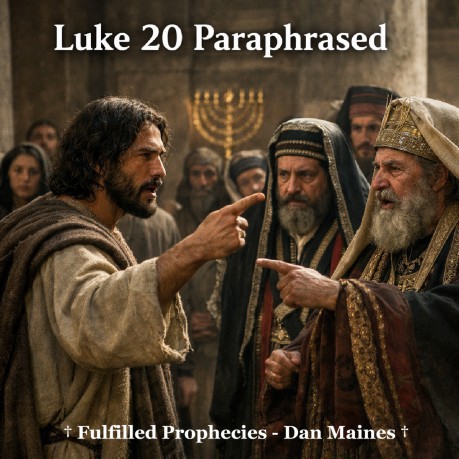
Luke 20
Paraphrased
By Dan Maines
Introduction
†
Jesus is in the temple confronting the leaders who had rejected both
John and the One John announced.
† This
chapter exposes false authority, corrupt stewardship, and the coming
judgment on that generation.
† It also shows
that the kingdom would not remain in the hands of those who murdered
the Son.
Luke 20:1
One day while Jesus was
teaching the people in the temple and announcing the good news, the
chief priests, scribes, and elders came up to Him.
†
Jesus is openly teaching in the temple, showing that true authority
was standing in God's house.
† The leaders
approach Him, not to learn, but to challenge and discredit Him.
†
This sets the tone for the whole chapter, truth confronting corrupt
leadership.
Luke 20:2
They spoke to Him
and said, Tell us, by what authority are You doing these things, and
who gave You this authority.
† They question
His authority because they won't submit to the One sent from
heaven.
† Their problem isn't lack of
evidence, it's refusal to believe.
† They
want credentials from the Son while ignoring the Father's
witness.
Luke 20:3
Jesus answered them, I
will ask you one thing also, and you answer Me.
†
Jesus doesn't dodge the issue, He exposes their dishonesty.
†
His question will reveal whether they care about truth or only
self-protection.
† The Judge turns the
examination back on the accusers.
Luke 20:4
Was
John's baptism from heaven or from men.
† If
John was from heaven, then they should've believed his testimony
about Jesus.
† If they deny John, they expose
themselves before the people.
† Their answer
to John is tied directly to their answer to Christ.
Luke
20:5
They reasoned among themselves, saying, If we say,
From heaven, He'll say, Why didn't you believe him.
†
They aren't searching for the truth, they're calculating damage
control.
† Their private discussion exposes
hearts ruled by fear and politics.
† They
know the right answer, but they won't say it.
Luke
20:6
But if we say, From men, all the people will stone
us, because they're convinced John was a prophet.
†
They fear the crowd more than they fear God.
†
This is what hypocritical religion does, it performs for men while
resisting heaven.
† They are trapped by the
very people they try to control.
Luke 20:7
So
they answered that they didn't know where it came from.
†
Their claimed ignorance is not honest ignorance, it's deliberate
evasion.
† They refuse a clear answer because
a clear answer would condemn them.
† When men
resist light, they often hide behind false uncertainty.
Luke
20:8
And Jesus said to them, Then I won't tell you by
what authority I do these things.
† Since
they reject revealed truth, more truth isn't owed to them.
†
Christ doesn't hand holy things to men committed to rebellion.
†
Their refusal to answer John leaves them unfit to hear further.
Luke
20:9
Then He began telling the people this parable: A
man planted a vineyard, leased it to vine growers, and went away for
a long time.
† The vineyard is Israel, a
familiar picture from Isaiah 5:1-7.
† The
vine growers are the leaders entrusted with stewardship over God's
people.
† Jesus is about to show the history
of their failure and the certainty of judgment.
Luke
20:10
At harvest time he sent a servant to the vine
growers so they'd give him some of the fruit of the vineyard, but the
vine growers beat him and sent him away empty-handed.
†
The servant pictures the prophets sent by God to call for fruit and
faithfulness.
† Instead of giving the owner
what was due, they abused the messenger.
†
This is Israel's long history of rejecting those sent to her.
Luke
20:11
And he sent another servant, but they beat him
too, treated him shamefully, and sent him away empty-handed.
†
God's patience is seen in sending messenger after messenger.
†
Their repeated cruelty shows that this wasn't a one-time failure, it
was a pattern.
† The leaders had become
enemies of the very voice of God.
Luke 20:12
And
he sent a third, but this one also they wounded and threw out.
†
The abuse keeps escalating, just as Israel's guilt kept piling up.
†
They don't merely ignore the message, they strike the messenger.
†
This builds the case for why judgment on that generation was
just.
Luke 20:13
Then the owner of the
vineyard said, What shall I do. I'll send my beloved son. Maybe
they'll respect him.
† The beloved Son is
Christ, the final and fullest revelation from the Father.
†
This doesn't mean God was uncertain, it means the parable is exposing
their wickedness.
† After the prophets came
the Son Himself.
Luke 20:14
But when the
vine growers saw him, they reasoned among themselves, saying, This is
the heir. Let's kill him so the inheritance will be ours.
†
They recognize the heir, which makes their guilt even greater.
†
This points directly to the leaders plotting Jesus' death.
†
They want the privileges of God's house without submission to God's
Son.
Luke 20:15
So they threw him out of
the vineyard and killed him. What then will the owner of the vineyard
do to them.
† Jesus was taken outside the
city and crucified, just as the parable pictures.
†
The question now is not whether judgment will come, but when.
†
By killing the Son, they seal their own sentence.
Luke
20:16
He'll come and destroy these vine growers and
give the vineyard to others. When they heard it, they said, May it
never be.
† This is the transfer of kingdom
privilege from corrupt Israelite leadership to a new covenant
people.
† Their protest shows they understood
the warning and hated it.
† The destruction
of Jerusalem in AD 70 proved that this judgment was not empty
talk.
Luke 20:17
But Jesus looked at them
and said, Then what is this that is written: The stone which the
builders rejected, this became the chief cornerstone.
†
Psalm 118:22 is applied directly to Christ.
†
The builders, the leaders, rejected the very stone God chose.
†
Their rejection couldn't cancel God's purpose, it only fulfilled
it.
Luke 20:18
Everyone who falls on that
stone will be broken to pieces, but if it falls on anyone, it'll
crush him to dust.
† Christ is either the
foundation of life or the stone of judgment.
†
Rejecting Him doesn't leave a man neutral, it leaves him shattered.
†
This warning fell especially on that generation of covenant
breakers.
Luke 20:19
The scribes and the
chief priests wanted to lay hands on Him that very hour, but they
feared the people, because they knew He had spoken this parable
against them.
† They understood the message
clearly enough when it exposed them.
† Again,
fear of the people restrains them more than fear of God.
†
Their reaction proves the parable hit its mark.
Luke
20:20
So they watched Him and sent spies who pretended
to be sincere, so they could trap Him in something He said and hand
Him over to the rule and authority of the governor.
†
Their sincerity is fake, their mission is entrapment.
†
This is how corrupt religion often works, outward holiness hiding
inward murder.
† They want Rome to do their
dirty work.
Luke 20:21
They questioned
Him, saying, Teacher, we know that You speak and teach rightly, and
You aren't swayed by appearances, but teach the way of God
truthfully.
† Their flattery is not
reverence, it's bait.
† Ironically, what they
say is true, even though they don't believe it.
†
Hypocrites can speak orthodox words while plotting evil.
Luke
20:22
Is it lawful for us to pay taxes to Caesar, or
not.
† They think they've found a perfect
political trap.
† If He says yes, they hope
to turn the people against Him.
† If He says
no, they hope to accuse Him before Rome.
Luke 20:23
But
He saw through their trickery and said to them,
†
Nothing escapes Christ's sight.
† Men can
hide motives from others, but never from Him.
†
His wisdom exposes the craftiness of the wicked.
Luke
20:24
Show Me a denarius. Whose image and inscription
does it have. They answered, Caesar's.
† The
coin itself exposes their participation in Caesar's system.
†
They already use the emperor's money while pretending moral
outrage.
† Jesus makes them answer their own
trap.
Luke 20:25
And He said to them, Then
give Caesar what belongs to Caesar, and give God what belongs to
God.
† Civil obligations don't cancel what is
owed to God.
† The deeper issue is that they
were refusing to give God His due, themselves.
†
Since man bears God's image, man belongs to God.
Luke
20:26
And they couldn't trap Him in what He said before
the people, and being amazed at His answer, they became silent.
†
Their scheme collapses in public.
† Truth
doesn't panic under pressure.
† Christ's
answer leaves them with nothing more to say.
Luke
20:27
Then some of the Sadducees came to Him, those who
deny that there's a resurrection, and they questioned Him,
†
Another group steps forward with another challenge.
†
The Sadducees rejected resurrection, so they attack the hope they
denied.
† Their theology was shallow because
they mishandled the Scriptures.
Luke 20:28
saying,
Teacher, Moses wrote to us that if a man's brother dies having a wife
but no children, his brother should take the wife and raise up
offspring for his brother.
† They cite the
law correctly, but they use it wrongly.
†
Their goal is not understanding, but ridicule.
†
They think a hypothetical puzzle can overthrow God's power.
Luke
20:29
Now there were seven brothers, and the first took
a wife and died childless.
† They build an
extreme case to mock resurrection.
† Their
argument assumes the age to come is just a continuation of earthly
arrangements.
† That false assumption is what
Jesus is about to correct.
Luke 20:30
And
the second took her as wife,
† The story
continues according to their setup.
† They
are piling up details to make their objection sound clever.
†
But cleverness is no substitute for truth.
Luke
20:31
and then the third, and in the same way all seven
died without leaving children.
† Their
example is designed to make resurrection look absurd.
†
They think earthly categories can fully explain the coming age.
†
But resurrection life isn't bound to old covenant structures.
Luke
20:32
Afterward the woman died also.
†
The scenario is now complete.
† They think
they've created an impossible dilemma.
† Yet
the problem exists only in their own misunderstanding.
Luke
20:33
So in the resurrection, whose wife will she be,
because all seven had her as wife.
† Their
question assumes marriage continues in the same form after the
resurrection.
† They are measuring heavenly
reality by earthly patterns.
† Christ will
answer by contrasting the ages.
Luke 20:34
Jesus
said to them, The sons of this age marry and are given in marriage,
†
He begins by distinguishing this age from the age to come.
†
Marriage belongs to the present order with its earthly continuance
and mortality.
† The Sadducees had failed to
recognize that covenantal transition.
Luke 20:35
but
those considered worthy to attain that age and the resurrection from
the dead neither marry nor are given in marriage.
†
The resurrection belongs to that age, the fulfilled covenant order in
Christ.
† Jesus is not teaching endless
earthly continuation, but transformed covenant standing.
†
The coming age would not be structured like the old one.
Luke
20:36
For they can't die anymore, because they're like
angels and are sons of God, being sons of the resurrection.
†
This is about resurrection life and covenant sonship, not becoming
literal angels.
† The point is no further
succession is needed where death no longer rules.
†
In Christ, the people of God stand in life, not under the old order
of death.
Luke 20:37
But that the dead are
raised, even Moses showed in the passage about the bush, where he
calls the Lord the God of Abraham, the God of Isaac, and the God of
Jacob.
† Jesus proves resurrection from the
very books the Sadducees claimed to honor.
†
He meets them on their own ground and defeats them there.
†
The covenant God is not bound to the grave.
Luke
20:38
Now He isn't the God of the dead, but of the
living, because all live to Him.
† God's
covenant relationship isn't terminated by death.
†
The patriarchs lived to Him, proving the certainty of resurrection.
†
This destroys the Sadducees' denial at its root.
Luke
20:39
Some of the scribes answered and said, Teacher,
You have spoken well.
† Even some among the
opposing ranks had to admit the force of His answer.
†
Truth can compel acknowledgment even from unfriendly listeners.
†
Christ's wisdom leaves no honest room for rebuttal.
Luke
20:40
Because they no longer dared to ask Him
anything.
† The challengers are now
silenced.
† Their traps have failed, one
after another.
† The authority they
questioned has now publicly exposed them.
Luke
20:41
Then He said to them, How is it that they say the
Christ is David's son.
† Jesus now asks the
question.
† The issue is not whether Messiah
is David's son, but whether that's all He is.
†
Their view of Christ was too small.
Luke 20:42
For
David himself says in the book of Psalms, The Lord said to my Lord,
Sit at My right hand,
† Psalm 110:1 reveals
the Messiah as greater than David.
† David
calls Him Lord, showing His superiority and exaltation.
†
Jesus is pressing them to see more than a merely earthly king.
Luke
20:43
until I make Your enemies a footstool for Your
feet.
† The Messiah would reign until His
enemies were subdued.
† This fits Christ's
present authority and coming judgment on His enemies.
†
The rejection of the Son would end in His vindication, not
theirs.
Luke 20:44
David therefore calls
Him Lord, so how is He his son.
† The answer
is that Messiah is both David's son and David's Lord.
†
He is the promised descendant, yet far greater than David.
†
The leaders couldn't understand this because they refused to see who
Jesus really was.
Luke 20:45
Then while
all the people were listening, He said to the disciples,
†
Jesus now turns from debate to warning.
† The
people are hearing, but the instruction is especially for His
disciples.
† They must learn how to recognize
false leaders.
Luke 20:46
Beware of the
scribes, who like walking around in long robes, love respectful
greetings in the marketplaces, chief seats in the synagogues, and
places of honor at banquets,
† He exposes
their love of status, recognition, and outward display.
†
Their religion is built on appearance and social honor.
†
Christ warns His disciples not to be impressed by religious
theater.
Luke 20:47
who devour widows'
houses and for show make long prayers. These will receive greater
condemnation.
† Their outward devotion hides
inward greed and abuse.
† The weak and
vulnerable were being exploited by the very men who should've
protected them.
† Because their sin was
cloaked in religion, their condemnation would be greater.
Historical
References
† Josephus described the
corruption, greed, and violence among the priestly rulers leading up
to Jerusalem's fall.
† Eusebius connected the
desolation of Jerusalem with divine judgment on the generation that
rejected Christ.
† Clement of Alexandria
spoke of the leaders' blindness and the superiority of the teaching
of Christ over empty religious display.
†
Irenaeus testified to Christ as the rejected stone who became the
cornerstone of God's true building.
How It Applies To Us
Today
† We must test authority by
truth, not by titles, robes, or public honor.
†
We must give God what belongs to Him, our loyalty, obedience, and
trust.
† We must never mistake religious
appearance for genuine faithfulness.
† We
must receive Christ as the cornerstone and not stumble over Him in
unbelief.
† We must beware of leaders who use
spiritual language while feeding on the weak.
†
We should live as sons of resurrection life, grounded in the victory
of Christ.
Q & A Appendix
Q:
Why did Jesus ask about John's baptism first?
A:
Because their response to John exposed their response to God. If they
admitted John was from heaven, they'd condemn themselves for
rejecting his witness to Christ (Luke 7:29-30).
Q:
What does the vineyard represent?
A: It
represents Israel as God's planted covenant people, just as Isaiah
had already pictured it in Isaiah 5:1-7.
Q: Who
are the vine growers in the parable?
A: They
are the leaders entrusted with the care of God's people, especially
the priests, scribes, and elders who rejected the prophets and the
Son (Matthew 23:29-36).
Q: What does the
destruction of the vine growers point to?
A: It
points to the judgment that came on Jerusalem and its corrupt
leadership in AD 70, when the old covenant order was brought down
(Luke 21:20-22).
Q: What does it mean that the
stone became the cornerstone?
A: It means
Christ was rejected by the builders, but God made Him the foundation
of His true house and people (Psalm 118:22; Ephesians 2:19-22).
Q:
Why was the condemnation of the scribes greater?
A:
Because they used religion as a cover for greed, hypocrisy, and
oppression, especially against widows, while presenting themselves as
holy (Luke 20:46-47; Matthew 23:14).
† This is the
fulfilled perspective we proclaim at Fulfilled Prophecies †
©
Fulfilled Prophecies , Dan Maines.
Source Index
†
Luke 20
† Josephus, Wars of the Jews
†
Eusebius, Ecclesiastical History
† Clement of
Alexandria, Stromata
† Irenaeus, Against
Heresies
Links