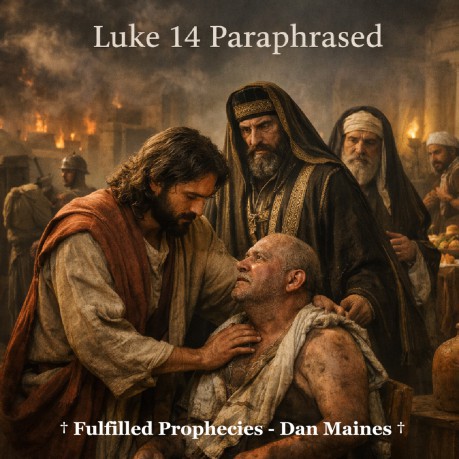
Luke 14
Paraphrased
By Dan Maines
Introduction
†
Jesus is exposing pride, hypocrisy, and the false security of
religious status in Israel.
† He shows that
the kingdom was being opened to those once considered unworthy, while
those invited first were rejecting Him.
†
This all points to the coming judgment on that generation and the
gathering of a new covenant people.
Luke 14:1
One
Sabbath He went to eat at the house of a leading Pharisee, and they
were watching Him closely.
† The leaders were
not seeking truth, they were looking for a reason to accuse Him.
†
This shows hardened hearts within Israel's leadership (Luke
11:53-54).
Luke 14:2
A man suffering from
swelling was there in front of Him.
† The
need for healing was obvious, but compassion was being tested against
their traditions.
† The Law was being misused
to block mercy (Hosea 6:6).
Luke 14:3
Jesus
asked the lawyers and Pharisees, is it lawful to heal on the Sabbath
or not?
† He forces them to confront their
own inconsistency.
† Their silence reveals
their guilt and hypocrisy.
Luke 14:4
They
kept silent, and He took hold of the man, healed him, and sent him
away.
† Jesus acts with authority, showing
the Sabbath was made for good.
† God's mercy
overrides their man-made restrictions.
Luke 14:5
He
said to them, which one of you will not immediately pull out his son
or ox if it falls into a well on the Sabbath day?
†
They already made exceptions for themselves.
†
Jesus exposes their selective obedience.
Luke 14:6
They
could make no reply to this.
† Truth silenced
them, yet they still refused to repent.
†
This shows willful blindness.
Luke 14:7
He
began speaking a parable to those invited when He noticed how they
were choosing places of honor.
† Pride was
openly displayed even in religious settings.
†
Status mattered more to them than humility.
Luke
14:8
When you are invited to a wedding feast, do not
sit in the place of honor, or someone more distinguished may be
invited.
† Jesus warns against
self-exaltation.
† Honor in God's kingdom
does not come through self-promotion.
Luke 14:9
The
host may come and say, give your place to this man, and then you will
be humiliated.
† Pride leads to shame.
†
Their system was built on outward recognition.
Luke
14:10
Instead, take the lowest place so that the host
may say, move up higher.
† True honor comes
from God, not man.
† Humility is the path to
exaltation (James 4:10).
Luke 14:11
Everyone
who exalts himself will be humbled, and he who humbles himself will
be exalted.
† This is a kingdom principle.
†
Israel's leaders were about to be humbled in judgment.
Luke
14:12
He said to the one who invited Him, do not invite
friends or rich neighbors expecting repayment.
†
Their giving was transactional.
† They sought
return, not righteousness.
Luke 14:13
Invite
the poor, crippled, lame, and blind.
† This
reflects God's grace toward the outcast.
†
The kingdom includes those society rejects.
Luke
14:14
You will be blessed because they cannot repay
you, for you will be repaid at the resurrection of the righteous.
†
True reward comes from God.
† This points to
covenant fulfillment and vindication.
Luke 14:15
One
of those reclining said, blessed is everyone who will eat bread in
the kingdom of God.
† He speaks confidently,
assuming inclusion.
† Jesus corrects this
assumption next.
Luke 14:16
A man gave a
big dinner and invited many.
† The invitation
represents Israel being called first.
† God
extended covenant blessings to them.
Luke 14:17
He
sent his slave to say, come, everything is ready.
†
The time of fulfillment had arrived in Christ.
†
The call was urgent and present.
Luke 14:18
They
all began making excuses.
† Israel rejected
the invitation through unbelief.
† Their
priorities were earthly, not spiritual.
Luke
14:19
Another said he had oxen to examine.
†
Material concerns replaced obedience.
† They
valued possessions over the kingdom.
Luke 14:20
Another
said he had married a wife and could not come.
†
Personal life became an excuse.
† They
refused the call of God.
Luke 14:21
The
master became angry and said bring in the poor and crippled.
†
The invitation shifts outward.
† This
includes the remnant and the nations.
Luke 14:22
There
is still room.
† God's grace is abundant.
†
The kingdom was expanding beyond Israel.
Luke 14:23
Go
out to the highways and compel them to come in.
†
This shows the inclusion of Gentiles.
† The
house will be filled despite rejection.
Luke 14:24
None
of those who were invited shall taste my dinner.
†
Judgment falls on those who rejected Christ.
†
This was fulfilled in AD 70.
Luke 14:25
Large
crowds were going along with Him, and He turned and spoke.
†
Many followed, but few understood the cost.
†
Jesus begins to define true discipleship.
Luke 14:26
If
anyone comes to Me and does not hate his family, he cannot be My
disciple.
† This means loyalty to Christ
above all.
† Covenant allegiance must come
first.
Luke 14:27
Whoever does not carry
his own cross cannot be My disciple.
† This
points to suffering and sacrifice.
†
Following Christ meant persecution in that generation.
Luke
14:28
Which of you does not calculate the cost before
building?
† Discipleship requires
commitment.
† This was not a casual
decision.
Luke 14:29
Otherwise others will
mock him.
† Failure to endure leads to
shame.
† Many in Israel started but did not
continue.
Luke 14:30
This man began to
build and was not able to finish.
†
Incomplete faith reveals a false start.
†
True disciples endure to the end.
Luke 14:31
A
king considers whether he can win before going to war.
†
Wisdom evaluates reality before action.
†
Jesus calls for serious consideration.
Luke
14:32
Otherwise he seeks terms of peace.
†
There is a cost to rejecting Christ.
† Israel
failed to seek peace with God.
Luke 14:33
None
of you can be My disciple unless he gives up everything.
†
Total surrender is required.
† This exposes
shallow followers.
Luke 14:34
Salt is
good, but if it loses its taste, it is useless.
†
Israel was meant to preserve truth.
† They
lost their purpose through corruption.
Luke 14:35
It
is thrown out. He who has ears, let him hear.
†
Judgment and removal were coming.
† Only
those who listened would understand.
Historical
References
† Josephus records the
rejection of truth and the destruction of Jerusalem, showing
fulfillment of judgment.
† Eusebius confirms
the early church understood these warnings as fulfilled in the first
century.
† Irenaeus speaks of the transition
from old covenant Israel to the new covenant people.
How
it applies to us today
† We must
reject pride and walk in humility before God.
†
We are called to value people over status and possessions.
†
True discipleship still requires surrender and commitment.
†
God's kingdom includes those who respond, not those who assume they
belong.
Q & A Appendix
Q:
Who were the first invited guests?
A: Israel
under the old covenant, who rejected Christ (Matthew 21:43).
Q:
Who are the poor and outcasts invited?
A: The
remnant and Gentiles brought into the kingdom (Ephesians 2:12-13).
Q:
What does counting the cost mean?
A: Fully
committing to Christ despite hardship (Luke 9:23).
Q:
What does losing saltiness represent?
A: Losing
covenant purpose and facing judgment (Matthew 5:13).
Q:
When was this judgment fulfilled?
A: In the
destruction of Jerusalem in AD 70 (Luke 21:20-22).
†
This is the fulfilled perspective we proclaim at Fulfilled Prophecies
†
© Fulfilled Prophecies - Dan Maines.
Source
Index
† Luke 14
†
Josephus, Wars of the Jews
† Irenaeus,
Against Heresies
† Eusebius, Ecclesiastical
History
Links